Centrosaurus
Name means “Pointed lizard”
Centrosaurus had one big horn on its nose and two little hooks on its frill. Thousands of them have been found together, so they probably lived in giant herds.
Centrosaurus was a medium-sized centrosaurine ceratopsid from the Dinosaur Park Formation of Alberta. It is known from enormous bonebeds containing the remains of hundreds to thousands of individuals, strong evidence that it gathered in large herds.
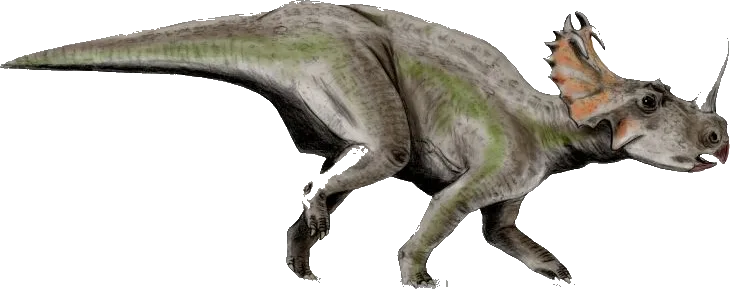
Centrosaurus BW.jpg — Nobu Tamura (http://spinops.blogspot.com) · CC BY 3.0
Pictures
Spin it in 3D
3D model description: a 3D model of Centrosaurus shaped from a scientific life reconstruction painting, with the painting's colours and skin texture wrapped around it. It is not a scan of a real fossil.
About this model
This model is shaped from a scientific life reconstruction by Nobu Tamura (http://spinops.blogspot.com): the painting's outline gives the 3D body and the painting itself is its skin. It is sized to the real animal's length (about 5.5 m), so in AR it appears life-size!
It looks best from the side, like the painting it comes from. It is not a fossil scan — museums such as the Smithsonian 3D collection share real fossil scans you can explore.
What might it sound like?
Transcript: Deep bellows answering each other across a herd
🤔 Nobody knows exactly how dinosaurs sounded
This is a scientific guess. Herd animals often call to keep in touch, and Centrosaurus's living relatives, birds and crocodiles, make low rumbles and bellows, so a herd of Centrosaurus may have been a noisy, bellowing crowd.
Voice boxes and soft tissue almost never fossilise, so sound reconstructions use clues: body size (bigger animals make lower sounds), the calls of living relatives (crocodiles boom with closed mouths; birds coo and hiss), and hollow structures such as hadrosaur crests that could have worked like a trumpet.
Sound: synthesised by DinoVerse from these scientific ideas (CC0). It is a creative guess, not a recording.
Food and habits
Herbivore
Plant-eater
How it ate
Clipped low plants with a narrow, hooked beak and sliced them with batteries of cheek teeth that were constantly replaced.
🔍 How do we know?
- tooth batteries built for slicing
- beak shape
- plant fossils from the same rock layers
It ate…
- ferns
- cycads
- horsetails
- low flowering plants
Centrosaurus
…and was eaten by
- Gorgosaurus
- Daspletosaurus
Arrows show energy moving up the food chain: from food to eater.
Watch it feed
Quick facts
| 📏 Length | 5–6 m (16–20 ft) |
|---|---|
| ↕️ Height | 1.7–2 m (6–7 ft) |
| ⚖️ Weight | 2,000–3,000 kg (4,410–6,610 lb) |
| ⏳ When it lived | 76.5–75.5 million years ago (Late Cretaceous) |
| 📍 Fossils found | Dinosaur Provincial Park, Alberta, Canada; Hilda mega-bonebed, Alberta, Canada |
| 🔎 Discovered | 1904 by Lawrence Lambe |
| 🧬 Group | Ceratopsians — Ornithischia › Marginocephalia › Ceratopsia |
Where scientists disagree, we show a range. Sizes are for adults.
How big was it?
Where and when
- 📍 Dinosaur Provincial Park, Alberta, Canada (North America)
- 📍 Hilda mega-bonebed, Alberta, Canada (North America)
Lived 76.5–75.5 million years ago
That's about 76 million years before you were born! Humans have only existed for about 0.3 million years.
See it on the big timeline →Did you know?
- 1Scientists have found places packed with thousands of Centrosaurus bones!
- 2Its nose horn could point forwards or curve backwards, depending on the animal.
- 3Two little hooks on its frill curled forward like bent fingers.
- 4One Centrosaurus leg bone shows it had a kind of cancer, just like some animals today.
- The Hilda mega-bonebed stretches across several kilometres of Alberta badlands and may record a whole herd drowned by a coastal flood or storm surge.
- In 2020 researchers diagnosed osteosarcoma, a malignant bone cancer, in a Centrosaurus fibula — the first confirmed case of this cancer in a dinosaur.
- The shape of the nasal horn varied a lot between individuals, which once led scientists to name extra species that are now thought to be ordinary variation.
- Like other centrosaurines, its frill was short, with large openings, so it was relatively light and probably used mainly for display.
Myth vs fact
❌ MythEvery Centrosaurus skull with a different horn shape is a different species.
✅ FactLarge bonebeds show that horn shape varied with age and between individuals within the same species.
Mini quiz
1. What do huge Centrosaurus bonebeds suggest?
2. Where was Centrosaurus found?
3. What did Centrosaurus eat?
Related animals
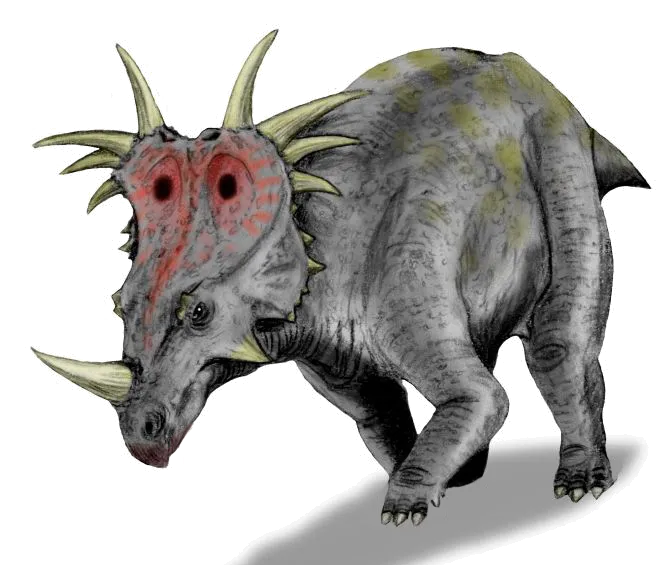
Styracosaurus
CeratopsianLate CretaceousHerbivore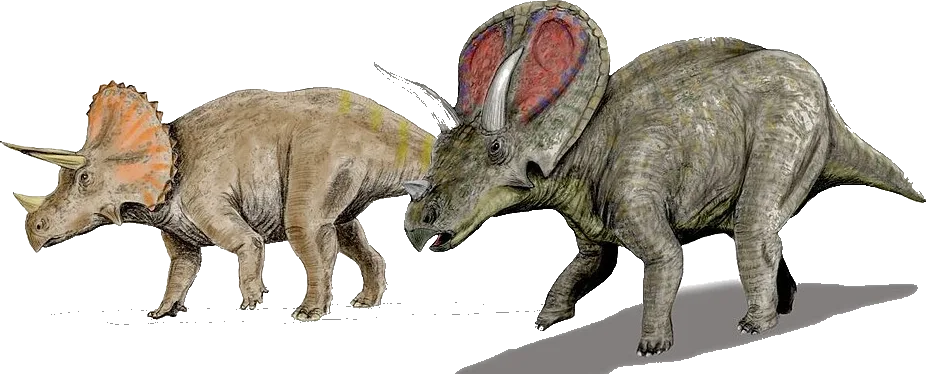
Triceratops
CeratopsianLate CretaceousHerbivore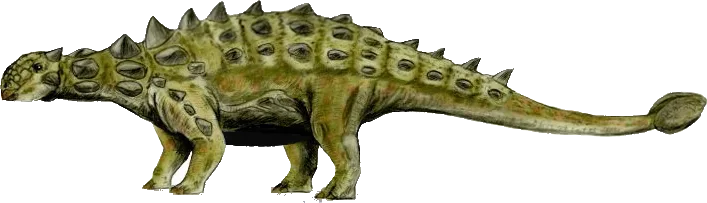
Euoplocephalus
AnkylosaurLate CretaceousHerbivore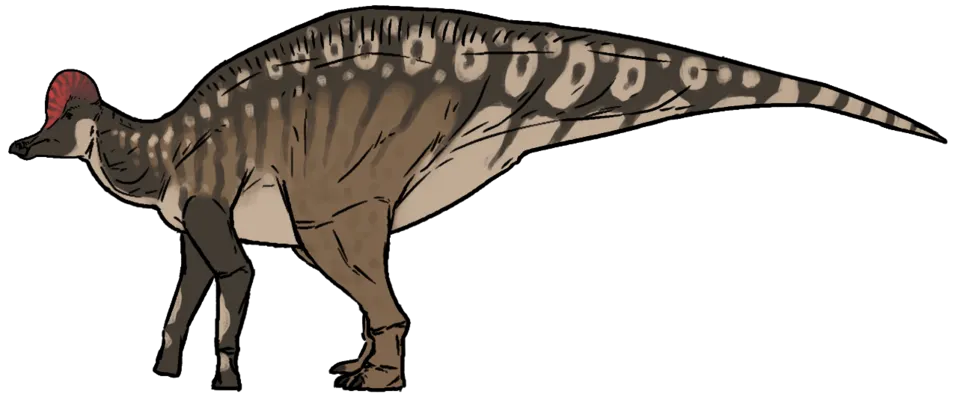
Corythosaurus
OrnithopodLate CretaceousHerbivore
Sources
Media on this page
- Centrosaurus BW.jpg — Nobu Tamura (http://spinops.blogspot.com) · CC BY 3.0
- Fern in forest by I. Levitan (1895, N. Novgorod).jpg — Isaac Levitan · Public domain
- Centrosaurus 3D model, shaped from the life reconstruction "Centrosaurus BW.jpg" — Nobu Tamura (http://spinops.blogspot.com) (artwork); 3D shaping by DinoVerse · CC BY 3.0
- Centrosaurus reconstructed call (synthesised) — DinoVerse (synthesised) · CC0 1.0
- Centrosaurus apertus skull and jaws, Dinosaur Provincial Park, Alberta, Canada, Late Cretaceous - Royal Ontario Museum - DSC00078.JPG — Daderot · CC0
- Centrosaurus.JPG — Sainterx · Public domain
- Centrosaurus.png — Fred Wierum · CC BY-SA 4.0
- Centrosaurus herd.jpg — ABelov2014 · CC BY 3.0