Euoplocephalus
Name means “Well-armed head”
Euoplocephalus was an armoured dinosaur with a tail club and even bony eyelids. It was smaller than Ankylosaurus but built just as tough.
Euoplocephalus was an ankylosaurid from the Late Cretaceous Dinosaur Park Formation of Alberta. Once used as a catch-all name for many Canadian ankylosaur fossils, it is now known from a smaller set of specimens after a 2013 revision split several others into separate genera.
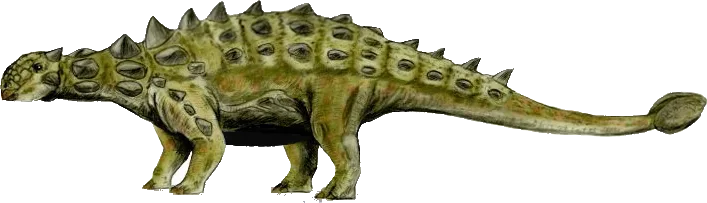
Euoplocephalus BW.jpg — Nobu Tamura (http://spinops.blogspot.com) · CC BY 3.0
Pictures
Spin it in 3D
3D model description: a 3D model of Euoplocephalus shaped from a scientific life reconstruction painting, with the painting's colours and skin texture wrapped around it. It is not a scan of a real fossil.
About this model
This model is shaped from a scientific life reconstruction by Nobu Tamura (http://spinops.blogspot.com): the painting's outline gives the 3D body and the painting itself is its skin. It is sized to the real animal's length (about 5.5 m), so in AR it appears life-size!
It looks best from the side, like the painting it comes from. It is not a fossil scan — museums such as the Smithsonian 3D collection share real fossil scans you can explore.
What might it sound like?
Transcript: Deep, nasal grunts with a hollow, echoing sound
🤔 Nobody knows exactly how dinosaurs sounded
This is a scientific guess. CT scans show Euoplocephalus had long, twisting nasal passages and inner ears tuned to low sounds, so it may have made and heard deep, resonant calls like its bird and crocodile relatives.
Voice boxes and soft tissue almost never fossilise, so sound reconstructions use clues: body size (bigger animals make lower sounds), the calls of living relatives (crocodiles boom with closed mouths; birds coo and hiss), and hollow structures such as hadrosaur crests that could have worked like a trumpet.
Sound: synthesised by DinoVerse from these scientific ideas (CC0). It is a creative guess, not a recording.
Food and habits
Herbivore
Plant-eater
How it ate
Grazed low vegetation with a broad, beaked snout and small teeth, and may have moved its jaw back and forth a little to shred food.
🔍 How do we know?
- tooth wear patterns
- broad muzzle
- jaw joint shape
It ate…
- ferns
- low shrubs
- flowering plants
- horsetails
Euoplocephalus
…and was eaten by
- Gorgosaurus
- Daspletosaurus
Arrows show energy moving up the food chain: from food to eater.
Watch it feed
Quick facts
| 📏 Length | 5–6 m (16–20 ft) |
|---|---|
| ↕️ Height | 1.4–1.8 m (5–6 ft) |
| ⚖️ Weight | 2,000–2,500 kg (4,410–5,510 lb) |
| ⏳ When it lived | 76.5–75 million years ago (Late Cretaceous) |
| 📍 Fossils found | Dinosaur Provincial Park, Alberta, Canada; Red Deer River valley, Alberta, Canada |
| 🔎 Discovered | 1902 by Lawrence Lambe |
| 🧬 Group | Ankylosaurs — Ornithischia › Thyreophora › Ankylosauria |
Where scientists disagree, we show a range. Sizes are for adults.
How big was it?
Where and when
- 📍 Dinosaur Provincial Park, Alberta, Canada (North America)
- 📍 Red Deer River valley, Alberta, Canada (North America)
Lived 76.5–75 million years ago
That's about 76 million years before you were born! Humans have only existed for about 0.3 million years.
See it on the big timeline →Did you know?
- 1Euoplocephalus had bony shutters over its eyes — armoured eyelids!
- 2Its body was covered in bony bumps and spikes, like a knight in armour.
- 3It carried a heavy club on the end of its tail.
- 4Its nose tubes twisted around inside its head like a curly straw.
- A 2013 review by Arbour and Currie reassigned many specimens once called Euoplocephalus to Anodontosaurus, Scolosaurus and Dyoplosaurus, so older books overstate how much of it we know.
- CT scans of its skull show looping nasal passages that may have worked like a heat-and-water exchanger or a resonating chamber for low-frequency calls.
- Its inner ear seems tuned to low-pitched sounds, which supports the idea that it communicated with deep calls.
- Some researchers think Euoplocephalus could move its jaw backward during chewing, a more complex feeding style than once assumed for ankylosaurs.
Myth vs fact
❌ MythEuoplocephalus is one of the best-known ankylosaurs, with dozens of skeletons.
✅ FactMany of those fossils were moved to other genera in 2013; Euoplocephalus itself is known from fewer, mostly partial specimens.
Mini quiz
1. What does 'Euoplocephalus' mean?
2. Which body part of Euoplocephalus had armour that is unusual?
3. Which country has Euoplocephalus fossils?
Related animals
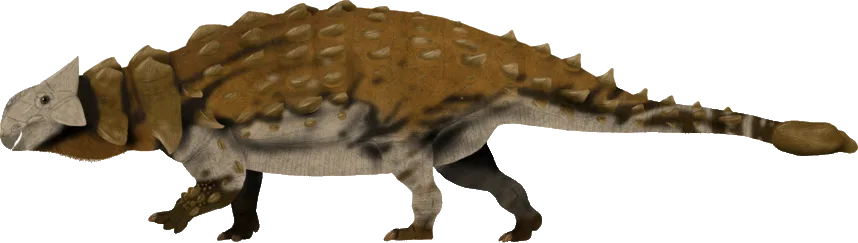
Ankylosaurus
AnkylosaurLate CretaceousHerbivore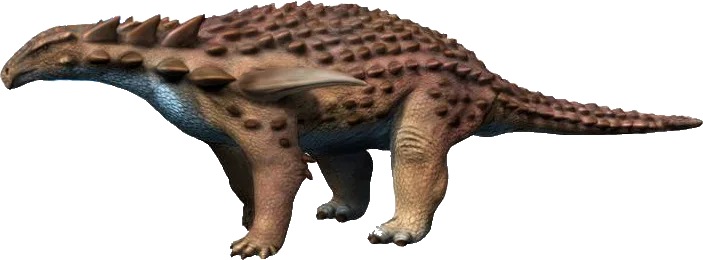
Borealopelta
AnkylosaurEarly CretaceousHerbivore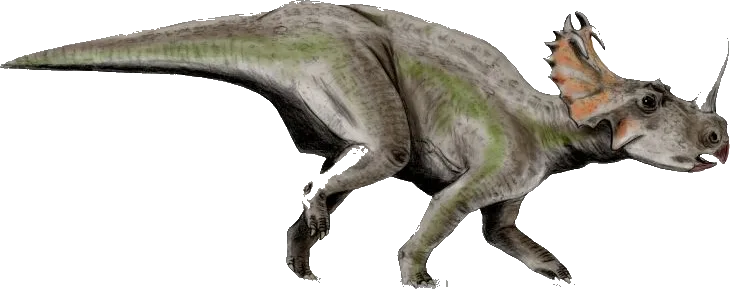
Centrosaurus
CeratopsianLate CretaceousHerbivore
Sources
Media on this page
- Euoplocephalus BW.jpg — Nobu Tamura (http://spinops.blogspot.com) · CC BY 3.0
- Fern in forest by I. Levitan (1895, N. Novgorod).jpg — Isaac Levitan · Public domain
- Euoplocephalus 3D model, shaped from the life reconstruction "Euoplocephalus BW.jpg" — Nobu Tamura (http://spinops.blogspot.com) (artwork); 3D shaping by DinoVerse · CC BY 3.0
- Euoplocephalus reconstructed call (synthesised) — DinoVerse (synthesised) · CC0 1.0
- Euoplocephalus TMP 1991.127.1.tif — Victoria M. Arbour, Philip J. Currie · CC BY 2.5
- Euoplocephalus BW.jpg — Nobu Tamura (http://spinops.blogspot.com) · CC BY 3.0
- Euoplocephalus armour.png — Victoria M. Arbour, Philip J. Currie · CC BY 2.5
- Euoplocephalus mandibles.png — Victoria M. Arbour, Philip J. Currie · CC BY 2.5