Borealopelta
Name means “Northern shield”
Borealopelta is one of the best-preserved dinosaurs ever found — it still has its armour, skin and even its colours! It was reddish-brown on top and lighter underneath.
Borealopelta was a nodosaurid ankylosaur whose front half was found in 2011 in marine rocks at an oil-sands mine in Alberta. Its armour, keratin coverings and skin are preserved in three dimensions, along with chemical traces of colour and the remains of its last meal.
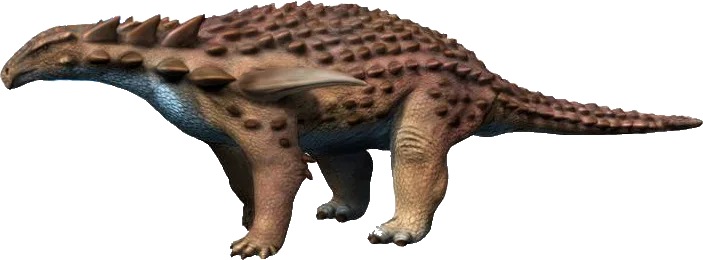
Borealopelta NT.jpg — Nobu Tamura email:nobu.tamura@yahoo.com http://spi · CC BY-SA 4.0
Pictures
Spin it in 3D
3D model description: a 3D model of Borealopelta shaped from a scientific life reconstruction painting, with the painting's colours and skin texture wrapped around it. It is not a scan of a real fossil.
About this model
This model is shaped from a scientific life reconstruction by Nobu Tamura email:nobu.tamura@yahoo.com http://spinops.blogspot.com/: the painting's outline gives the 3D body and the painting itself is its skin. It is sized to the real animal's length (about 5.3 m), so in AR it appears life-size!
It looks best from the side, like the painting it comes from. It is not a fossil scan — museums such as the Smithsonian 3D collection share real fossil scans you can explore.
What might it sound like?
Transcript: Low, snuffling grunts while it browses
🤔 Nobody knows exactly how dinosaurs sounded
This is a scientific guess. Like other ankylosaurs it had long nasal passages, and its living relatives, birds and crocodiles, make low grunts and closed-mouth calls, so soft, deep grunts are a reasonable idea.
Voice boxes and soft tissue almost never fossilise, so sound reconstructions use clues: body size (bigger animals make lower sounds), the calls of living relatives (crocodiles boom with closed mouths; birds coo and hiss), and hollow structures such as hadrosaur crests that could have worked like a trumpet.
Sound: synthesised by DinoVerse from these scientific ideas (CC0). It is a creative guess, not a recording.
Food and habits
Herbivore
Plant-eater
How it ate
Browsed selectively on soft, low-growing ferns, snipping leaves with its beak and swallowing them with little chewing; stones in its stomach may have helped break food down.
🔍 How do we know?
- fossilised stomach contents
- gastroliths
- charcoal mixed with the last meal
It ate…
- ferns
- cycads
- conifer leaves
- horsetails
Borealopelta
…and was eaten by
- large theropods
Arrows show energy moving up the food chain: from food to eater.
Watch it feed
Quick facts
| 📏 Length | 5–5.5 m (16–18 ft) |
|---|---|
| ↕️ Height | 1.2–1.5 m (4–5 ft) |
| ⚖️ Weight | 1,100–1,500 kg (2,430–3,310 lb) |
| ⏳ When it lived | 112–110 million years ago (Early Cretaceous) |
| 📍 Fossils found | Suncor Millennium Mine, Fort McMurray, Alberta, Canada |
| 🔎 Discovered | 2011 by Shawn Funk, a heavy-equipment operator (named by Caleb Brown and colleagues in 2017) |
| 🧬 Group | Ankylosaurs — Ornithischia › Thyreophora › Ankylosauria |
Where scientists disagree, we show a range. Sizes are for adults.
How big was it?
Where and when
- 📍 Suncor Millennium Mine, Fort McMurray, Alberta, Canada (North America)
Lived 112–110 million years ago
That's about 111 million years before you were born! Humans have only existed for about 0.3 million years.
See it on the big timeline →Did you know?
- 1Borealopelta is so well preserved that people call it a 'dinosaur statue'!
- 2Scientists found chemicals from its real skin colour: reddish-brown on top, paler underneath.
- 3Its last meal is still in its tummy — mostly ferns!
- 4It had two long spikes sticking out from its shoulders.
- Chemical analysis by Caleb Brown and colleagues (2017) detected benzothiazole, a breakdown product of reddish pheomelanin pigment, concentrated on the upper body — evidence of countershading, a camouflage pattern suggesting it still needed to hide from big predators.
- A 2020 study of its fossilised stomach contents found mostly leptosporangiate ferns plus some cycad and conifer bits, and lots of charcoal, suggesting it fed on fresh growth after wildfires.
- Growth rings in tiny twigs from the stomach suggest it died in late spring or summer.
- It probably died near a river, bloated and floated out to sea, then sank belly-up into soft seabed mud, which helped preserve its armour in its natural position.
- The shoulder spikes are about 50 cm long, and some researchers suggest they were used more for display than defence, since they are larger than needed for protection.
Myth vs fact
❌ MythBecause it was found in sea rocks, Borealopelta was a swimming dinosaur.
✅ FactIt was a land animal; its body was washed out to sea after death and sank to the seabed.
Mini quiz
1. What colour was Borealopelta on its back?
2. What was Borealopelta's last meal mostly made of?
3. Where was Borealopelta discovered?
Related animals
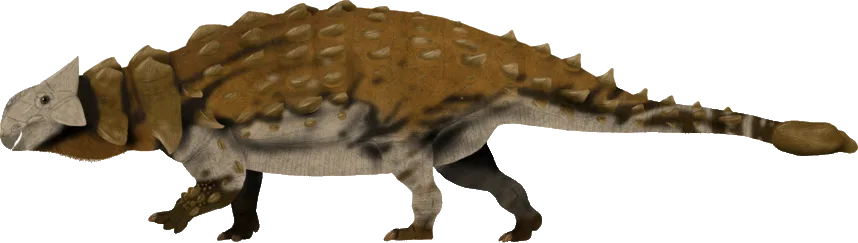
Ankylosaurus
AnkylosaurLate CretaceousHerbivore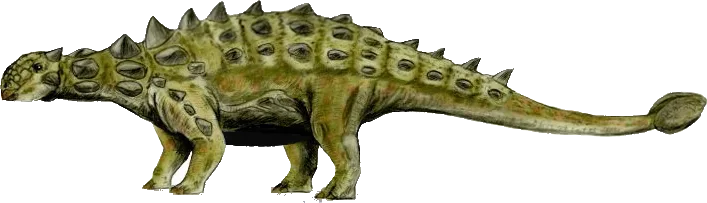
Euoplocephalus
AnkylosaurLate CretaceousHerbivore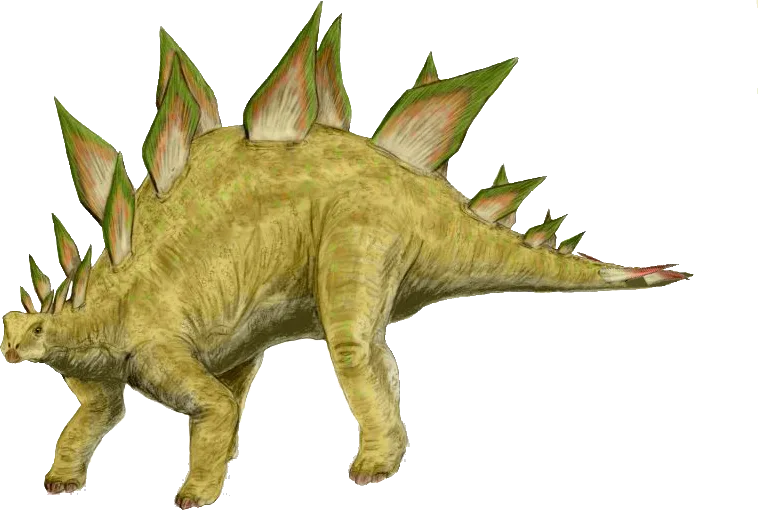
Stegosaurus
StegosaurLate JurassicHerbivore
Media on this page
- Borealopelta NT.jpg — Nobu Tamura email:nobu.tamura@yahoo.com http://spinops.blogspot.com/ · CC BY-SA 4.0
- Fern in forest by I. Levitan (1895, N. Novgorod).jpg — Isaac Levitan · Public domain
- Borealopelta 3D model, shaped from the life reconstruction "Borealopelta NT.jpg" — Nobu Tamura email:nobu.tamura@yahoo.com http://spinops.blogspot.com/ (artwork); 3D shaping · CC BY-SA 4.0
- Borealopelta reconstructed call (synthesised) — DinoVerse (synthesised) · CC0 1.0
- Nodosaur.jpg — ケラトプスユウタ · CC BY-SA 4.0
- Borealopelta Royal Tyrrell 4.jpg — Etemenanki3 · CC BY-SA 4.0
- Borealopelta dorsal view.png — Caleb M. Brown · CC BY 4.0
- Borealopelta markmitchelli.png — Connor Ashbridge · CC BY 4.0