Ankylosaurus
Name means “Fused lizard”
Ankylosaurus was covered in bony armour like a walking tank and had a heavy club on the end of its tail. It lived alongside T. rex.
Ankylosaurus was the largest known ankylosaurid, living in western North America at the very end of the Cretaceous. It is known only from partial skeletons, but these show a broad, armoured skull, bony plates set in the skin, and a stiff tail ending in a large bony club.
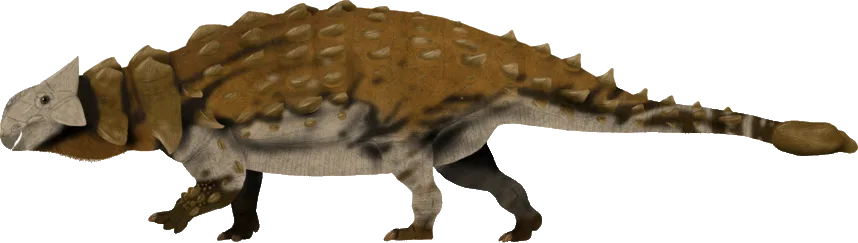
Ankylosaurus magniventris by sphenaphinae.png — Sphenaphinae · CC BY-SA 4.0
Pictures
Spin it in 3D
3D model description: a 3D model of Ankylosaurus shaped from a scientific life reconstruction painting, with the painting's colours and skin texture wrapped around it. It is not a scan of a real fossil.
About this model
This model is shaped from a scientific life reconstruction by Sphenaphinae: the painting's outline gives the 3D body and the painting itself is its skin. It is sized to the real animal's length (about 7.0 m), so in AR it appears life-size!
It looks best from the side, like the painting it comes from. It is not a fossil scan — museums such as the Smithsonian 3D collection share real fossil scans you can explore.
What might it sound like?
Transcript: Very deep, resonant boom with a buzzing rumble
🤔 Nobody knows exactly how dinosaurs sounded
This is a scientific guess. Ankylosaurs had long, looping nasal passages that may have helped them make or hear low sounds, and their bird and crocodile relatives use closed-mouth booms, so a deep, resonant call is plausible.
Voice boxes and soft tissue almost never fossilise, so sound reconstructions use clues: body size (bigger animals make lower sounds), the calls of living relatives (crocodiles boom with closed mouths; birds coo and hiss), and hollow structures such as hadrosaur crests that could have worked like a trumpet.
Sound: synthesised by DinoVerse from these scientific ideas (CC0). It is a creative guess, not a recording.
Food and habits
Herbivore
Plant-eater
How it ate
Cropped low plants with a wide, beaked snout, taking big mouthfuls, and pulped them with small, leaf-shaped teeth.
🔍 How do we know?
- small leaf-shaped teeth
- wide muzzle for bulk feeding
- low body and head position
Arrows show energy moving up the food chain: from food to eater.
Watch it walk
Quick facts
| 📏 Length | 6–8 m (20–26 ft) |
|---|---|
| ↕️ Height | 1.4–1.7 m (5–6 ft) |
| ⚖️ Weight | 4,800–8,000 kg (10,580–17,640 lb) |
| ⏳ When it lived | 68–66 million years ago (Late Cretaceous) |
| 📍 Fossils found | Hell Creek Formation, Montana, USA; Lance Formation, Wyoming, USA; Scollard Formation, Alberta, Canada |
| 🔎 Discovered | 1908 by Barnum Brown |
| 🧬 Group | Ankylosaurs — Ornithischia › Thyreophora › Ankylosauria |
Where scientists disagree, we show a range. Sizes are for adults.
How big was it?
Where and when
- 📍 Hell Creek Formation, Montana, USA (North America)
- 📍 Lance Formation, Wyoming, USA (North America)
- 📍 Scollard Formation, Alberta, Canada (North America)
Lived 68–66 million years ago
That's about 67 million years before you were born! Humans have only existed for about 0.3 million years.
See it on the big timeline →Did you know?
- 1Ankylosaurus was about as long as a school bus — but much lower and wider!
- 2Even its eyelids had bony armour.
- 3Its tail club was made of fused bones and could swing hard enough to break a bone.
- 4It lived at the same time as T. rex and Triceratops.
- The tail club was supported by interlocking vertebrae and bony tendons that made the end of the tail a rigid handle; studies of club size suggest large clubs could deliver bone-breaking blows.
- A 2022 study of the closely related Zuul found damaged and healed armour on its flanks, suggesting ankylosaurids also used their clubs against each other, not just predators.
- Its nasal passages loop through the skull; possible roles include warming and moistening air, saving water, and acting as a resonating chamber for calls.
- No complete Ankylosaurus skeleton has been found, so its exact length and weight are estimated from relatives like Euoplocephalus, which is why ranges are wide.
Myth vs fact
❌ MythThe tail club was a bony ball on the end of a floppy tail.
✅ FactThe last part of the tail was stiffened by locked-together bones and ossified tendons, making a strong, rigid handle for the club.
❌ MythAnkylosaurus is known from lots of complete skeletons.
✅ FactOnly a few partial skeletons, skulls and pieces of armour have been found; many full reconstructions borrow details from its relatives.
Mini quiz
1. What did Ankylosaurus have at the end of its tail?
2. What does 'Ankylosaurus' mean?
3. Which predator lived at the same time as Ankylosaurus?
Related animals
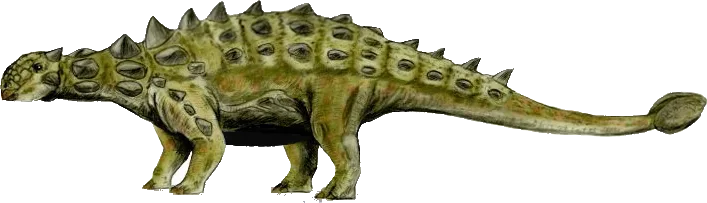
Euoplocephalus
AnkylosaurLate CretaceousHerbivore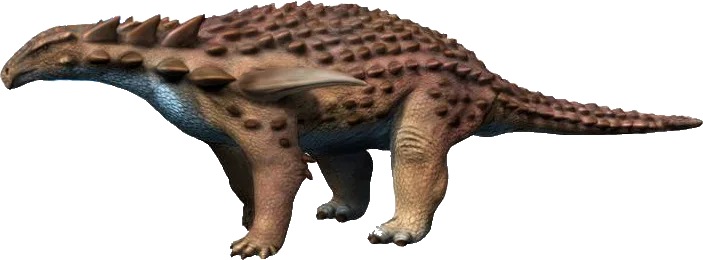
Borealopelta
AnkylosaurEarly CretaceousHerbivore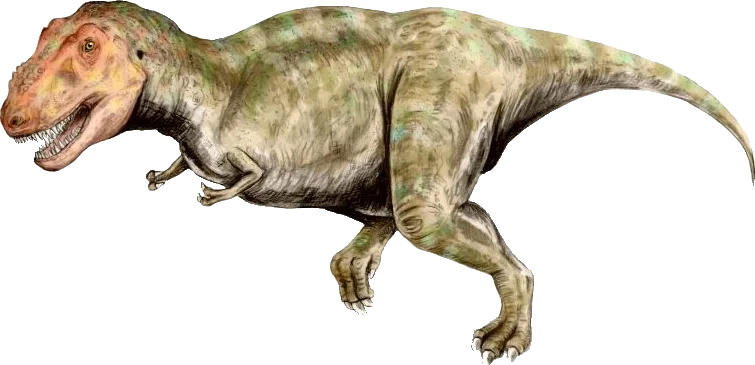
Tyrannosaurus rex
TheropodLate CretaceousCarnivore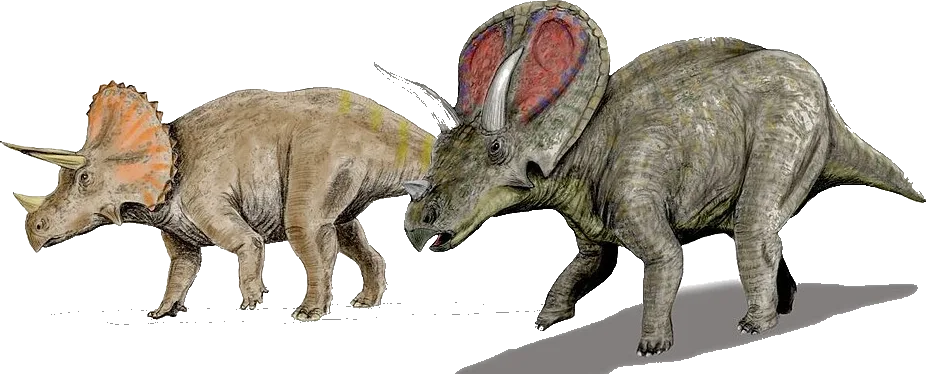
Triceratops
CeratopsianLate CretaceousHerbivore
Sources
Media on this page
- Ankylosaurus magniventris by sphenaphinae.png — Sphenaphinae · CC BY-SA 4.0
- Fern in forest by I. Levitan (1895, N. Novgorod).jpg — Isaac Levitan · Public domain
- Ankylosaurus 3D model, shaped from the life reconstruction "Ankylosaurus magniventris by sphenaphinae.png" — Sphenaphinae (artwork); 3D shaping by DinoVerse · CC BY-SA 4.0
- Ankylosaurus reconstructed call (synthesised) — DinoVerse (synthesised) · CC0 1.0
- Ankylosaur head - cast - Custer County Montana - Museum of the Rockies - 2013-07-08.jpg — Tim Evanson · CC BY-SA 2.0
- Ankylosaurus.jpg — Barnum Brown · Public domain
- Ankylosaurus; from Offensive weapons and means of defense of fossil vertebrates (Abel 1908).png — Othenio Abel · Public domain
- Ankylosaurus armor.png — Victoria M. Arbour, Jordan C. Mallon · CC BY 4.0