Say it: an-KY-loh-SORE-us · Name means: “Fused lizard”
Key facts about Ankylosaurus
⏳ Lived
68–66 million years ago Late Cretaceous
🌿 Diet
Herbivore (plant-eater)
📏 Length
6–8 m (20–26 ft)
↕️ Height
1.4–1.7 m (5–6 ft)
⚖️ Weight
4,800–8,000 kg (10,580–17,640 lb)
📍 Found in
North America
🔎 Discovered
1908 by Barnum Brown
About Ankylosaurus
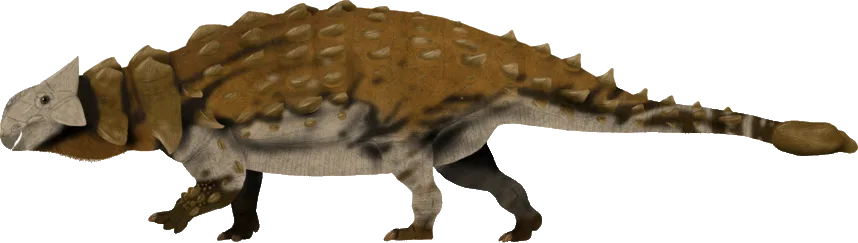
Ankylosaurus was covered in bony armour like a walking tank and had a heavy club on the end of its tail. It lived alongside T. rex.
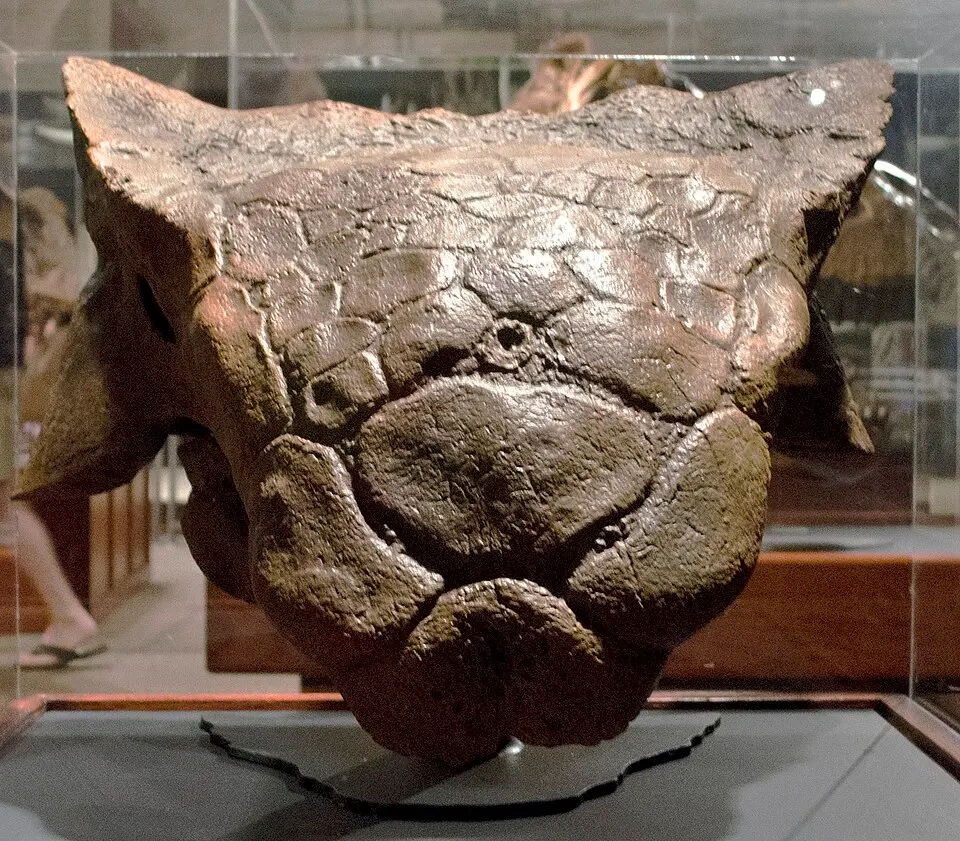
Ankylosaurus was the largest known ankylosaurid, living in western North America at the very end of the Cretaceous. It is known only from partial skeletons, but these show a broad, armoured skull, bony plates set in the skin, and a stiff tail ending in a large bony club.
Drawn to scale next to a 1.7 m adult and a 12 m school bus.
Did you know?
Ankylosaurus was about as long as a school bus — but much lower and wider!
Even its eyelids had bony armour.
Its tail club was made of fused bones and could swing hard enough to break a bone.
It lived at the same time as T. rex and Triceratops.
The tail club was supported by interlocking vertebrae and bony tendons that made the end of the tail a rigid handle; studies of club size suggest large clubs could deliver bone-breaking blows.
A 2022 study of the closely related Zuul found damaged and healed armour on its flanks, suggesting ankylosaurids also used their clubs against each other, not just predators.
Its nasal passages loop through the skull; possible roles include warming and moistening air, saving water, and acting as a resonating chamber for calls.
No complete Ankylosaurus skeleton has been found, so its exact length and weight are estimated from relatives like Euoplocephalus, which is why ranges are wide.
 DinoVerse · Dinosaur fact sheet