Triceratops
Name means “Three-horned face”
Triceratops was a giant plant-eater with three horns and a big bony frill around its neck. It lived at the same time and place as T. rex!
Triceratops was one of the last and largest ceratopsids, living in western North America in the final few million years before the end-Cretaceous extinction. Its fossils are among the most common in the Hell Creek and Lance formations, and its horns and solid frill were likely used for display, recognition and sparring with rivals.
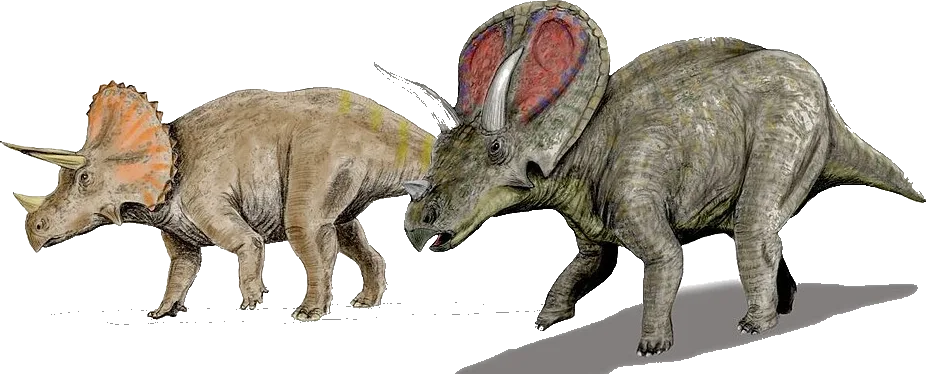
Triceratops & Torosaurus.jpg — Nobu Tamura (http://spinops.blogspot.com) · CC BY-SA 3.0
Pictures
Spin it in 3D
3D model description: a 3D model of Triceratops shaped from a scientific life reconstruction painting, with the painting's colours and skin texture wrapped around it. It is not a scan of a real fossil.
About this model
This model is shaped from a scientific life reconstruction by Source: Nobu TamuraDerivative: User:MathKnight: the painting's outline gives the 3D body and the painting itself is its skin. It is sized to the real animal's length (about 8.5 m), so in AR it appears life-size!
It looks best from the side, like the painting it comes from. It is not a fossil scan — museums such as the Smithsonian 3D collection share real fossil scans you can explore.
What might it sound like?
Transcript: Low, rumbling bellow that rolls out for about 3 seconds
🤔 Nobody knows exactly how dinosaurs sounded
No one knows exactly what Triceratops sounded like. This is a scientific guess: its closest living relatives, birds and crocodiles, make deep closed-mouth rumbles and bellows, and a big-bodied animal like Triceratops probably made low sounds too.
Voice boxes and soft tissue almost never fossilise, so sound reconstructions use clues: body size (bigger animals make lower sounds), the calls of living relatives (crocodiles boom with closed mouths; birds coo and hiss), and hollow structures such as hadrosaur crests that could have worked like a trumpet.
Sound: synthesised by DinoVerse from these scientific ideas (CC0). It is a creative guess, not a recording.
Food and habits
Herbivore
Plant-eater
How it ate
Snipped tough plants with a sharp, parrot-like beak, then sliced them up with hundreds of tightly packed cheek teeth that worked like scissors.
🔍 How do we know?
- tooth batteries built for slicing
- beak shape
- plant fossils from the same rock layers
Arrows show energy moving up the food chain: from food to eater.
Watch it feed
Quick facts
| 📏 Length | 8–9 m (26–30 ft) |
|---|---|
| ↕️ Height | 2.9–3 m (10 ft) |
| ⚖️ Weight | 6,000–12,000 kg (13,230–26,460 lb) |
| ⏳ When it lived | 68–66 million years ago (Late Cretaceous) |
| 📍 Fossils found | Hell Creek Formation, Montana, USA; Lance Formation, Wyoming, USA; South Dakota, USA; Scollard Formation, Alberta, Canada |
| 🔎 Discovered | 1889 by Othniel Charles Marsh (fossil found by John Bell Hatcher) |
| 🧬 Group | Ceratopsians — Ornithischia › Marginocephalia › Ceratopsia |
Where scientists disagree, we show a range. Sizes are for adults.
How big was it?
Where and when
- 📍 Hell Creek Formation, Montana, USA (North America)
- 📍 Lance Formation, Wyoming, USA (North America)
- 📍 South Dakota, USA (North America)
- 📍 Scollard Formation, Alberta, Canada (North America)
Lived 68–66 million years ago
That's about 67 million years before you were born! Humans have only existed for about 0.3 million years.
See it on the big timeline →Did you know?
- 1Each brow horn on a big Triceratops could be longer than your arm!
- 2Triceratops had one of the biggest heads of any land animal ever.
- 3It had hundreds of teeth packed in rows, and new teeth grew in when old ones wore out.
- 4Some Triceratops skulls have healed holes from fighting with other Triceratops.
- Its cheek teeth formed 'dental batteries' of up to around 800 teeth, with only a few in use at once, giving it a slicing, guillotine-like bite for tough, fibrous plants.
- Healed lesions on Triceratops frills and skull bones match the pattern expected if rivals locked horns, supporting the idea that horns were used in combat with their own kind.
- In 2010 researchers proposed that Torosaurus, with its larger, holed frill, was simply the fully grown form of Triceratops; later studies of skull shape and growth stages mostly disagree, and most palaeontologists still treat them as separate genera.
- A skin impression from a Triceratops specimen shows large scales, some with cone-like bumps, so it was probably scaly rather than feathered.
- Two species are recognised, T. horridus and T. prorsus, and some researchers think one may have evolved into the other over time.
Myth vs fact
❌ MythThe first Triceratops horns belonged to a giant prehistoric bison.
✅ FactIn 1887 a pair of horns was briefly named Bison alticornis, but better fossils soon showed they came from a horned dinosaur, which Marsh named Triceratops in 1889.
❌ MythTriceratops' frill was a shield to block T. rex bites.
✅ FactThe frill was mostly for display and recognising its own kind; T. rex bite marks have even been found on frills, so it was not a perfect shield.
Mini quiz
1. What does the name 'Triceratops' mean?
2. Which big predator lived alongside Triceratops?
3. What did Triceratops eat?
Related animals
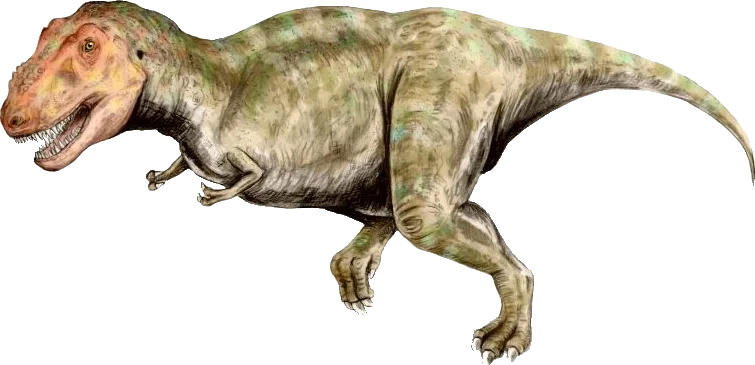
Tyrannosaurus rex
TheropodLate CretaceousCarnivore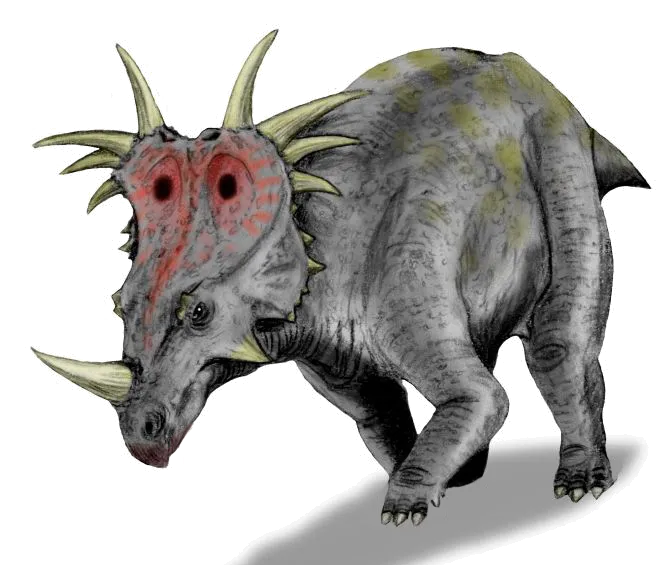
Styracosaurus
CeratopsianLate CretaceousHerbivore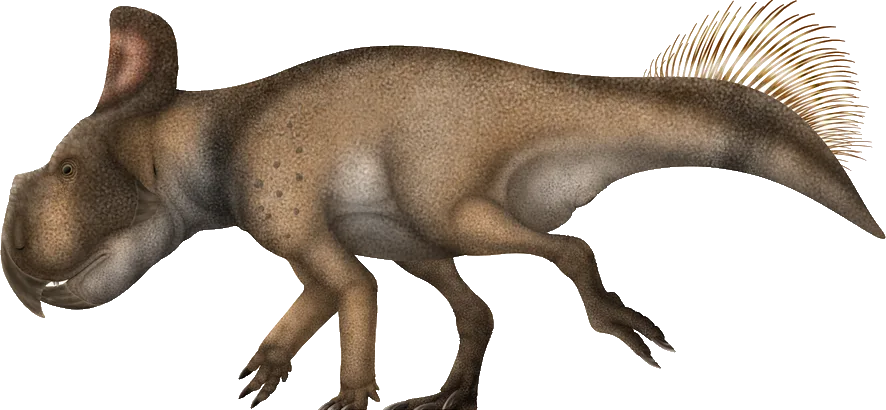
Protoceratops
CeratopsianLate CretaceousHerbivore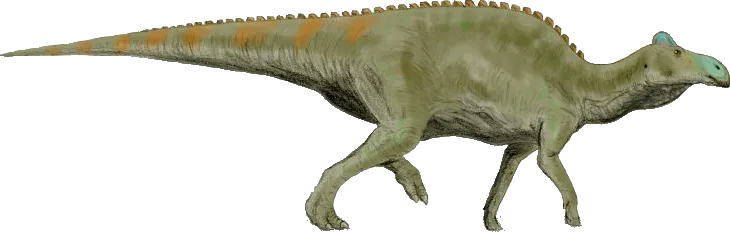
Edmontosaurus
OrnithopodLate CretaceousHerbivore
Sources
Media on this page
- Triceratops & Torosaurus.jpg — Nobu Tamura (http://spinops.blogspot.com) · CC BY-SA 3.0
- Fern in forest by I. Levitan (1895, N. Novgorod).jpg — Isaac Levitan · Public domain
- Triceratops 3D model, shaped from the life reconstruction "Triceratops BWMK.jpg" — Source: Nobu TamuraDerivative: User:MathKnight (artwork); 3D shaping by DinoVerse · CC BY-SA 3.0
- Triceratops reconstructed call (synthesised) — DinoVerse (synthesised) · CC0 1.0
- LA-Triceratops mount-2.jpg — Source: Allie_Caulfield Derivative: User:MathKnight · CC BY-SA 3.0
- 2014 Triceratops horridus fossil.jpg — Ginkgoales · CC BY-SA 4.0
- Back and below of Triceratops skull - Fergus County Montana - Museum of the Rockies - 2013-07-08.jpg — Tim Evanson · CC BY-SA 2.0
- Juvenile Triceratops.jpg — Tim Evanson from Washington, D.C., United States of America · CC BY-SA 2.0