Styracosaurus
Name means “Spiked lizard”
Styracosaurus had one long horn on its nose and a crown of long spikes around its frill. It was a rhino-sized plant-eater.
Styracosaurus was a centrosaurine ceratopsid from the Dinosaur Park Formation of Alberta. It is famous for a tall nasal horn and four to six long spikes projecting from the back of its frill, structures that most likely worked as display signals.
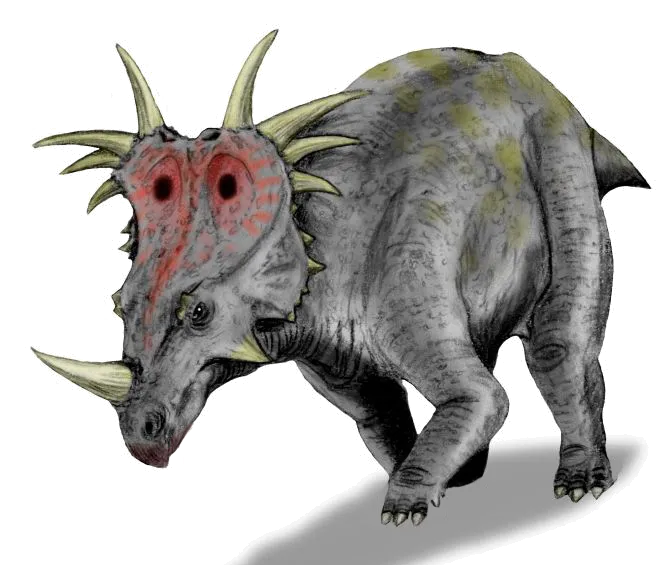
Styracosaurus BW transparent.png — Nobu Tamura (http://spinops.blogspot.com) · CC BY-SA 3.0
Pictures
Spin it in 3D
3D model description: a 3D model of Styracosaurus shaped from a scientific life reconstruction painting, with the painting's colours and skin texture wrapped around it. It is not a scan of a real fossil.
About this model
This model is shaped from a scientific life reconstruction by Nobu Tamura (http://spinops.blogspot.com): the painting's outline gives the 3D body and the painting itself is its skin. It is sized to the real animal's length (about 5.3 m), so in AR it appears life-size!
It looks best from the side, like the painting it comes from. It is not a fossil scan — museums such as the Smithsonian 3D collection share real fossil scans you can explore.
What might it sound like?
Transcript: Short, deep grunts, repeated two or three times
🤔 Nobody knows exactly how dinosaurs sounded
This is a scientific guess. Large reptiles and birds make low grunts and rumbles, and a heavy, rhino-like plant-eater such as Styracosaurus probably used similar low sounds to keep in touch or warn rivals.
Voice boxes and soft tissue almost never fossilise, so sound reconstructions use clues: body size (bigger animals make lower sounds), the calls of living relatives (crocodiles boom with closed mouths; birds coo and hiss), and hollow structures such as hadrosaur crests that could have worked like a trumpet.
Sound: synthesised by DinoVerse from these scientific ideas (CC0). It is a creative guess, not a recording.
Food and habits
Herbivore
Plant-eater
How it ate
Bit off low plants with a deep, hooked beak and chopped them into pieces with rows of shearing cheek teeth.
🔍 How do we know?
- tooth batteries built for slicing
- beak shape
- head held low to the ground
It ate…
- ferns
- cycads
- low shrubs
- flowering plants
Styracosaurus
…and was eaten by
- Gorgosaurus
- Daspletosaurus
Arrows show energy moving up the food chain: from food to eater.
Watch it feed
Quick facts
| 📏 Length | 5–5.5 m (16–18 ft) |
|---|---|
| ↕️ Height | 1.6–1.8 m (5–6 ft) |
| ⚖️ Weight | 1,800–2,700 kg (3,970–5,950 lb) |
| ⏳ When it lived | 75.5–74.5 million years ago (Late Cretaceous) |
| 📍 Fossils found | Dinosaur Provincial Park, Alberta, Canada; Dinosaur Park Formation near Steveville, Alberta, Canada |
| 🔎 Discovered | 1913 by Lawrence Lambe (fossil found by Charles M. Sternberg) |
| 🧬 Group | Ceratopsians — Ornithischia › Marginocephalia › Ceratopsia |
Where scientists disagree, we show a range. Sizes are for adults.
How big was it?
Where and when
- 📍 Dinosaur Provincial Park, Alberta, Canada (North America)
- 📍 Dinosaur Park Formation near Steveville, Alberta, Canada (North America)
Lived 75.5–74.5 million years ago
That's about 75 million years before you were born! Humans have only existed for about 0.3 million years.
See it on the big timeline →Did you know?
- 1The longest spikes on its frill were about half a metre long — as long as a baseball bat is to a small kid!
- 2Its nose horn was about as long as your leg from knee to foot.
- 3Styracosaurus was about the size of a big rhino.
- 4No two Styracosaurus had exactly the same pattern of frill spikes.
- Its frill spikes and nasal horn were probably too thin and spread out to be very useful against predators, so most researchers interpret them as display features for attracting mates or recognising its own species.
- A well-preserved skull nicknamed 'Hannah', described in 2020, showed that frill spikes varied between individuals and could even differ between the left and right sides of one animal.
- Bonebeds containing several Styracosaurus hint that it lived in groups, although the evidence is not as strong as the huge bonebeds known for Centrosaurus.
- Styracosaurus shared its habitat with several other horned dinosaurs, such as Centrosaurus and Chasmosaurus, which may have avoided competition by living in slightly different times or places.
Myth vs fact
❌ MythStyracosaurus used its frill spikes as weapons to stab predators.
✅ FactThe spikes pointed backwards and outwards and were likely for showing off, not fighting; the nose horn was its most useful defensive weapon.
Mini quiz
1. What does 'Styracosaurus' mean?
2. How many long horns did Styracosaurus have on its nose?
3. In which country have Styracosaurus fossils been found?
Related animals
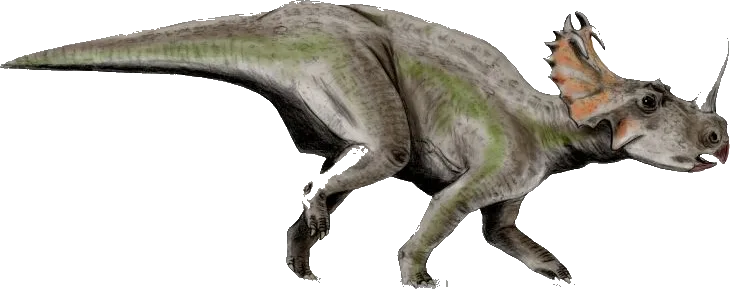
Centrosaurus
CeratopsianLate CretaceousHerbivore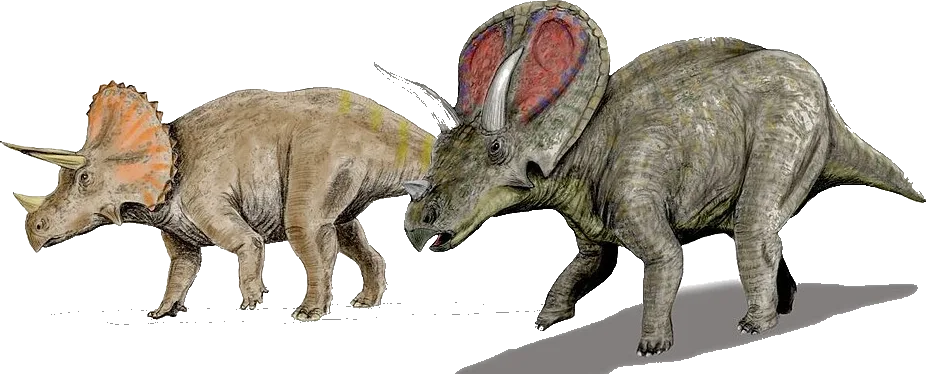
Triceratops
CeratopsianLate CretaceousHerbivore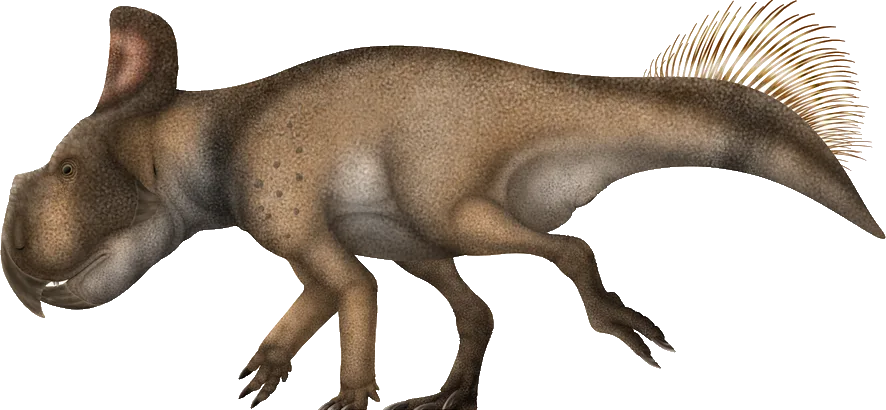
Protoceratops
CeratopsianLate CretaceousHerbivore
Sources
Media on this page
- Styracosaurus BW transparent.png — Nobu Tamura (http://spinops.blogspot.com) · CC BY-SA 3.0
- Fern in forest by I. Levitan (1895, N. Novgorod).jpg — Isaac Levitan · Public domain
- Styracosaurus 3D model, shaped from the life reconstruction "Styracosaurus BW transparent.png" — Nobu Tamura (http://spinops.blogspot.com) (artwork); 3D shaping by DinoVerse · CC BY-SA 3.0
- Styracosaurus reconstructed call (synthesised) — DinoVerse (synthesised) · CC0 1.0
- StyracosaurCMN2.jpg — LittleLazyLass · CC BY-SA 4.0
- Styracosaurus.jpg — Claire Houck from New York City, USA · CC BY-SA 2.0
- Styracosaurus "parksi" AMNH.jpg — Jonathan Chen · CC BY-SA 4.0
- Styracosaurus albertensis.png — Connor Ashbridge · CC BY 4.0