Therizinosaurus
Name means “Scythe lizard”
Therizinosaurus was a giant, feathery plant-eater with the longest claws of any known animal. It was a theropod, but it ate leaves instead of meat.
Therizinosaurus cheloniformis was a giant therizinosaurid from the Late Cretaceous of Mongolia, one of the largest members of an unusual group of plant-eating theropods. It is famous for hand claws with bony cores over half a metre long, but because its skull has never been found, much of its appearance is reconstructed from smaller relatives.
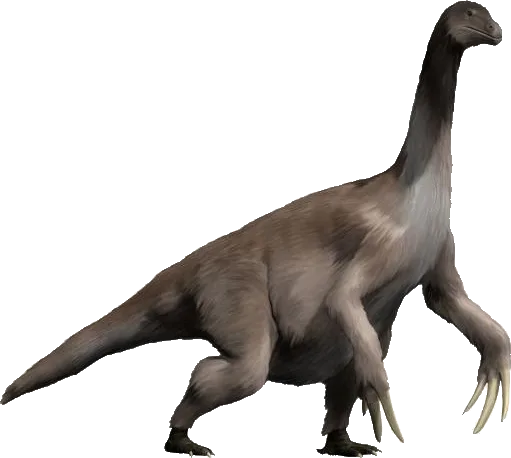
Therizinosaurus NT.jpg — Nobu Tamura email:nobu.tamura@yahoo.com http://spi · CC BY-SA 4.0
Pictures
Spin it in 3D
3D model description: a 3D model of Therizinosaurus shaped from a scientific life reconstruction painting, with the painting's colours and skin texture wrapped around it. It is not a scan of a real fossil.
About this model
This model is shaped from a scientific life reconstruction by Nobu Tamura email:nobu.tamura@yahoo.com http://spinops.blogspot.com/: the painting's outline gives the 3D body and the painting itself is its skin. It is sized to the real animal's length (about 9.5 m), so in AR it appears life-size!
It looks best from the side, like the painting it comes from. It is not a fossil scan — museums such as the Smithsonian 3D collection share real fossil scans you can explore.
What might it sound like?
Transcript: Deep, slow grunts with a soft humming rumble, about 2 seconds
🤔 Nobody knows exactly how dinosaurs sounded
This is a scientific guess. Large animals usually have low voices, and Therizinosaurus's relatives, birds and crocodiles, grunt and boom with their mouths closed. Nothing is known directly about its voice.
Voice boxes and soft tissue almost never fossilise, so sound reconstructions use clues: body size (bigger animals make lower sounds), the calls of living relatives (crocodiles boom with closed mouths; birds coo and hiss), and hollow structures such as hadrosaur crests that could have worked like a trumpet.
Sound: synthesised by DinoVerse from these scientific ideas (CC0). It is a creative guess, not a recording.
Food and habits
Herbivore
Plant-eater
How it ate
Pulled leafy branches towards its mouth with its long arms and huge claws, then stripped the leaves with a beak and small leaf-shaped cheek teeth, digesting them in a big belly.
🔍 How do we know?
- leaf-shaped teeth and beaks in close relatives
- wide hips for a large plant-digesting gut
- long neck suited to browsing
It ate…
- leaves
- tree branches
- shrubs
- fruits
Therizinosaurus
…and was eaten by
- Tarbosaurus
Arrows show energy moving up the food chain: from food to eater.
Watch it walk
Quick facts
| 📏 Length | 9–10 m (30–33 ft) |
|---|---|
| ↕️ Height | 3.5–5 m (11–16 ft) |
| ⚖️ Weight | 3,000–5,000 kg (6,610–11,020 lb) |
| ⏳ When it lived | 71–69 million years ago (Late Cretaceous) |
| 📍 Fossils found | Nemegt Formation, Gobi Desert, Mongolia |
| 🔎 Discovered | 1948 by Soviet-Mongolian expedition (named by Evgeny Maleev in 1954) |
| 🧬 Group | Theropods — Saurischia › Theropoda |
Where scientists disagree, we show a range. Sizes are for adults.
How big was it?
Where and when
- 📍 Nemegt Formation, Gobi Desert, Mongolia (Asia)
Lived 71–69 million years ago
That's about 70 million years before you were born! Humans have only existed for about 0.3 million years.
See it on the big timeline →Did you know?
- 1Therizinosaurus had claws longer than your arm, the longest claws of any animal ever found!
- 2Even though it was related to T. rex, it ate plants.
- 3When scientists first found its claws, they thought they came from a giant turtle.
- 4Nobody has ever found its head, so scientists guess what it looked like from its cousins.
- When the first claws were described in 1954 by Evgeny Maleev, he thought they belonged to a huge turtle-like reptile, which is why its species name cheloniformis means 'turtle-shaped'.
- The bony claw cores reach more than 50 centimetres, and in life they were covered by an even longer keratin sheath.
- A 2023 study comparing claw shapes suggested Therizinosaurus's claws were poorly suited to digging or fighting and were more likely used for pulling vegetation and display.
- Smaller relatives such as Beipiaosaurus and Erlikosaurus show that therizinosaurs had beaks, leaf-shaped teeth and simple feathers, so Therizinosaurus was likely similar.
Myth vs fact
❌ MythTherizinosaurus used its giant claws to fight and kill other dinosaurs.
✅ FactIt was a plant-eater. Its claws may have helped defend it, but they were mainly useful for pulling down branches and possibly for showing off.
Mini quiz
1. What did Therizinosaurus eat?
2. What did scientists first think Therizinosaurus's claws came from?
3. Which part of Therizinosaurus has never been found?
Related animals
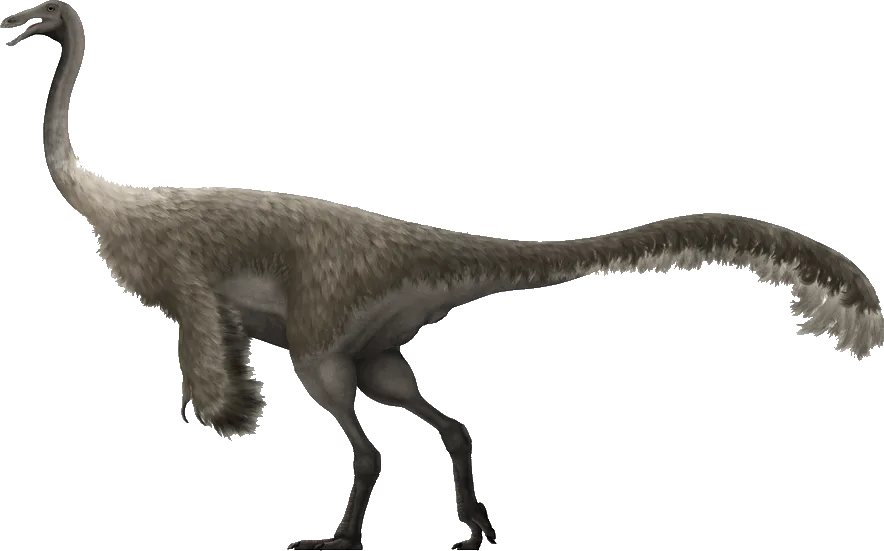
Gallimimus
TheropodLate CretaceousOmnivore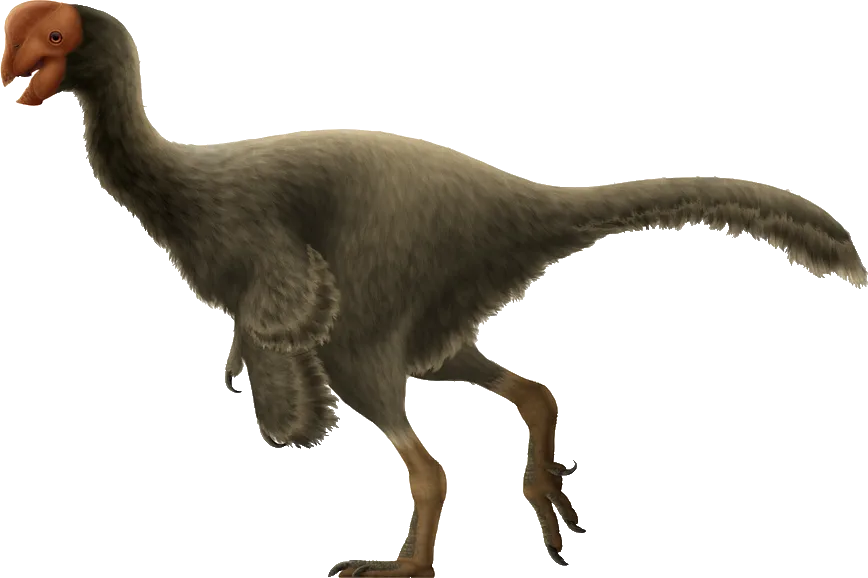
Oviraptor
TheropodLate CretaceousOmnivore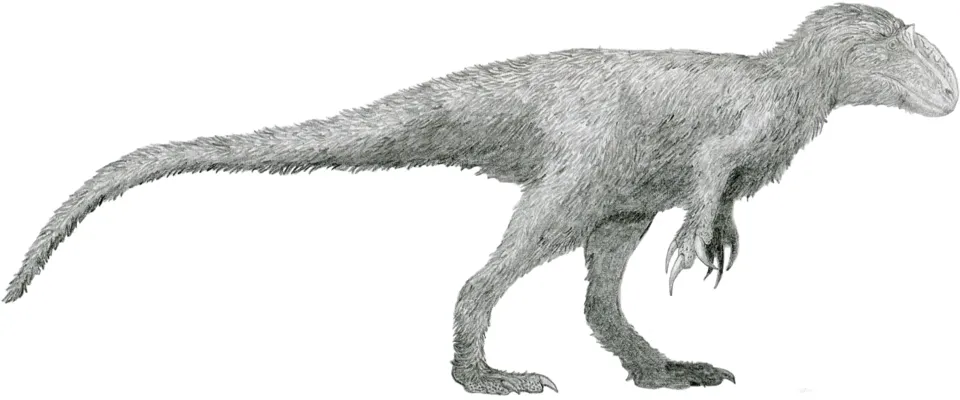
Yutyrannus
TheropodEarly CretaceousCarnivore
Sources
Media on this page
- Therizinosaurus NT.jpg — Nobu Tamura email:nobu.tamura@yahoo.com http://spinops.blogspot.com/ · CC BY-SA 4.0
- Fern in forest by I. Levitan (1895, N. Novgorod).jpg — Isaac Levitan · Public domain
- Therizinosaurus 3D model, shaped from the life reconstruction "Therizinosaurus NT.jpg" — Nobu Tamura email:nobu.tamura@yahoo.com http://spinops.blogspot.com/ (artwork); 3D shaping · CC BY-SA 4.0
- Therizinosaurus reconstructed call (synthesised) — DinoVerse (synthesised) · CC0 1.0
- Therizinosaurus arms.jpg — Yuya Tamai from Gifu, Japan · CC BY 2.0
- AMNH 6368 Therizinosaur.png — Charles Whitney Gilmore · Public domain
- Therizinosaur skeletons.jpg — Jaime A. Headden (User:Qilong) · CC BY 3.0
- Therizinosauroid embryo restoration.jpg — Pavel Riha (e-mail) · CC BY-SA 3.0