Gallimimus
Name means “Chicken mimic”
Gallimimus looked like a giant ostrich with a long tail. It was one of the fastest runners of the dinosaur world.
Gallimimus bullatus was the largest well-known ornithomimid, an 'ostrich-mimic' theropod from the Late Cretaceous Nemegt Formation of Mongolia. Its toothless beak, long neck and long, slender legs suggest a fast-running omnivore that ate a mix of plants and small animals.
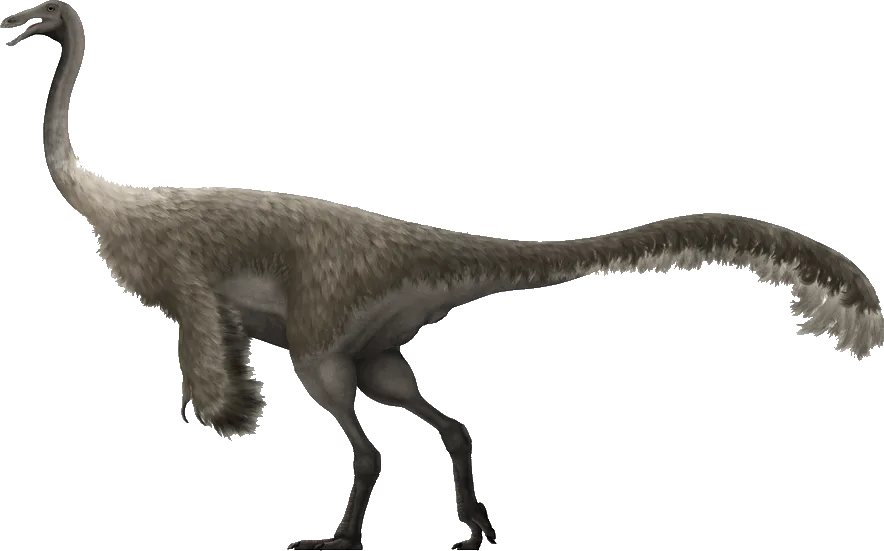
Gallimimus Restoration.png — PaleoNeolitic · CC BY 4.0
Pictures
Spin it in 3D
3D model description: a 3D model of Gallimimus shaped from a scientific life reconstruction painting, with the painting's colours and skin texture wrapped around it. It is not a scan of a real fossil.
About this model
This model is shaped from a scientific life reconstruction by PaleoNeolitic: the painting's outline gives the 3D body and the painting itself is its skin. It is sized to the real animal's length (about 5.5 m), so in AR it appears life-size!
It looks best from the side, like the painting it comes from. It is not a fossil scan — museums such as the Smithsonian 3D collection share real fossil scans you can explore.
What might it sound like?
Transcript: Hollow, goose-like honk followed by a deep booming hum, about 2 seconds
🤔 Nobody knows exactly how dinosaurs sounded
This is a scientific guess. Gallimimus was built much like an ostrich or emu, birds that boom and honk with their mouths closed. Because birds are living dinosaurs, scientists think many dinosaurs may have called in similar ways.
Voice boxes and soft tissue almost never fossilise, so sound reconstructions use clues: body size (bigger animals make lower sounds), the calls of living relatives (crocodiles boom with closed mouths; birds coo and hiss), and hollow structures such as hadrosaur crests that could have worked like a trumpet.
Sound: synthesised by DinoVerse from these scientific ideas (CC0). It is a creative guess, not a recording.
Food and habits
Omnivore
Eats plants and meat
How it ate
Pecked and snipped food with a long, toothless beak; it may also have swallowed stones to help grind tough plants in its gizzard, like an ostrich.
🔍 How do we know?
- toothless beak
- gizzard stones found with close relatives
- long neck and grasping hands suited to picking food
It ate…
- plants
- seeds
- insects
- small lizards
- small mammals
Gallimimus
…and was eaten by
- Tarbosaurus
Arrows show energy moving up the food chain: from food to eater.
Watch it walk
Quick facts
| 📏 Length | 5–6 m (16–20 ft) |
|---|---|
| ↕️ Height | 1.7–1.9 m (6 ft) |
| ⚖️ Weight | 400–490 kg (880–1,080 lb) |
| ⏳ When it lived | 71–69 million years ago (Late Cretaceous) |
| 📍 Fossils found | Nemegt Formation, Gobi Desert, Mongolia; Bugin Tsav, Gobi Desert, Mongolia |
| 🔎 Discovered | 1963 by Polish-Mongolian expedition (named by Halszka Osmólska, Ewa Roniewicz and Rinchen Barsbold in 1972) |
| 🧬 Group | Theropods — Saurischia › Theropoda |
Where scientists disagree, we show a range. Sizes are for adults.
How big was it?
Where and when
- 📍 Nemegt Formation, Gobi Desert, Mongolia (Asia)
- 📍 Bugin Tsav, Gobi Desert, Mongolia (Asia)
Lived 71–69 million years ago
That's about 70 million years before you were born! Humans have only existed for about 0.3 million years.
See it on the big timeline →Did you know?
- 1Gallimimus had no teeth, just a beak, like a bird.
- 2Its long legs made it super fast, maybe as fast as a racehorse.
- 3It was about as tall as a grown-up and as long as a car.
- 4Its name means 'chicken mimic', because its neck reminded scientists of a chicken's.
- The first fossils were collected in the 1960s by Polish-Mongolian expeditions, and in 1972 it was named for features of its neck vertebrae that resemble those of a chicken.
- Running speed estimates for ornithomimids vary, but their long lower legs and light build suggest top speeds in the range of large running birds.
- A 2001 study suggested comb-like structures inside the beak were used to filter food from water like a duck, but later work found they were more like the ridges in a turtle's or plant-eating bird's beak.
- Close relatives such as Ornithomimus are preserved with feathers, so Gallimimus was very likely feathered too, though direct feather fossils for it have not been found.
Myth vs fact
❌ MythGallimimus ran around in huge herds escaping big predators.
✅ FactSome related ornithomimids are found in groups, so herding is possible, but there is no direct fossil evidence of large Gallimimus herds.
Mini quiz
1. Which living bird does Gallimimus look most like?
2. What did Gallimimus have instead of teeth?
3. Which big predator lived alongside Gallimimus in Mongolia?
Related animals
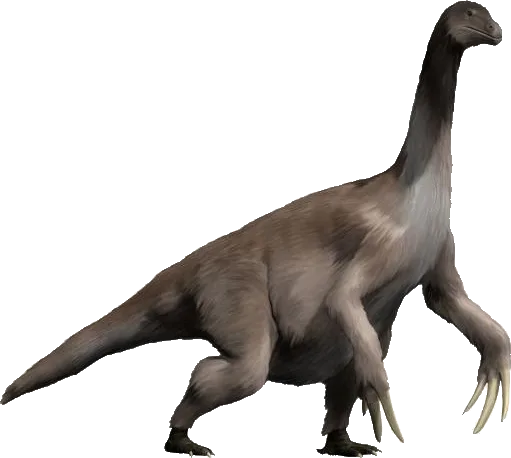
Therizinosaurus
TheropodLate CretaceousHerbivore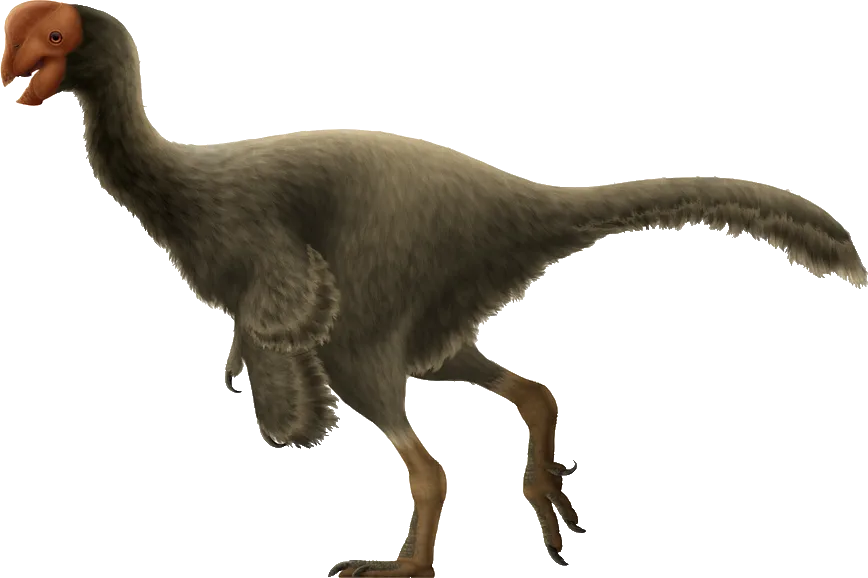
Oviraptor
TheropodLate CretaceousOmnivore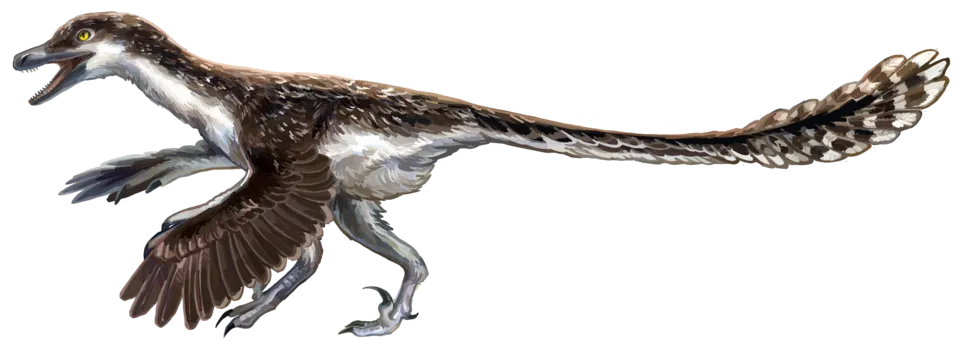
Velociraptor
TheropodLate CretaceousCarnivore
Sources
Media on this page
- Gallimimus Restoration.png — PaleoNeolitic · CC BY 4.0
- Fern in forest by I. Levitan (1895, N. Novgorod).jpg — Isaac Levitan · Public domain
- Gallimimus 3D model, shaped from the life reconstruction "Gallimimus Restoration.png" — PaleoNeolitic (artwork); 3D shaping by DinoVerse · CC BY 4.0
- Gallimimus reconstructed call (synthesised) — DinoVerse (synthesised) · CC0 1.0
- Gallimimus bullatus.001 - Natural History Museum of London.JPG — Fernando Losada Rodríguez · CC BY-SA 4.0
- Dinosauria - Gallimimus.jpg — Tylwyth Eldar · CC BY-SA 4.0
- Gallimimus.jpg — Mi:RO 4979 · Public domain
- Gallimimus Restoration.png — PaleoNeolitic · CC BY 4.0