Velociraptor
Name means “Swift thief”
Velociraptor was a fast, feathered hunter about the size of a big turkey. It had a sharp, curved claw on each foot.
Velociraptor was a small dromaeosaurid theropod from the Late Cretaceous deserts of Mongolia and northern China. Quill knobs on its forearm bones show it had large wing feathers, and its retractable sickle claw was probably used to pin and hold struggling prey.
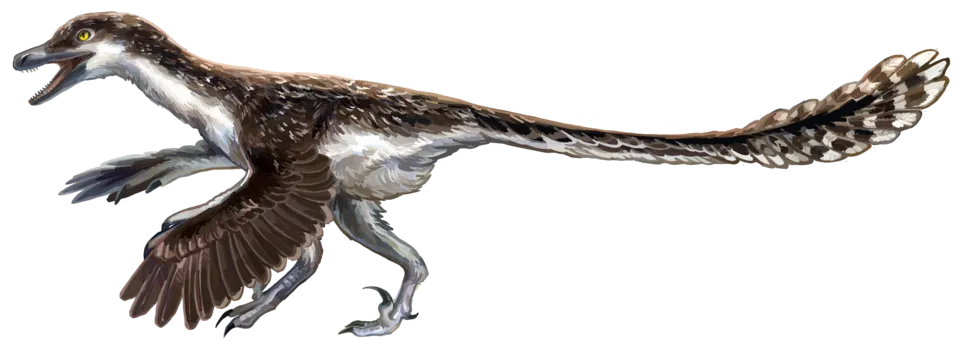
Velociraptor recon.png — Entelognathus · CC BY-SA 4.0
Pictures
Spin it in 3D
3D model description: a 3D model of Velociraptor shaped from a scientific life reconstruction painting, with the painting's colours and skin texture wrapped around it. It is not a scan of a real fossil.
About this model
This model is shaped from a scientific life reconstruction by Entelognathus: the painting's outline gives the 3D body and the painting itself is its skin. It is sized to the real animal's length (about 1.8 m), so in AR it appears life-size!
It looks best from the side, like the painting it comes from. It is not a fossil scan — museums such as the Smithsonian 3D collection share real fossil scans you can explore.
What might it sound like?
Transcript: Sharp, breathy hiss ending in a soft clicking chirp, about 2 seconds
🤔 Nobody knows exactly how dinosaurs sounded
This is a scientific guess. Velociraptor's closest living relatives are birds, and both birds and crocodiles hiss when threatened. A small body like Velociraptor's would make higher sounds than a giant like T. rex, but no one knows its true voice.
Voice boxes and soft tissue almost never fossilise, so sound reconstructions use clues: body size (bigger animals make lower sounds), the calls of living relatives (crocodiles boom with closed mouths; birds coo and hiss), and hollow structures such as hadrosaur crests that could have worked like a trumpet.
Sound: synthesised by DinoVerse from these scientific ideas (CC0). It is a creative guess, not a recording.
Food and habits
Carnivore
Meat-eater
How it ate
Pinned smaller prey down with its feet and big curved toe claw, then tore off bites with its narrow jaws full of small, hooked, serrated teeth.
It ate…
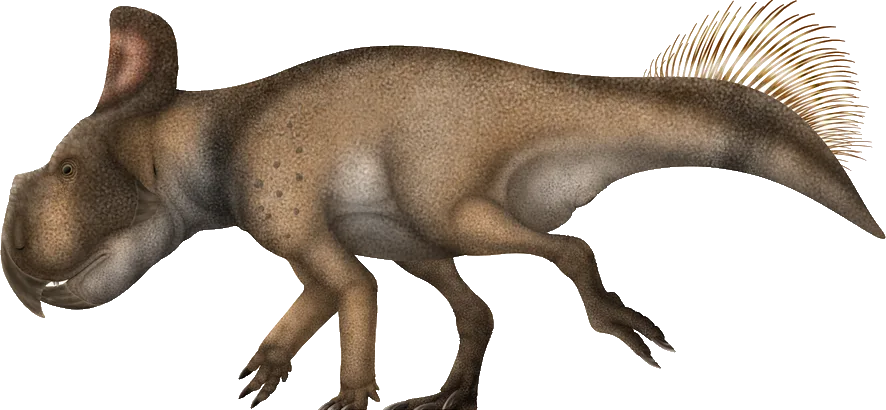 Protoceratops
- small mammals
- lizards
- baby dinosaurs
- pterosaurs (scavenged)
Velociraptor
…and was eaten by
👑 Probably nothing, once fully grown — a top predator or too big to tackle!
Arrows show energy moving up the food chain: from food to eater.
Watch it walk
Quick facts
| 📏 Length | 1.5–2 m (5–7 ft) |
|---|---|
| ↕️ Height | 0.5–0.6 m (2 ft) |
| ⚖️ Weight | 15–20 kg (30–40 lb) |
| ⏳ When it lived | 75–71 million years ago (Late Cretaceous) |
| 📍 Fossils found | Djadochta Formation, Bayanzag (Flaming Cliffs), Mongolia; Tugrikin Shireh, Gobi Desert, Mongolia; Bayan Mandahu, Inner Mongolia, China |
| 🔎 Discovered | 1923 by Peter Kaisen (American Museum of Natural History expedition) |
| 🧬 Group | Theropods — Saurischia › Theropoda |
Where scientists disagree, we show a range. Sizes are for adults.
How big was it?
Where and when
- 📍 Djadochta Formation, Bayanzag (Flaming Cliffs), Mongolia (Asia)
- 📍 Tugrikin Shireh, Gobi Desert, Mongolia (Asia)
- 📍 Bayan Mandahu, Inner Mongolia, China (Asia)
Lived 75–71 million years ago
That's about 73 million years before you were born! Humans have only existed for about 0.3 million years.
See it on the big timeline →Did you know?
- 1Velociraptor was about as tall as your knee, not as tall as a person!
- 2It had feathers, and even had little bumps on its arms where big wing feathers grew.
- 3Each foot had one giant curved claw that it held up off the ground so it stayed sharp.
- 4One famous fossil shows a Velociraptor and a Protoceratops frozen in the middle of a fight!
- In 2007 researchers found quill knobs on a Velociraptor ulna, the attachment points for large feathers, showing it had well-developed wing feathers even though it could not fly.
- The 'Fighting Dinosaurs' specimen, found in 1971, preserves a Velociraptor with its sickle claw in a Protoceratops's neck while the Protoceratops bites its arm; both were probably buried by a collapsing sand dune or sandstorm.
- Studies of the sickle claw suggest it was not a slashing blade but a gripping hook, used like the talons of a hawk to pin prey while the predator fed (the 'raptor prey restraint' model).
- Whether Velociraptor hunted in groups is debated: there is no direct fossil evidence of pack hunting, and many scientists now think dromaeosaurs behaved more like squabbling modern birds or Komodo dragons than coordinated wolves.
Myth vs fact
❌ MythVelociraptor was taller than a person and had scaly skin.
✅ FactReal Velociraptor was turkey-sized, about half a metre tall at the hip, and covered in feathers. The giant film 'raptors' were based more on its bigger relative Deinonychus.
❌ MythVelociraptor was a genius that could open doors.
✅ FactIts brain was fairly large for a dinosaur, similar to some birds, but there is no evidence it was unusually intelligent.
Mini quiz
1. About how big was a real Velociraptor?
2. What covered Velociraptor's body?
3. In which country have most Velociraptor fossils been found?
Related animals
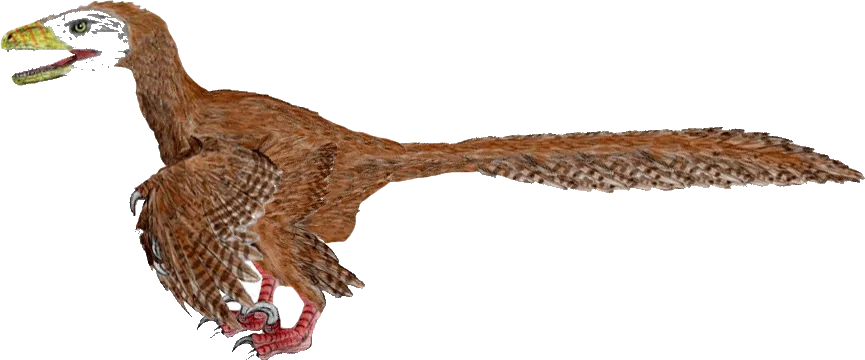
Deinonychus
TheropodEarly CretaceousCarnivore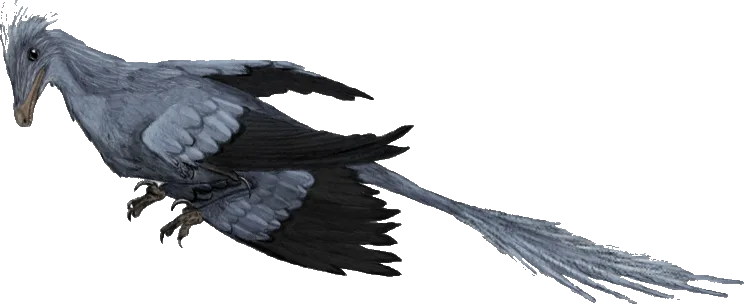
Microraptor
TheropodEarly CretaceousCarnivoreProtoceratops
CeratopsianLate CretaceousHerbivore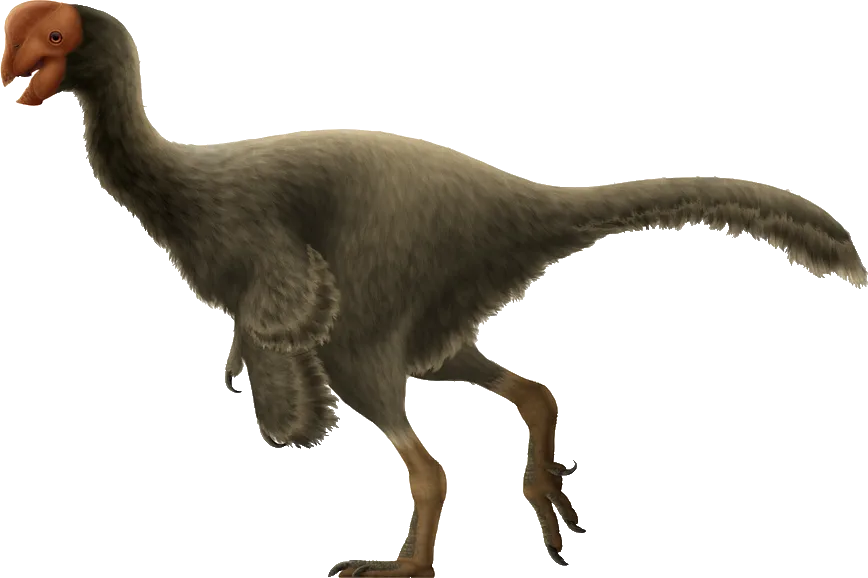
Oviraptor
TheropodLate CretaceousOmnivore
Sources
Media on this page
- Velociraptor recon.png — Entelognathus · CC BY-SA 4.0
- Fern in forest by I. Levitan (1895, N. Novgorod).jpg — Isaac Levitan · Public domain
- Velociraptor 3D model, shaped from the life reconstruction "Velociraptor recon.png" — Entelognathus (artwork); 3D shaping by DinoVerse · CC BY-SA 4.0
- Velociraptor reconstructed call (synthesised) — DinoVerse (synthesised) · CC0 1.0
- Velociraptor skeleton white background.jpg — Eduard Solà Vázquez · CC BY 3.0
- Dinosaur Input Device Velociraptor.jpg — Matt Mechtley from Heidelberg, Deutschland · CC BY-SA 2.0
- Velociraptor.jpg — Jaime A. Headden (User:Qilong) · CC BY 3.0
- Velociraptor MPC-D 100 25 skull.png — Rinchen Barsbold & Halszka Osmólska · CC BY 4.0