Yutyrannus
Name means “Feathered tyrant”
Yutyrannus was a big, fluffy meat-eater covered in long feathers. It is the largest animal ever found with fossil feathers on its body.
Yutyrannus huali was a large tyrannosauroid theropod from the Early Cretaceous of northeastern China, known from three skeletons preserved with long, filament-like feathers. Its discovery showed that feather coats were not limited to small dinosaurs, perhaps helping it keep warm in a cool climate.
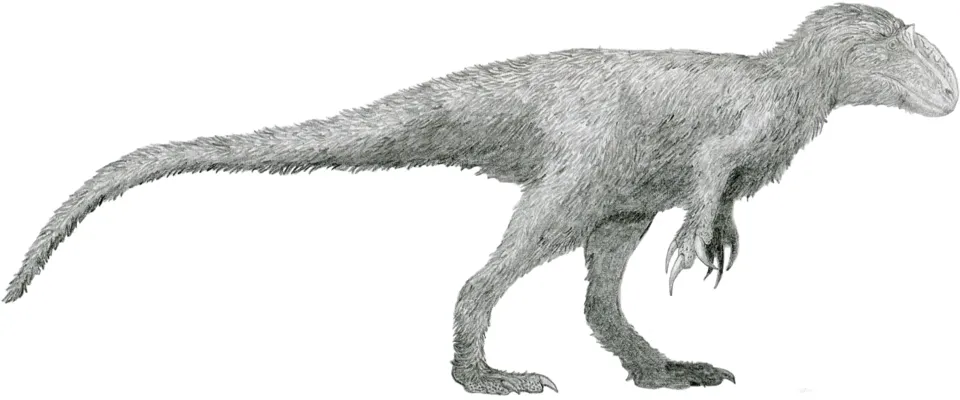
Yutyrannus huali.png — Tomopteryx · CC BY-SA 4.0
Pictures
Spin it in 3D
3D model description: a smooth, rounded model of Yutyrannus built from the DinoVerse illustration, showing its overall body shape and proportions. It is not a scan of a real fossil.
About this model
This is a simplified body-shape model, sized to the real animal's length (about 8.3 m). In AR it appears life-size!
It looks best from the side, like the painting it comes from. It is not a fossil scan — museums such as the Smithsonian 3D collection share real fossil scans you can explore.
What might it sound like?
Transcript: Low, purring growl that swells into a deep rumble, about 3 seconds
🤔 Nobody knows exactly how dinosaurs sounded
This is a scientific guess. Yutyrannus was a large animal, so its voice was probably deep, and its living relatives, birds and crocodiles, often make low closed-mouth growls and booms. No direct evidence of its sound exists.
Voice boxes and soft tissue almost never fossilise, so sound reconstructions use clues: body size (bigger animals make lower sounds), the calls of living relatives (crocodiles boom with closed mouths; birds coo and hiss), and hollow structures such as hadrosaur crests that could have worked like a trumpet.
Sound: synthesised by DinoVerse from these scientific ideas (CC0). It is a creative guess, not a recording.
Food and habits
Carnivore
Meat-eater
How it ate
Bit into prey with a long, deep skull and serrated teeth, and could grab with three-fingered hands that were much longer than those of later tyrannosaurs.
🔍 How do we know?
- serrated, blade-like teeth
- large predator body plan
- plant-eating dinosaurs found in the same rocks
It ate…
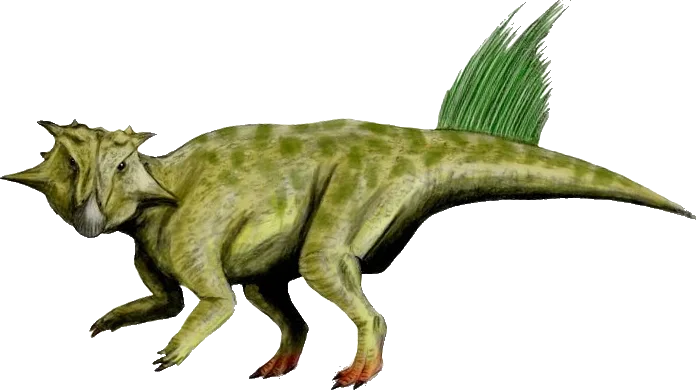 Psittacosaurus
- Dongbeititan
- ornithopods
- small feathered dinosaurs
Yutyrannus
…and was eaten by
👑 Probably nothing, once fully grown — a top predator or too big to tackle!
Arrows show energy moving up the food chain: from food to eater.
Watch it call
Quick facts
| 📏 Length | 7.5–9 m (25–30 ft) |
|---|---|
| ↕️ Height | 2.5–3 m (8–10 ft) |
| ⚖️ Weight | 1,100–1,400 kg (2,430–3,090 lb) |
| ⏳ When it lived | 126–122 million years ago (Early Cretaceous) |
| 📍 Fossils found | Yixian Formation, Liaoning Province, China |
| 🔎 Discovered | 2012 by Xu Xing and colleagues (described from three specimens) |
| 🧬 Group | Theropods — Saurischia › Theropoda |
Where scientists disagree, we show a range. Sizes are for adults.
How big was it?
Where and when
- 📍 Yixian Formation, Liaoning Province, China (Asia)
Lived 126–122 million years ago
That's about 124 million years before you were born! Humans have only existed for about 0.3 million years.
See it on the big timeline →Did you know?
- 1Yutyrannus was covered in long, fluffy feathers, like a giant bird.
- 2It was as long as a bus and weighed about as much as a car.
- 3Its feathers were longer than a pencil.
- 4It was a cousin of T. rex, but lived about 60 million years earlier.
- Its feathers were simple filaments up to about 15 to 20 centimetres long, preserved on the neck, hips, arms and tail of different specimens.
- At around 1.1 to 1.4 tonnes, it is the largest animal known with direct fossil evidence of feathers.
- Climate studies suggest the Yixian Formation had relatively cool average temperatures, which may explain why a large animal kept an insulating coat.
- It was described as an early tyrannosauroid, but some recent analyses find its exact position uncertain, so its relationship to T. rex is still being tested.
- Three specimens of different ages were found together, which has led to suggestions that it lived or died in groups, though this is not certain.
Myth vs fact
❌ MythYutyrannus proves that T. rex was covered in feathers too.
✅ FactNot quite. Skin patches from adult T. rex show scales, so big tyrannosaurs from warmer times may have lost most of their feathers.
Mini quiz
1. What covered Yutyrannus's body?
2. Which famous dinosaur was a cousin of Yutyrannus?
3. In which country was Yutyrannus found?
Related animals
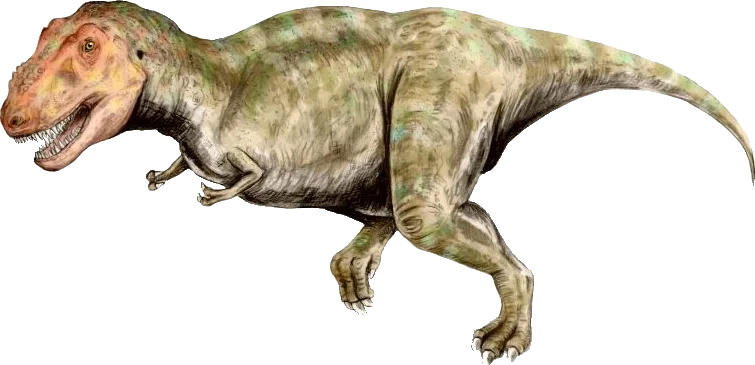
Tyrannosaurus rex
TheropodLate CretaceousCarnivorePsittacosaurus
CeratopsianEarly CretaceousHerbivore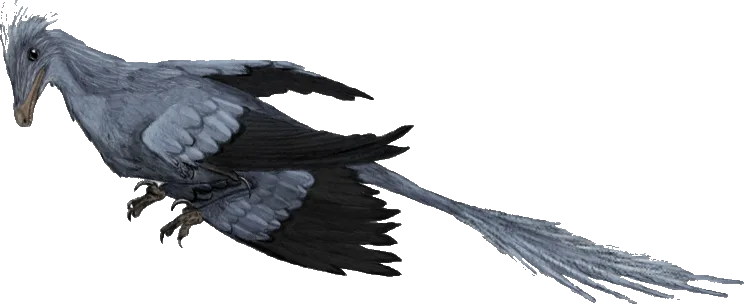
Microraptor
TheropodEarly CretaceousCarnivore
Media on this page
- Yutyrannus huali.png — Tomopteryx · CC BY-SA 4.0
- Fern in forest by I. Levitan (1895, N. Novgorod).jpg — Isaac Levitan · Public domain
- Yutyrannus simplified 3D model — DinoVerse (generated from original artwork) · CC0 1.0
- Yutyrannus reconstructed call (synthesised) — DinoVerse (synthesised) · CC0 1.0
- Laika ac Dino Kingdom 2012 (7882288828).jpg — Laika ac from USA · CC BY-SA 2.0
- Dongbeititan and Yutyrannus.jpg — PaleoEquii · CC BY-SA 4.0
- Fig 6 yutyrannus.png — Zhiheng Li, Zhonghe Zhou, and Julia A. Clarke · CC BY 4.0
- Yutyrannus TD.png — TotalDino · CC BY 4.0