Psittacosaurus
Name means “Parrot lizard”
Psittacosaurus was a small dinosaur with a beak like a parrot and bristles on its tail. It was an early cousin of Triceratops.
Psittacosaurus was a small, mostly two-legged early ceratopsian from Early Cretaceous Asia. With more than ten named species and hundreds of specimens, it is one of the most species-rich dinosaur genera, and exceptional fossils preserve its skin, tail bristles and even colour patterns.
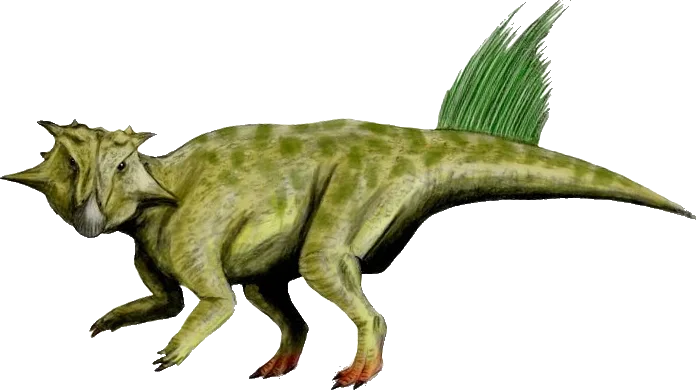
Psittacosaurus sibiricus whole BW.jpg — Nobu Tamura (http://spinops.blogspot.com) · CC BY 3.0
Pictures
Spin it in 3D
3D model description: a 3D model of Psittacosaurus shaped from a scientific life reconstruction painting, with the painting's colours and skin texture wrapped around it. It is not a scan of a real fossil.
About this model
This model is shaped from a scientific life reconstruction by Nobu Tamura (http://spinops.blogspot.com): the painting's outline gives the 3D body and the painting itself is its skin. It is sized to the real animal's length (about 1.8 m), so in AR it appears life-size!
It looks best from the side, like the painting it comes from. It is not a fossil scan — museums such as the Smithsonian 3D collection share real fossil scans you can explore.
What might it sound like?
Transcript: Soft, high-pitched grunting chirps
🤔 Nobody knows exactly how dinosaurs sounded
This is a scientific guess. Smaller animals usually make higher sounds, and living relatives like birds and crocodiles make short grunts and calls, so a dog-sized Psittacosaurus probably had a fairly high, short voice.
Voice boxes and soft tissue almost never fossilise, so sound reconstructions use clues: body size (bigger animals make lower sounds), the calls of living relatives (crocodiles boom with closed mouths; birds coo and hiss), and hollow structures such as hadrosaur crests that could have worked like a trumpet.
Sound: synthesised by DinoVerse from these scientific ideas (CC0). It is a creative guess, not a recording.
Food and habits
Herbivore
Plant-eater
How it ate
Cracked and sliced tough plants with a powerful, parrot-like beak, then swallowed small stones (gastroliths) that helped grind the food in its gut.
🔍 How do we know?
- gastroliths in the belly area
- beak shape and bite strength
- self-sharpening teeth
Arrows show energy moving up the food chain: from food to eater.
Watch it walk
Quick facts
| 📏 Length | 1.5–2 m (5–7 ft) |
|---|---|
| ↕️ Height | 0.5–0.7 m (2 ft) |
| ⚖️ Weight | 10–37 kg (20–80 lb) |
| ⏳ When it lived | 126–101 million years ago (Early Cretaceous) |
| 📍 Fossils found | Yixian Formation, Liaoning, China; Öösh, Övörkhangai Province, Mongolia; Shestakovo, Kemerovo Oblast, Russia |
| 🔎 Discovered | 1923 by Henry Fairfield Osborn (fossils found by the AMNH Central Asiatic Expedition in 1922) |
| 🧬 Group | Ceratopsians — Ornithischia › Marginocephalia › Ceratopsia |
Where scientists disagree, we show a range. Sizes are for adults.
How big was it?
Where and when
- 📍 Yixian Formation, Liaoning, China (Asia)
- 📍 Öösh, Övörkhangai Province, Mongolia (Asia)
- 📍 Shestakovo, Kemerovo Oblast, Russia (Asia)
Lived 126–101 million years ago
That's about 114 million years before you were born! Humans have only existed for about 0.3 million years.
See it on the big timeline →Did you know?
- 1Psittacosaurus had a beak just like a parrot!
- 2It had long bristles sticking up from its tail like a brush.
- 3It swallowed stones to help mash up food in its tummy.
- 4Babies walked on four legs, but grown-ups walked on two.
- A specimen in Germany's Senckenberg Museum preserves skin pigment showing countershading — darker above and lighter below — which suggests it lived in dim, forested habitats where this pattern hides animals best.
- The same specimen has a row of long, quill-like bristles on the top of its tail; whether these are related to the feathers of theropods is still debated.
- Bone studies show that hatchlings walked on all fours and switched to walking on two legs as they grew, a change rarely documented so clearly in any dinosaur.
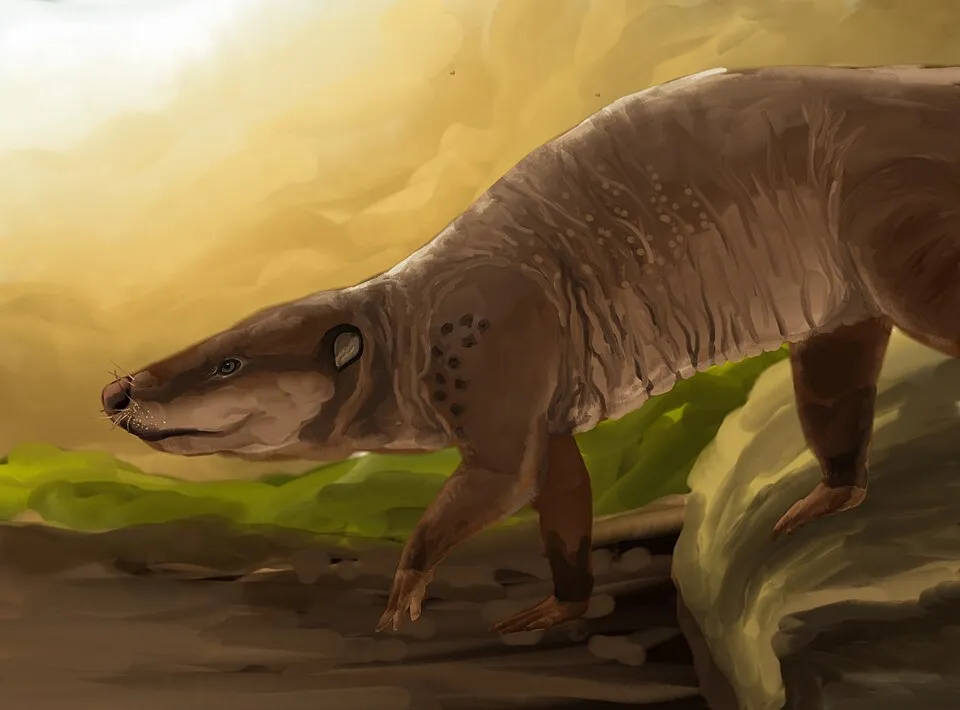
- A fossil of the mammal Repenomamus with baby Psittacosaurus bones in its stomach, and a 2023 fossil of Repenomamus caught attacking a Psittacosaurus bigger than itself, prove that some mammals preyed on dinosaurs.
Myth vs fact
❌ MythDinosaurs were never eaten by mammals.
✅ FactFossils from China show the badger-sized mammal Repenomamus ate young Psittacosaurus.
Mini quiz
1. What does 'Psittacosaurus' mean?
2. What did Psittacosaurus swallow to help grind its food?
3. Which mammal is known to have eaten baby Psittacosaurus?
Related animals
 Not a dinosaur
Repenomamus
MammalEarly CretaceousCarnivore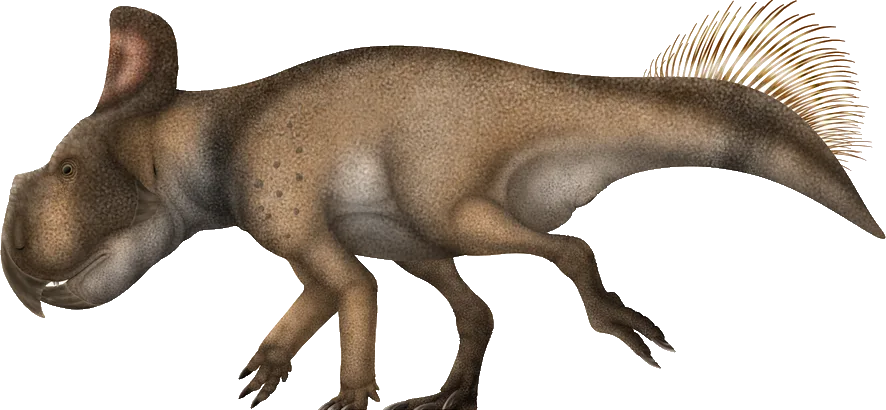
Protoceratops
CeratopsianLate CretaceousHerbivore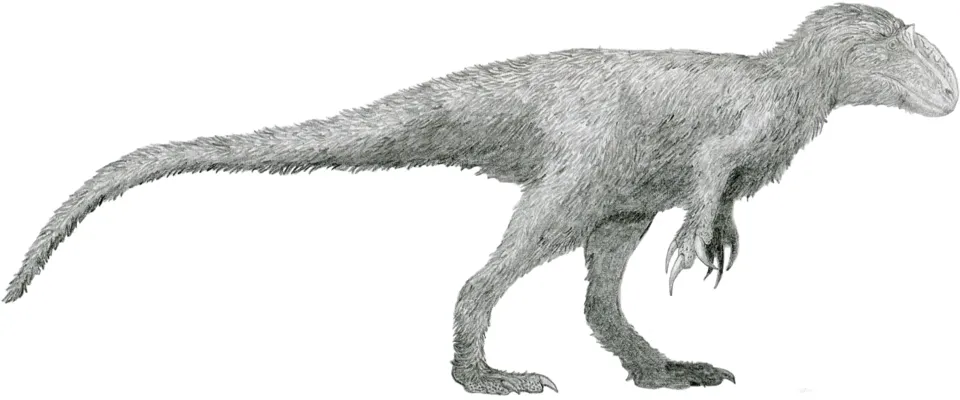
Yutyrannus
TheropodEarly CretaceousCarnivore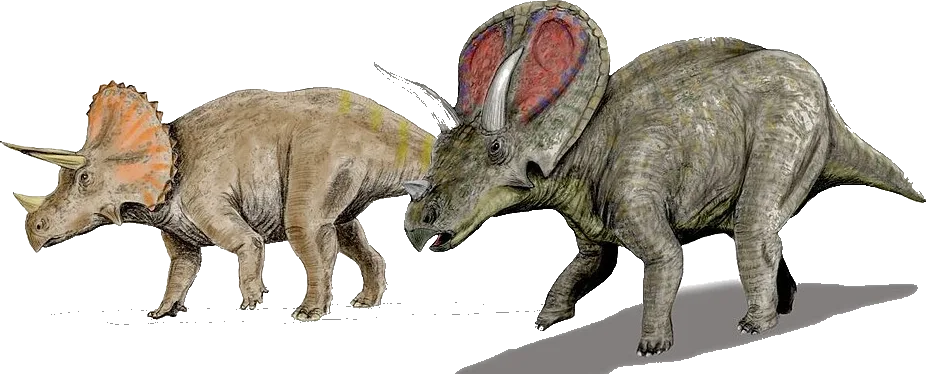
Triceratops
CeratopsianLate CretaceousHerbivore
Sources
Media on this page
- Psittacosaurus sibiricus whole BW.jpg — Nobu Tamura (http://spinops.blogspot.com) · CC BY 3.0
- Fern in forest by I. Levitan (1895, N. Novgorod).jpg — Isaac Levitan · Public domain
- Psittacosaurus 3D model, shaped from the life reconstruction "Psittacosaurus sibiricus whole BW.jpg" — Nobu Tamura (http://spinops.blogspot.com) (artwork); 3D shaping by DinoVerse · CC BY 3.0
- Psittacosaurus reconstructed call (synthesised) — DinoVerse (synthesised) · CC0 1.0
- The Childrens Museum of Indianapolis - Psittacosaurus skeleton cast.jpg — Unknown (see source) · CC BY-SA 3.0
- Dinosaurium, Psittacosaurus mongoliensis.jpg — Radim Holiš · CC BY-SA 3.0 cz
- Machurochelys liaoxiensis and Psittacosaurus.jpg — Christopher, Tania and Isabelle Luna · CC BY 2.0
- Psittacosaurus (Vinther et al. 2016, cropped).png — Vinther et al. · CC BY 4.0