Pteranodon
Name means “Toothless wing”
🚫 Not a dinosaur!
Pteranodon was a pterosaur, a flying reptile. Pterosaurs were close cousins of dinosaurs, but their legs did not sit straight under the body in the dinosaur way and they evolved on a separate branch — so they are not dinosaurs and not the ancestors of birds.
Pteranodon was a giant flying reptile with wings wider than a car is long and a big pointy crest on its head. It was not a dinosaur!
Pteranodon was a large pterosaur that soared over the Western Interior Seaway of North America, with a wingspan of about 5–7 m in big males. Over a thousand specimens show clear differences between large-crested males and smaller, small-crested females.
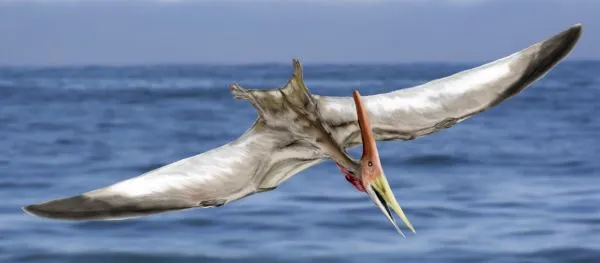
Pteranodon NT.jpg — NobuTamura email:nobu.tamura@yahoo.com www.palaeoc · CC BY-SA 3.0
Pictures
Spin it in 3D
3D model description: a smooth, rounded model of Pteranodon built from the DinoVerse illustration, showing its overall body shape and proportions. It is not a scan of a real fossil.
About this model
This is a simplified body-shape model, sized to the real animal's length (about 6.0 m). In AR it appears life-size!
It looks best from the side, like the painting it comes from. It is not a fossil scan — museums such as the Smithsonian 3D collection share real fossil scans you can explore.
What might it sound like?
Transcript: Raspy hissing call, like a big seabird
🤔 Nobody knows exactly how dinosaurs sounded
This is a scientific guess. No pterosaur voice organ has fossilised. Their living relatives, crocodiles and birds, hiss, croak and call, and big seabirds with similar lifestyles make harsh, raspy sounds.
Voice boxes and soft tissue almost never fossilise, so sound reconstructions use clues: body size (bigger animals make lower sounds), the calls of living relatives (crocodiles boom with closed mouths; birds coo and hiss), and hollow structures such as hadrosaur crests that could have worked like a trumpet.
Sound: synthesised by DinoVerse from these scientific ideas (CC0). It is a creative guess, not a recording.
Food and habits
Piscivore
Fish-eater
How it ate
Soared over the sea and snatched fish from near the surface with its long, toothless beak, possibly diving or sitting on the water to fish, and swallowed prey whole.
🔍 How do we know?
- fish bones and scales found with a skeleton
- long, toothless beak like fish-eating birds
- fossils found in sea rocks far from shore
It ate…
- fish
- squid-like cephalopods
Pteranodon
…and was eaten by
- Cretoxyrhina (ginsu shark)
- Tylosaurus
Arrows show energy moving up the food chain: from food to eater.
Watch it fly
Quick facts
| 📏 Wingspan | 5–7 m (16–23 ft) |
|---|---|
| ↕️ Height | 1.5–1.8 m (5–6 ft) |
| ⚖️ Weight | 20–50 kg (40–110 lb) |
| ⏳ When it lived | 86–84 million years ago (Late Cretaceous) |
| 📍 Fossils found | Smoky Hill Chalk, Niobrara Formation, western Kansas, USA; Pierre Shale, South Dakota, USA; Wyoming, USA |
| 🔎 Discovered | 1870 by Othniel Charles Marsh (named in 1876) |
| 🧬 Group | Pterosaurs — Archosauria › Avemetatarsalia › Pterosauria |
Where scientists disagree, we show a range. Sizes are for adults.
How big was it?
Where and when
- 📍 Smoky Hill Chalk, Niobrara Formation, western Kansas, USA (North America)
- 📍 Pierre Shale, South Dakota, USA (North America)
- 📍 Wyoming, USA (North America)
Lived 86–84 million years ago
That's about 85 million years before you were born! Humans have only existed for about 0.3 million years.
See it on the big timeline →Did you know?
- 1Pteranodon's wings stretched wider than a big car is long!
- 2Its name means 'toothless wing' because it had no teeth at all.
- 3Its wings were made of skin stretched from one super-long finger to its legs.
- 4Pteranodon is often called a 'pterodactyl', but that's really the name of a different, smaller pterosaur.
- Adults fall into two size classes: larger individuals with big crests and narrow hips, and smaller ones with tiny crests and wider hips, interpreted as males and females — evidence that crests were display structures.
- Its wingspan figures here (about 5–7 m) are wingspans, not body length; the body itself was small and lightweight, with hollow, air-filled bones.
- Studies of pterosaur limbs suggest Pteranodon launched into the air using all four limbs in a powerful vault, with the arms doing most of the work.
- A Pteranodon neck bone with a Cretoxyrhina shark tooth stuck in it shows these sharks bit pterosaurs, either as live prey or carcasses floating at sea.
Myth vs fact
❌ MythPteranodon was a flying dinosaur.
✅ FactPteranodon was a pterosaur, a flying reptile on a separate branch from dinosaurs.
❌ MythPterosaurs like Pteranodon were the ancestors of birds.
✅ FactBirds evolved from small feathered theropod dinosaurs; pterosaurs died out 66 million years ago and left no descendants.
Mini quiz
1. Is Pteranodon a dinosaur?
2. What does 'Pteranodon' mean?
3. What did Pteranodon mostly eat?
Related animals
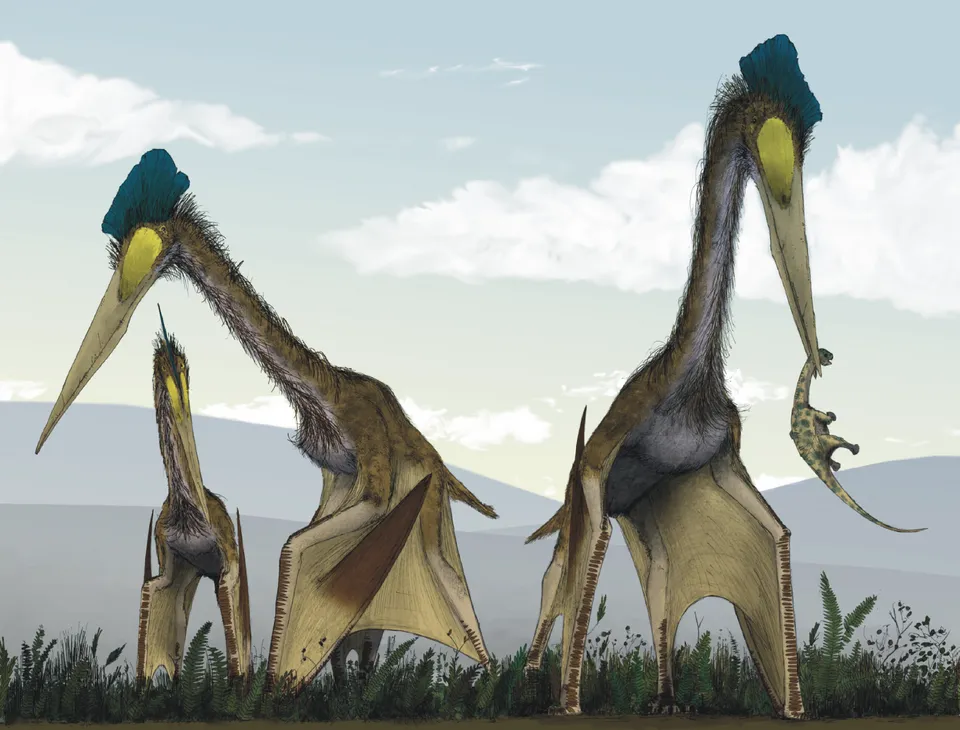 Not a dinosaur
Quetzalcoatlus
PterosaurLate CretaceousCarnivore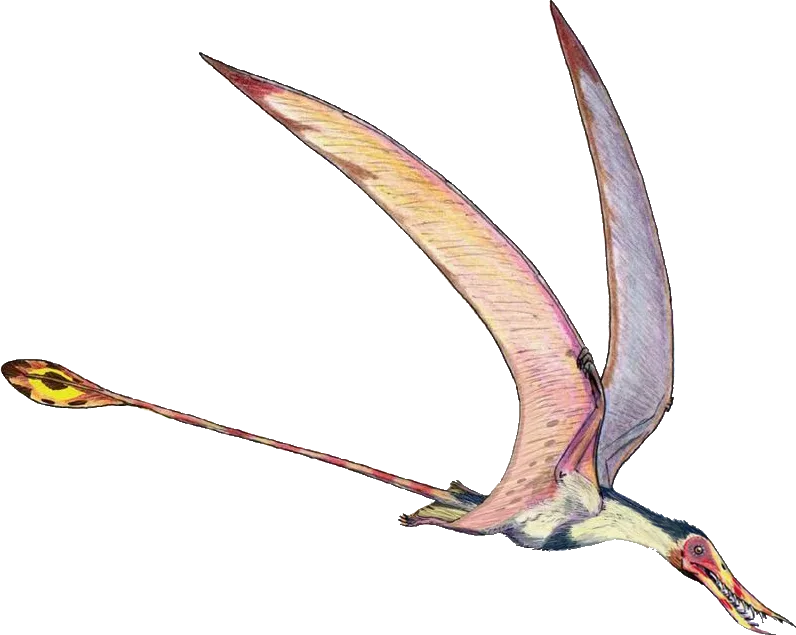 Not a dinosaur
Rhamphorhynchus
PterosaurLate JurassicPiscivore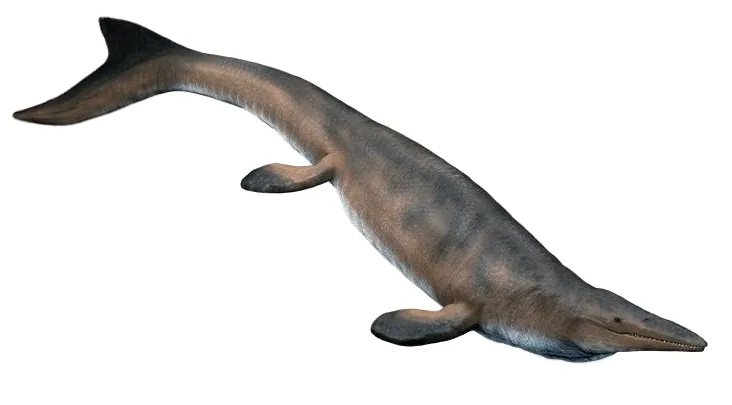 Not a dinosaur
Mosasaurus
MosasaurLate CretaceousCarnivore
Archaeopteryx
TheropodLate JurassicCarnivore
Media on this page
- Pteranodon NT.jpg — NobuTamura email:nobu.tamura@yahoo.com www.palaeocritti.com · CC BY-SA 3.0
- Cumulus Clouds over Yellow Prairie2.jpg — Wing-Chi Poon, colors adjusted by Kjetil r · CC BY-SA 2.5
- Pteranodon simplified 3D model — DinoVerse (generated from original artwork) · CC0 1.0
- Pteranodon reconstructed call (synthesised) — DinoVerse (synthesised) · CC0 1.0
- Pteranodon amnh martyniuk.jpg — Matt Martyniuk · CC BY 3.0
- Old Pteranodon mount.jpg — Unknown authorUnknown author · Public domain
- Pteranodon AMNH.jpg — Jonathan Chen · CC BY-SA 4.0
- Pteranodon choking on fish - Pterosaurs Flight in the Age of Dinosaurs.jpg — Tim Evanson · CC BY-SA 2.0