Archaeopteryx
Name means “Ancient wing”
Archaeopteryx was a feathered dinosaur the size of a crow, with wings, teeth and a long bony tail. It is one of the earliest birds ever found.
Archaeopteryx is a Late Jurassic avialan dinosaur from southern Germany, combining bird-like feathered wings with teeth, clawed fingers and a long bony tail. Described just two years after Darwin's 'On the Origin of Species', it became a classic example of a transitional fossil linking non-avian dinosaurs and birds.
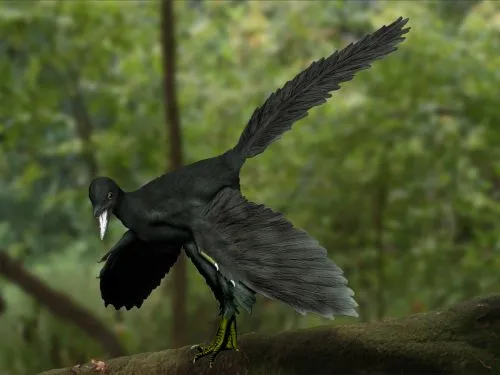
Archaeopteryx NT.jpg — NobuTamura http://paleoexhibit.blogspot.com/ http: · CC BY-SA 3.0
Pictures
Spin it in 3D
3D model description: a smooth, rounded model of Archaeopteryx built from the DinoVerse illustration, showing its overall body shape and proportions. It is not a scan of a real fossil.
About this model
This is a simplified body-shape model, sized to the real animal's length (about 0.5 m). In AR it appears life-size!
It looks best from the side, like the painting it comes from. It is not a fossil scan — museums such as the Smithsonian 3D collection share real fossil scans you can explore.
What might it sound like?
Transcript: Short, scratchy chirps and a quick squawk, about 1.5 seconds
🤔 Nobody knows exactly how dinosaurs sounded
This is a scientific guess. Archaeopteryx was a small early bird, but the voice box that lets modern birds sing evolved later. It may have made simple chirps, squawks or hisses like other small dinosaurs and young crocodiles.
Voice boxes and soft tissue almost never fossilise, so sound reconstructions use clues: body size (bigger animals make lower sounds), the calls of living relatives (crocodiles boom with closed mouths; birds coo and hiss), and hollow structures such as hadrosaur crests that could have worked like a trumpet.
Sound: synthesised by DinoVerse from these scientific ideas (CC0). It is a creative guess, not a recording.
Food and habits
Carnivore
Meat-eater
How it ate
Snapped up insects and small animals with a beak-like snout full of small, sharp teeth, possibly using its clawed fingers to help hold food.
🔍 How do we know?
- small, pointed, unserrated teeth
- clawed fingers able to grasp
- small body size and lagoon-island habitat
It ate…
- insects
- small lizards
- small fish
- other small animals
Archaeopteryx
…and was eaten by
👑 Probably nothing, once fully grown — a top predator or too big to tackle!
Arrows show energy moving up the food chain: from food to eater.
Watch it walk
Quick facts
| 📏 Length | 0.4–0.5 m (1–2 ft) |
|---|---|
| ↕️ Height | 0.2–0.3 m (1 ft) |
| ⚖️ Weight | 0.5–1 kg (1.1–2.2 lb) |
| ⏳ When it lived | 151–148 million years ago (Late Jurassic) |
| 📍 Fossils found | Solnhofen limestone, near Eichstätt, Bavaria, Germany; Langenaltheim, Bavaria, Germany |
| 🔎 Discovered | 1861 by Hermann von Meyer (named from a single feather and the London specimen) |
| 🧬 Group | Theropods — Saurischia › Theropoda |
Where scientists disagree, we show a range. Sizes are for adults.
How big was it?
Where and when
- 📍 Solnhofen limestone, near Eichstätt, Bavaria, Germany (Europe)
- 📍 Langenaltheim, Bavaria, Germany (Europe)
Lived 151–148 million years ago
That's about 150 million years before you were born! Humans have only existed for about 0.3 million years.
See it on the big timeline →Did you know?
- 1Archaeopteryx is a dinosaur AND an early bird, both at once!
- 2It had feathers and wings like a bird, but also teeth and a long bony tail like other dinosaurs.
- 3It was about the size of a crow or a magpie.
- 4The very first clue to Archaeopteryx was a single fossil feather found in 1861.
- Around a dozen skeletons are known, all from the fine-grained Solnhofen limestones of Bavaria, which preserved even the outlines of its feathers.
- Its feathers were asymmetric like those of modern flying birds, and most researchers think it could fly at least in short bursts, though how well it flapped is still debated.
- A study of melanosomes in the isolated 1861 feather suggested it was black or dark, although the exact colour pattern of the whole animal remains uncertain.
- Phylogenetic studies have sometimes placed Archaeopteryx closer to deinonychosaurs like Velociraptor than to modern birds; most still treat it as an early avialan, but the debate shows how blurry the line between birds and other dinosaurs is.
Myth vs fact
❌ MythArchaeopteryx was a 'missing link' halfway between reptiles and birds, and not really a dinosaur.
✅ FactBirds are dinosaurs, and Archaeopteryx is a feathered dinosaur near the base of the bird family tree.
❌ MythArchaeopteryx was the direct ancestor of all modern birds.
✅ FactIt is an early relative of birds, but probably a side branch rather than the great-great-grandparent of every bird alive today.
Mini quiz
1. Which of these did Archaeopteryx have?
2. What was the first Archaeopteryx fossil ever found?
3. Is Archaeopteryx a dinosaur?
Related animals
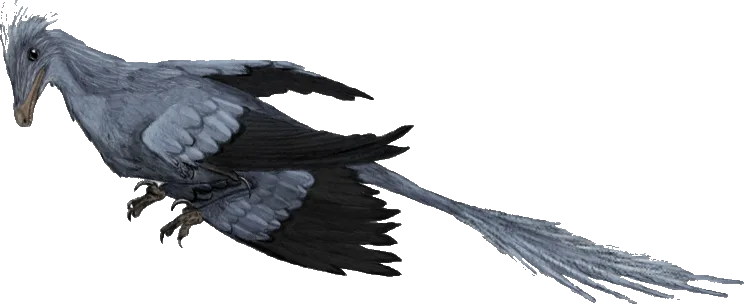
Microraptor
TheropodEarly CretaceousCarnivore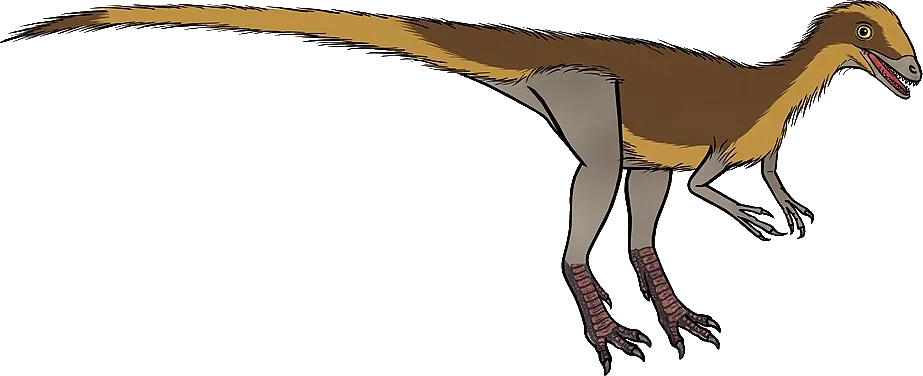
Compsognathus
TheropodLate JurassicCarnivore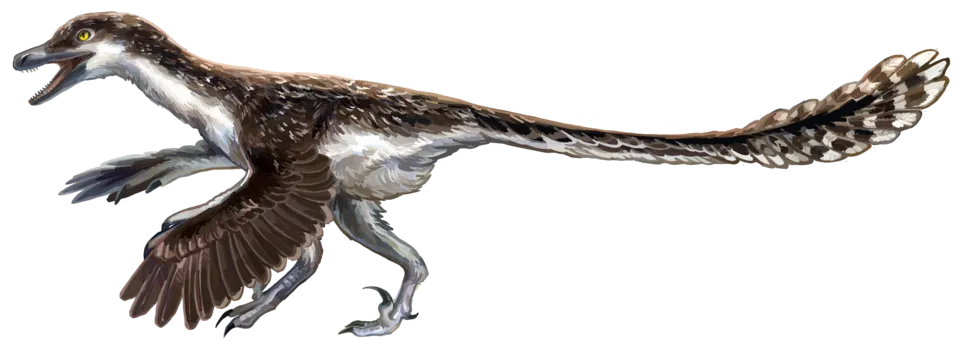
Velociraptor
TheropodLate CretaceousCarnivore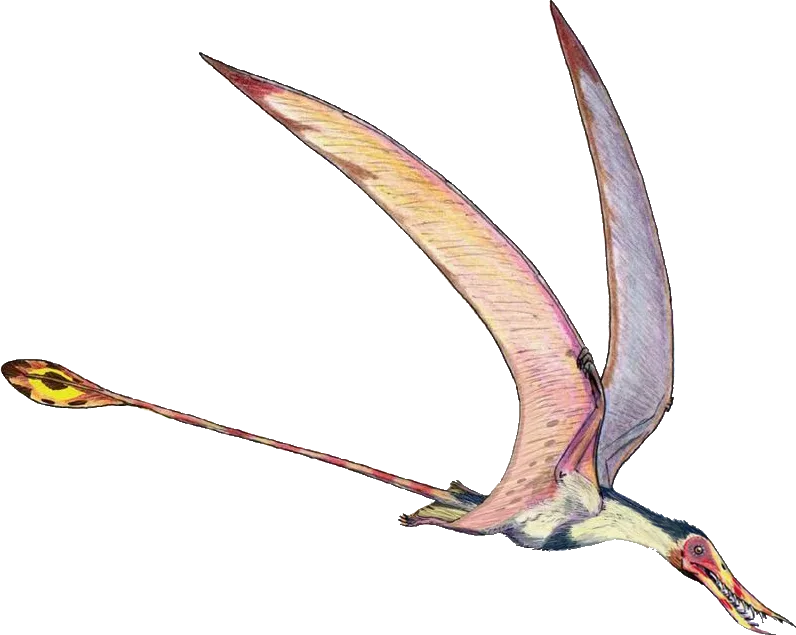 Not a dinosaur
Rhamphorhynchus
PterosaurLate JurassicPiscivore
Sources
Media on this page
- Archaeopteryx NT.jpg — NobuTamura http://paleoexhibit.blogspot.com/ http://spinops.blogspot.com/ · CC BY-SA 3.0
- Fern in forest by I. Levitan (1895, N. Novgorod).jpg — Isaac Levitan · Public domain
- Archaeopteryx simplified 3D model — DinoVerse (generated from original artwork) · CC0 1.0
- Archaeopteryx reconstructed call (synthesised) — DinoVerse (synthesised) · CC0 1.0
- Archaeopteryx lithographica (Berlin specimen).jpg — H. Raab (User: Vesta) · CC BY-SA 3.0
- Archaeopteryx, Compsognathus and Rhamphorhynchus by Knight.jpg — Charles R. Knight · Public domain
- Archaeopteryx (Chicken Wing).jpg — H. Raab (User:Vesta) · CC BY-SA 3.0
- Archaeopteryx (Daiting Specimen).jpg — H. Raab (User:Vesta) · CC BY-SA 3.0