Rhamphorhynchus
Name means “Beak snout”
🚫 Not a dinosaur!
Rhamphorhynchus was a pterosaur, a flying reptile. Pterosaurs were close cousins of dinosaurs, but their legs did not sit straight under the body in the dinosaur way and they evolved on a separate branch.
Rhamphorhynchus was a flying reptile with sharp teeth for catching fish and a long tail with a little diamond-shaped flag on the end. It was not a dinosaur!
Rhamphorhynchus was a long-tailed pterosaur from the Late Jurassic Solnhofen lagoons of Germany. Hundreds of beautifully preserved specimens, some with wing membranes and stomach contents, make it one of the best-studied pterosaurs.
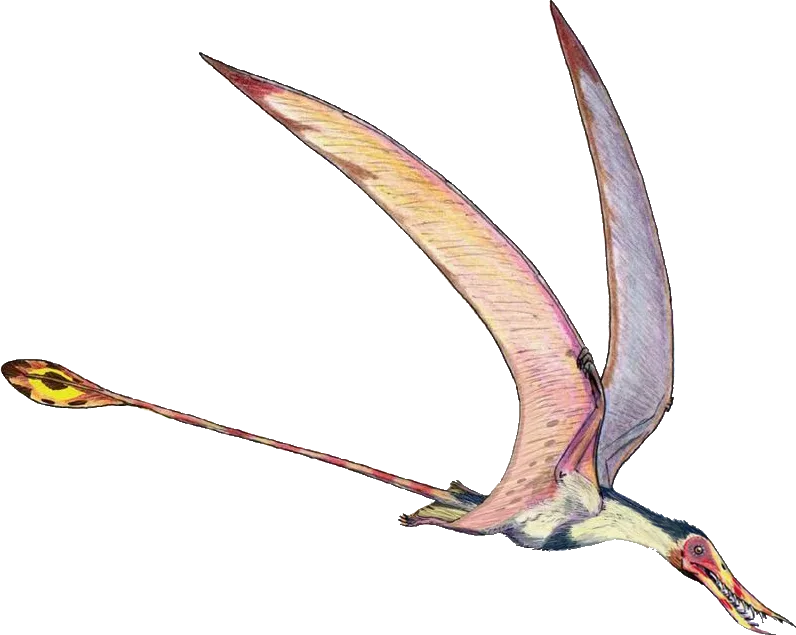
Rhamphorhynchus DB.jpg — ДиБгд at Russian Wikipedia · Public domain
Pictures
Spin it in 3D
3D model description: a 3D model of Rhamphorhynchus shaped from a scientific life reconstruction painting, with the painting's colours and skin texture wrapped around it. It is not a scan of a real fossil.
About this model
This model is shaped from a scientific life reconstruction by ДиБгд at Russian Wikipedia: the painting's outline gives the 3D body and the painting itself is its skin. It is sized to the real animal's length (about 1.3 m), so in AR it appears life-size!
It looks best from the side, like the painting it comes from. It is not a fossil scan — museums such as the Smithsonian 3D collection share real fossil scans you can explore.
What might it sound like?
Transcript: Sharp, high screech, like a gull
🤔 Nobody knows exactly how dinosaurs sounded
This is a scientific guess. No pterosaur voice organ has fossilised, but birds and crocodiles, their closest living relatives, can make loud calls, and small fishing animals like gulls and terns have shrill voices.
Voice boxes and soft tissue almost never fossilise, so sound reconstructions use clues: body size (bigger animals make lower sounds), the calls of living relatives (crocodiles boom with closed mouths; birds coo and hiss), and hollow structures such as hadrosaur crests that could have worked like a trumpet.
Sound: synthesised by DinoVerse from these scientific ideas (CC0). It is a creative guess, not a recording.
Food and habits
Piscivore
Fish-eater
How it ate
Flew low over shallow lagoons and snapped up slippery fish with long, forward-pointing teeth that interlocked like a fish trap.
🔍 How do we know?
- fish remains in the stomach area
- needle-like, forward-pointing teeth
- coprolites with fish bones
It ate…
- small fish
- squid-like cephalopods
Rhamphorhynchus
…and was eaten by
- Aspidorhynchus
Arrows show energy moving up the food chain: from food to eater.
Watch it fly
Quick facts
| 📏 Wingspan | 0.8–1.8 m (3–6 ft) |
|---|---|
| ↕️ Height | 0.2–0.3 m (1 ft) |
| ⚖️ Weight | 0.5–2 kg (1.1–4.4 lb) |
| ⏳ When it lived | 151–148 million years ago (Late Jurassic) |
| 📍 Fossils found | Solnhofen Limestone, Bavaria, Germany; Eichstätt, Bavaria, Germany |
| 🔎 Discovered | 1846 by Hermann von Meyer |
| 🧬 Group | Pterosaurs — Archosauria › Avemetatarsalia › Pterosauria |
Where scientists disagree, we show a range. Sizes are for adults.
How big was it?
Where and when
- 📍 Solnhofen Limestone, Bavaria, Germany (Europe)
- 📍 Eichstätt, Bavaria, Germany (Europe)
Lived 151–148 million years ago
That's about 150 million years before you were born! Humans have only existed for about 0.3 million years.
See it on the big timeline →Did you know?
- 1Rhamphorhynchus had a long tail with a diamond-shaped flap at the tip, like a kite tail!
- 2Its teeth pointed forward like a spiky fish trap.
- 3One fossil shows a Rhamphorhynchus that got caught by a big fish!
- 4Some fossils are so good you can see the shape of its skin wings.
- A famous Solnhofen slab preserves a Rhamphorhynchus tangled in the jaws of the large fish Aspidorhynchus, which may have grabbed it at the water's surface; both seem to have died and sunk together.
- Studies of growth stages showed that several 'species' of Rhamphorhynchus were really different ages of the same few species, with the tail vane changing shape as they grew.
- Specimens under ultraviolet light reveal details of the wing membrane, including stiffening fibres that helped control its shape.
- Its slow growth compared with birds suggests young Rhamphorhynchus may have been able to fly soon after hatching but took years to reach full size.
Myth vs fact
❌ MythRhamphorhynchus was an early bird.
✅ FactIt was a pterosaur; birds come from feathered dinosaurs. Archaeopteryx, an early bird relative, lived in the same Solnhofen lagoons.
Mini quiz
1. Is Rhamphorhynchus a dinosaur?
2. What was at the end of Rhamphorhynchus's long tail?
3. Which early bird relative lived in the same place as Rhamphorhynchus?
Related animals
 Not a dinosaur
Pteranodon
PterosaurLate CretaceousPiscivore Not a dinosaur
Quetzalcoatlus
PterosaurLate CretaceousCarnivore
Archaeopteryx
TheropodLate JurassicCarnivore
Compsognathus
TheropodLate JurassicCarnivore
Media on this page
- Rhamphorhynchus DB.jpg — ДиБгд at Russian Wikipedia · Public domain
- Cumulus Clouds over Yellow Prairie2.jpg — Wing-Chi Poon, colors adjusted by Kjetil r · CC BY-SA 2.5
- Rhamphorhynchus 3D model, shaped from the life reconstruction "Rhamphorhynchus DB.jpg" — ДиБгд at Russian Wikipedia (artwork); 3D shaping by DinoVerse · Public domain
- Rhamphorhynchus reconstructed call (synthesised) — DinoVerse (synthesised) · CC0 1.0
- Rhamphorhynchus munsteri.jpg — M0tty · CC BY-SA 3.0
- Cast of Rhamphorhynchus muensteri 02 - Pterosaurs Flight in the Age of Dinosaurs.jpg — Tim Evanson · CC BY-SA 2.0
- Rhamphorhynchus DB.jpg — ДиБгд at Russian Wikipedia · Public domain
- Rhamphorhynchus Flock.jpg — Oleg Kuznetsov - 3depix - http://3depix.com/ 3D Epix Inc. · CC BY-SA 4.0