Saltasaurus
Name means “Lizard from Salta”
Saltasaurus was a fairly small long-necked dinosaur with bony armour in its skin. It lived in Argentina near the end of the age of dinosaurs.
Saltasaurus loricatus was a small saltasaurid titanosaur from the latest Cretaceous Lecho Formation of northwestern Argentina. It was the first sauropod found with clear body armour (osteoderms), which changed how scientists pictured these giants.
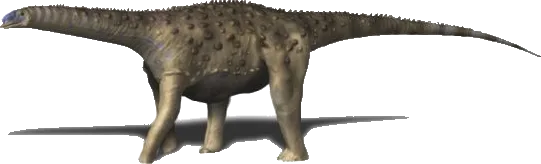
Saltasaurus loricatus.jpg — Nobu Tamura (http://spinops.blogspot.com) · CC BY 3.0
Pictures
Spin it in 3D
3D model description: a 3D model of Saltasaurus shaped from a scientific life reconstruction painting, with the painting's colours and skin texture wrapped around it. It is not a scan of a real fossil.
About this model
This model is shaped from a scientific life reconstruction by Nobu Tamura (http://spinops.blogspot.com): the painting's outline gives the 3D body and the painting itself is its skin. It is sized to the real animal's length (about 10.0 m), so in AR it appears life-size!
It looks best from the side, like the painting it comes from. It is not a fossil scan — museums such as the Smithsonian 3D collection share real fossil scans you can explore.
What might it sound like?
Transcript: Low, grumbling bellow, about 3 seconds long
🤔 Nobody knows exactly how dinosaurs sounded
This is a scientific guess. Saltasaurus was small for a sauropod but still elephant-sized, so it probably had a low voice, and like birds and crocodiles it may have made closed-mouth calls.
Voice boxes and soft tissue almost never fossilise, so sound reconstructions use clues: body size (bigger animals make lower sounds), the calls of living relatives (crocodiles boom with closed mouths; birds coo and hiss), and hollow structures such as hadrosaur crests that could have worked like a trumpet.
Sound: synthesised by DinoVerse from these scientific ideas (CC0). It is a creative guess, not a recording.
Food and habits
Herbivore
Plant-eater
How it ate
Cropped low and medium-height plants with simple, peg-like teeth at the front of its jaws, swallowing them whole to be broken down slowly in its large gut.
🔍 How do we know?
- peg-like teeth seen in related titanosaurs
- body shape suited to mid-height browsing
- fossilised dung from Indian titanosaurs containing grasses and other plants
It ate…
- Conifers
- Ferns
- Cycads
- Flowering plants
Saltasaurus
…and was eaten by
- Abelisaurid theropods
Arrows show energy moving up the food chain: from food to eater.
Watch it feed
Quick facts
| 📏 Length | 8–12 m (26–39 ft) |
|---|---|
| ↕️ Height | 2.5–3.5 m (8–11 ft) |
| ⚖️ Weight | 2,500–7,000 kg (5,510–15,430 lb) |
| ⏳ When it lived | 71–67 million years ago (Late Cretaceous) |
| 📍 Fossils found | Lecho Formation, El Brete, Salta Province, Argentina |
| 🔎 Discovered | 1975 by José Bonaparte and Jaime Powell (named 1980) |
| 🧬 Group | Sauropods — Saurischia › Sauropodomorpha › Sauropoda |
Where scientists disagree, we show a range. Sizes are for adults.
How big was it?
Where and when
- 📍 Lecho Formation, El Brete, Salta Province, Argentina (South America)
Lived 71–67 million years ago
That's about 69 million years before you were born! Humans have only existed for about 0.3 million years.
See it on the big timeline →Did you know?
- 1Saltasaurus had little bony plates in its skin, like a suit of armour!
- 2It was small for a long-necked dinosaur, only about as long as a bus.
- 3It was named after Salta, the part of Argentina where it was found.
- 4Its relatives laid eggs in huge nesting grounds with thousands of nests.
- Its armour had two kinds of osteoderms: larger oval plates about 10 to 12 cm across and a dense mosaic of tiny bony studs a few millimetres wide.
- When described in 1980, Saltasaurus overturned the idea that sauropods relied only on size for defence; osteoderms are now known in many other titanosaurs.
- Titanosaur nesting grounds such as Auca Mahuevo in Argentina show that relatives of Saltasaurus laid clutches of round eggs in shallow pits, possibly returning to the same sites year after year.
- Some scientists have suggested osteoderms may also have stored minerals for egg-laying, not only protected the animal; this idea is still debated.
Myth vs fact
❌ MythSauropods were so big that they never needed armour.
✅ FactSaltasaurus had bony plates and studs in its skin, and similar osteoderms have now been found in many other titanosaurs.
❌ MythAll sauropods were gigantic.
✅ FactSaltasaurus was only about 8 to 12 m long, showing that titanosaurs came in many sizes.
Mini quiz
1. What made Saltasaurus special among long-necked dinosaurs?
2. Where was Saltasaurus found?
3. What kind of dinosaur group did Saltasaurus belong to?
Related animals
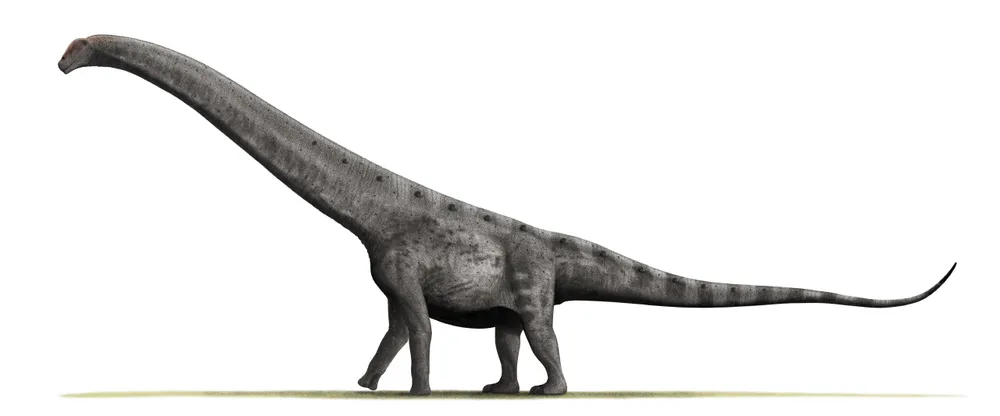
Argentinosaurus
SauropodLate CretaceousHerbivore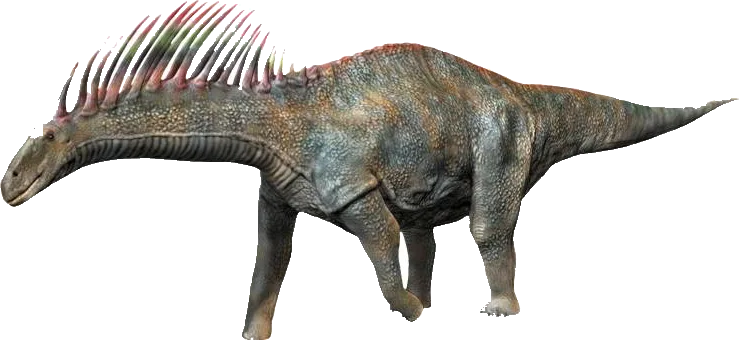
Amargasaurus
SauropodEarly CretaceousHerbivore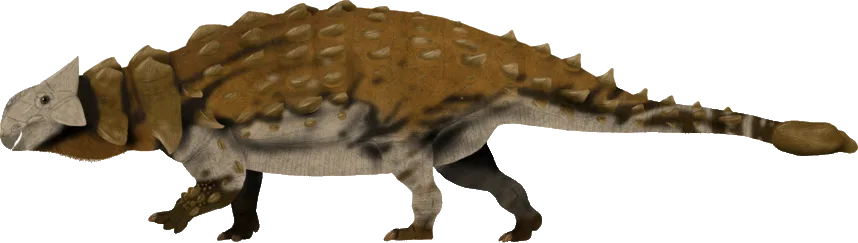
Ankylosaurus
AnkylosaurLate CretaceousHerbivore
Sources
Media on this page
- Saltasaurus loricatus.jpg — Nobu Tamura (http://spinops.blogspot.com) · CC BY 3.0
- Fern in forest by I. Levitan (1895, N. Novgorod).jpg — Isaac Levitan · Public domain
- Saltasaurus 3D model, shaped from the life reconstruction "Saltasaurus loricatus.jpg" — Nobu Tamura (http://spinops.blogspot.com) (artwork); 3D shaping by DinoVerse · CC BY 3.0
- Saltasaurus reconstructed call (synthesised) — DinoVerse (synthesised) · CC0 1.0
- Saltasaurus dinosaur.png — LadyofHats Altered by Steveoc 86 and FunkMonk · Public domain
- Saltasaurus.jpg — Ignacio A. Cerda and Jaime E. Powell · CC BY 2.0
- Saltasaurus environment.jpg — ABelov2014 · CC BY 3.0
- Saltasaurus loricatus egg.JPG — Ninjatacoshell · CC BY-SA 3.0