Spinosaurus
Name means “Spine lizard”
Spinosaurus was a giant fish-eating dinosaur with a huge sail on its back. It spent lots of time in rivers, a bit like a crocodile.
Spinosaurus aegyptiacus was a spinosaurid theropod from the river systems of North Africa about 99 to 93 million years ago, and one of the longest known predatory dinosaurs. Its tall back sail, dense bones, short hind legs and paddle-like tail point to a life closely tied to water, though exactly how well it swam is still argued over.
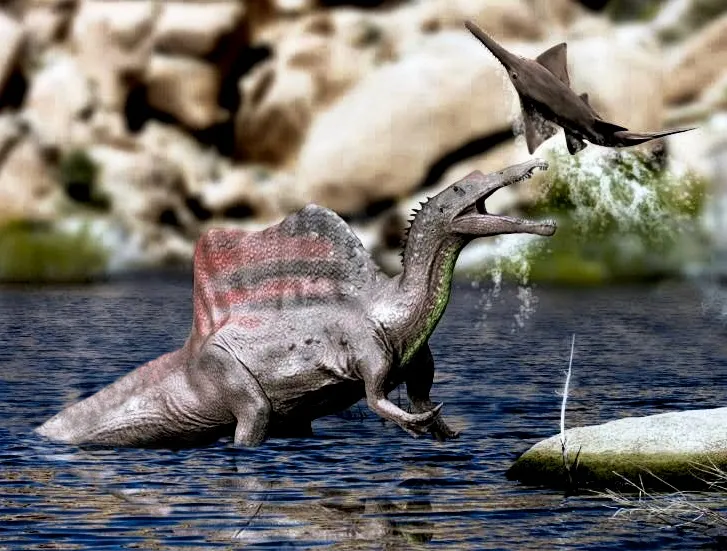
Spinosaurus life restoration with Onchopristis.jpg — Nobu Tamura · CC BY-SA 4.0
Pictures
Spin it in 3D
3D model description: a 3D model of Spinosaurus shaped from a scientific life reconstruction painting, with the painting's colours and skin texture wrapped around it. It is not a scan of a real fossil.
About this model
This model is shaped from a scientific life reconstruction by Dmitry Bogdanov: the painting's outline gives the 3D body and the painting itself is its skin. It is sized to the real animal's length (about 13.5 m), so in AR it appears life-size!
It looks best from the side, like the painting it comes from. It is not a fossil scan — museums such as the Smithsonian 3D collection share real fossil scans you can explore.
What might it sound like?
Transcript: Low, rolling throaty growl with a wet rumble, about 3 seconds
🤔 Nobody knows exactly how dinosaurs sounded
This is a scientific guess. Big animals usually make deep sounds, and Spinosaurus's living relatives, crocodiles and birds, often call with their mouths closed. Crocodiles also rumble at the water's surface, so a river giant like Spinosaurus may have done something similar.
Voice boxes and soft tissue almost never fossilise, so sound reconstructions use clues: body size (bigger animals make lower sounds), the calls of living relatives (crocodiles boom with closed mouths; birds coo and hiss), and hollow structures such as hadrosaur crests that could have worked like a trumpet.
Sound: synthesised by DinoVerse from these scientific ideas (CC0). It is a creative guess, not a recording.
Food and habits
Piscivore
Fish-eater
How it ate
Snatched slippery fish with a long, narrow, crocodile-like snout full of straight cone-shaped teeth, helped by pressure-sensing pits near the tip of its jaws.
It ate…
- Onchopristis (giant sawfish)
- Mawsonia (coelacanth)
- lungfish
- small dinosaurs
- pterosaurs
Spinosaurus
…and was eaten by
👑 Probably nothing, once fully grown — a top predator or too big to tackle!
Arrows show energy moving up the food chain: from food to eater.
Watch it walk
Quick facts
| 📏 Length | 12–15 m (39–49 ft) |
|---|---|
| ↕️ Height | 3–4 m (10–13 ft) |
| ⚖️ Weight | 6,000–8,000 kg (13,230–17,640 lb) |
| ⏳ When it lived | 99–93 million years ago (Late Cretaceous) |
| 📍 Fossils found | Kem Kem beds, Morocco; Bahariya Formation, Egypt |
| 🔎 Discovered | 1912 by Richard Markgraf (named by Ernst Stromer in 1915) |
| 🧬 Group | Theropods — Saurischia › Theropoda |
Where scientists disagree, we show a range. Sizes are for adults.
How big was it?
Where and when
- 📍 Kem Kem beds, Morocco (Africa)
- 📍 Bahariya Formation, Egypt (Africa)
Lived 99–93 million years ago
That's about 96 million years before you were born! Humans have only existed for about 0.3 million years.
See it on the big timeline →Did you know?
- 1Spinosaurus was even longer than T. rex, about as long as a school bus and a car put together!
- 2The sail on its back was held up by spines taller than a grown-up person.
- 3It loved eating fish, including sawfish bigger than a car.
- 4The very first Spinosaurus fossils were destroyed by a bomb in World War II, so scientists had to find new ones.
- The original specimen described by Ernst Stromer was destroyed in a 1944 Allied bombing raid on Munich, so for decades Spinosaurus was known mostly from Stromer's drawings and notes.
- A 2020 study of a partial skeleton from Morocco described tall, flexible tail spines that formed a fin-like paddle, which its authors argued powered swimming through water.
- Scientists still debate how aquatic it was: a 2022 bone-density study suggested it hunted underwater, while other teams argue it was a 'giant heron' that waded in shallows and could not dive well because its sail made it unstable in deep water.
- Its nostrils sat far back on the snout and the jaw tip had small pits that may have held pressure sensors, features also seen in fish-hunting crocodiles.
- Spinosaurus shared its rivers with other big predators such as Carcharodontosaurus, so eating mostly fish may have helped it avoid competing with them.
Myth vs fact
❌ MythSpinosaurus fought Tyrannosaurus rex.
✅ FactThey never met. Spinosaurus lived in Africa around 95 million years ago, about 30 million years before T. rex appeared in North America.
❌ MythSpinosaurus was a close relative of Dimetrodon because both had sails.
✅ FactDimetrodon was not even a dinosaur; it was an earlier relative of mammals. Their sails evolved separately.
Mini quiz
1. What was Spinosaurus's favourite kind of food?
2. What happened to the first Spinosaurus fossils?
3. On which continent did Spinosaurus live?
Related animals
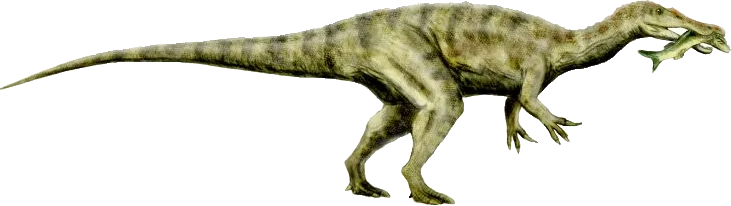
Baryonyx
TheropodEarly CretaceousPiscivore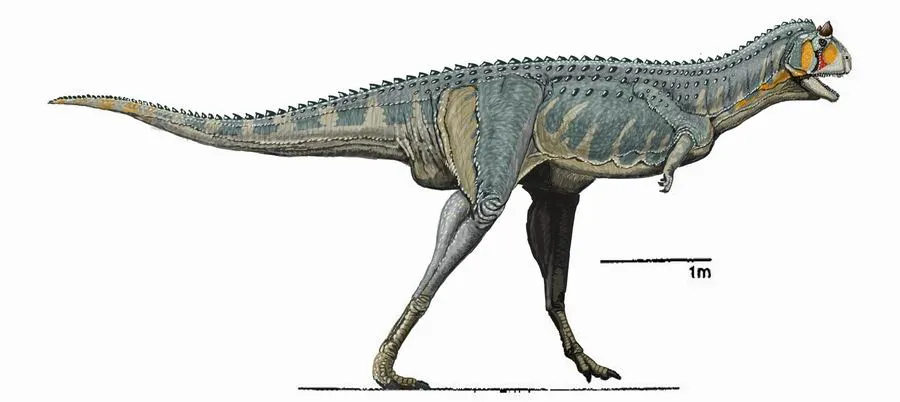
Carnotaurus
TheropodLate CretaceousCarnivore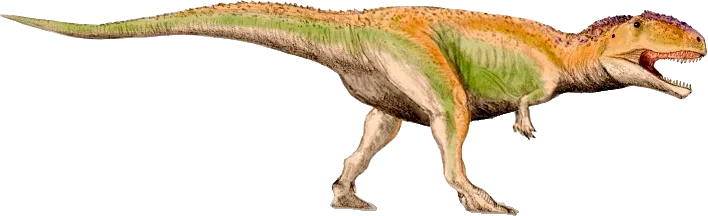
Giganotosaurus
TheropodLate CretaceousCarnivore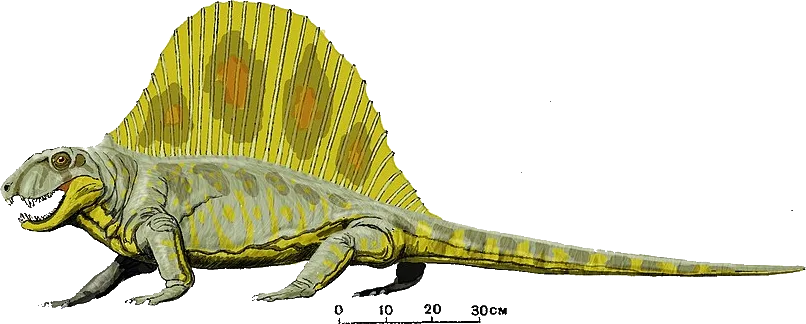 Not a dinosaur
Dimetrodon
SynapsidEarly PermianCarnivore
Sources
Media on this page
- Spinosaurus life restoration with Onchopristis.jpg — Nobu Tamura · CC BY-SA 4.0
- Fern in forest by I. Levitan (1895, N. Novgorod).jpg — Isaac Levitan · Public domain
- Spinosaurus 3D model, shaped from the life reconstruction "Spinosaurus2DB.jpg" — Dmitry Bogdanov (artwork); 3D shaping by DinoVerse · CC BY-SA 3.0
- Spinosaurus reconstructed call (synthesised) — DinoVerse (synthesised) · CC0 1.0
- FSAC-KK-11888.jpg — 3blindMies · CC BY-SA 4.0
- Digital flesh model of Spinosaurus.jpg — Paul C Sereno, Nathan Myhrvold, Donald M Henderson, Frank E Fish, Daniel Vidal, Stephanie · CC BY 4.0
- Digital skeletal reconstruction of Spinosaurus.png — Paul C Sereno, Nathan Myhrvold, Donald M Henderson, Frank E Fish, Daniel Vidal, Stephanie · CC BY 4.0
- Four spinosaurids by Abelov2014.jpg — Андрей Белов · CC BY 3.0