Baryonyx
Name means “Heavy claw”
Baryonyx was a fish-eating dinosaur with a snout like a crocodile and a giant claw on each thumb. It was found in England by a man looking for rocks.
Baryonyx walkeri was a spinosaurid theropod from the Early Cretaceous of southern England, and the first spinosaurid known from a fairly complete skeleton. Fish scales and young Iguanodon bones preserved in its gut show it ate both fish and land animals.
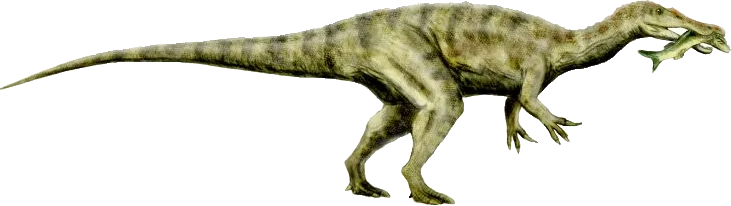
Baryonyx BW.jpg — Nobu Tamura · CC BY 2.5
Pictures
Spin it in 3D
3D model description: a 3D model of Baryonyx shaped from a scientific life reconstruction painting, with the painting's colours and skin texture wrapped around it. It is not a scan of a real fossil.
About this model
This model is shaped from a scientific life reconstruction by Nobu Tamura: the painting's outline gives the 3D body and the painting itself is its skin. It is sized to the real animal's length (about 8.8 m), so in AR it appears life-size!
It looks best from the side, like the painting it comes from. It is not a fossil scan — museums such as the Smithsonian 3D collection share real fossil scans you can explore.
What might it sound like?
Transcript: Throaty, gurgling growl with a low hiss, about 2 seconds
🤔 Nobody knows exactly how dinosaurs sounded
This is a scientific guess. Baryonyx was a big theropod that lived near rivers, and its living relatives, crocodiles and birds, make closed-mouth growls, hisses and rumbles. Its true voice is unknown.
Voice boxes and soft tissue almost never fossilise, so sound reconstructions use clues: body size (bigger animals make lower sounds), the calls of living relatives (crocodiles boom with closed mouths; birds coo and hiss), and hollow structures such as hadrosaur crests that could have worked like a trumpet.
Sound: synthesised by DinoVerse from these scientific ideas (CC0). It is a creative guess, not a recording.
Food and habits
Piscivore
Fish-eater
How it ate
Hooked fish out of rivers with its huge thumb claw and gripped them in a long, crocodile-like snout lined with many cone-shaped teeth.
🔍 How do we know?
- acid-etched fish scales in its stomach area
- bones of a young Iguanodon in its stomach area
- narrow crocodile-like snout and cone-shaped teeth
It ate…
- Scheenstia (Lepidotes) fish
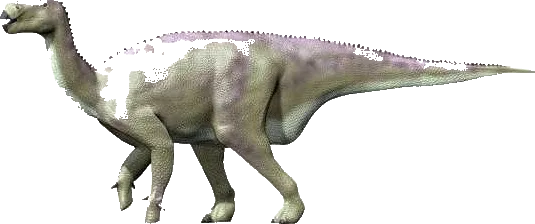 young Iguanodon
- other fish
- carcasses
Baryonyx
…and was eaten by
👑 Probably nothing, once fully grown — a top predator or too big to tackle!
Arrows show energy moving up the food chain: from food to eater.
Watch it walk
Quick facts
| 📏 Length | 7.5–10 m (25–33 ft) |
|---|---|
| ↕️ Height | 2–2.5 m (7–8 ft) |
| ⚖️ Weight | 1,200–2,000 kg (2,650–4,410 lb) |
| ⏳ When it lived | 130–125 million years ago (Early Cretaceous) |
| 📍 Fossils found | Weald Clay, Smokejacks Pit, Ockley, Surrey, England |
| 🔎 Discovered | 1983 by William Walker (named by Alan Charig and Angela Milner in 1986) |
| 🧬 Group | Theropods — Saurischia › Theropoda |
Where scientists disagree, we show a range. Sizes are for adults.
How big was it?
Where and when
- 📍 Weald Clay, Smokejacks Pit, Ockley, Surrey, England (Europe)
Lived 130–125 million years ago
That's about 128 million years before you were born! Humans have only existed for about 0.3 million years.
See it on the big timeline →Did you know?
- 1Baryonyx was found in 1983 by William Walker, who was hunting for fossils in a clay pit in England.
- 2The first thing he found was a giant claw, about as long as a ruler!
- 3Its snout looked like a crocodile's, perfect for catching slippery fish.
- 4Scientists found fish scales in its tummy, showing what it had for dinner.
- The skeleton was found by amateur collector William Walker in a Surrey clay pit in 1983, and named in his honour three years later by Alan Charig and Angela Milner of the Natural History Museum.
- Its stomach region contained acid-etched scales of the large fish Scheenstia (formerly Lepidotes) and bones of a juvenile Iguanodon, the first direct evidence of a fish-eating dinosaur.
- Its skull shares features with crocodiles, such as a rosette of teeth at the snout tip and an S-shaped upper jaw, an example of convergent evolution for catching fish.
- Some fossils from Spain, Portugal and the Isle of Wight were once referred to Baryonyx but have since been given new names, such as Iberospinus, Ceratosuchops and Riparovenator.
Myth vs fact
❌ MythBaryonyx only ate fish.
✅ FactFish were a big part of its diet, but bones of a young Iguanodon in its stomach show it also ate land animals, perhaps by hunting or scavenging.
Mini quiz
1. What was found inside Baryonyx's stomach area?
2. In which country was Baryonyx discovered?
3. What does 'Baryonyx' mean?
Related animals
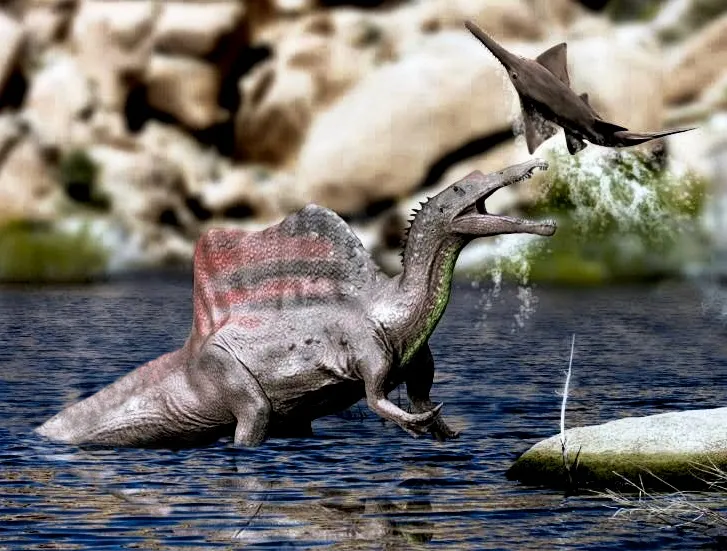
Spinosaurus
TheropodLate CretaceousPiscivoreIguanodon
OrnithopodEarly CretaceousHerbivore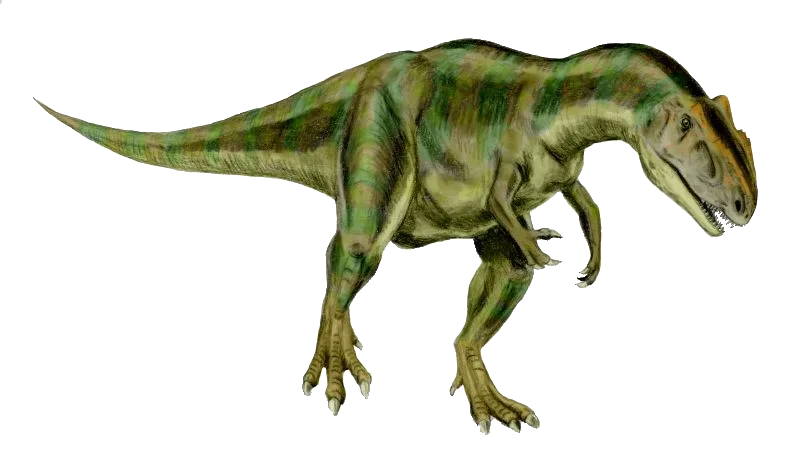
Allosaurus
TheropodLate JurassicCarnivore
Media on this page
- Baryonyx BW.jpg — Nobu Tamura · CC BY 2.5
- Fern in forest by I. Levitan (1895, N. Novgorod).jpg — Isaac Levitan · Public domain
- Baryonyx 3D model, shaped from the life reconstruction "Baryonyx BW.jpg" — Nobu Tamura (artwork); 3D shaping by DinoVerse · CC BY 2.5
- Baryonyx reconstructed call (synthesised) — DinoVerse (synthesised) · CC0 1.0
- Baryonyx walkeri mount NMNS.jpg — ★Kumiko★ · CC BY-SA 2.0
- Baryonyx Andrey Atuchin.jpg — Andrey Atuchin · CC BY 4.0
- Baryonyx NHM.jpg — Ripton Scott from Wimbledon, United Kingdom · CC BY-SA 2.0
- Baryonyx dentary.jpg — Nizar Ibrahim, Paul C. Sereno, David J. Varricchio, David M. Martill, Didier B. Dutheil, D · CC BY 4.0