DinoVerse · Dinosaur fact sheet
Baryonyx
Say it: BAH-ree-ON-iks · Name means: “Heavy claw”
| ⏳ Lived | 130–125 million years ago Early Cretaceous |
|---|---|
| 🐟 Diet | Piscivore (fish-eater) |
| 📏 Length | 7.5–10 m (25–33 ft) |
| ↕️ Height | 2–2.5 m (7–8 ft) |
| ⚖️ Weight | 1,200–2,000 kg (2,650–4,410 lb) |
| 📍 Found in | Europe |
| 🔎 Discovered | 1983 by William Walker (named by Alan Charig and Angela Milner in 1986) |
About Baryonyx
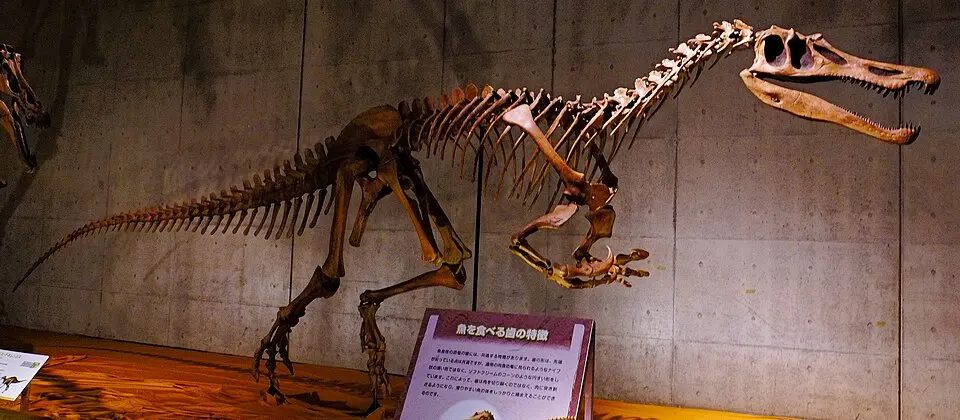
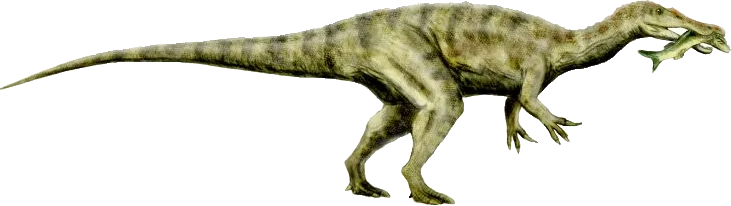
Baryonyx was a fish-eating dinosaur with a snout like a crocodile and a giant claw on each thumb. It was found in England by a man looking for rocks.
Baryonyx walkeri was a spinosaurid theropod from the Early Cretaceous of southern England, and the first spinosaurid known from a fairly complete skeleton. Fish scales and young Iguanodon bones preserved in its gut show it ate both fish and land animals.
How big was it?
Drawn to scale next to a 1.7 m adult and a 12 m school bus.
Did you know?
- Baryonyx was found in 1983 by William Walker, who was hunting for fossils in a clay pit in England.
- The first thing he found was a giant claw, about as long as a ruler!
- Its snout looked like a crocodile's, perfect for catching slippery fish.
- Scientists found fish scales in its tummy, showing what it had for dinner.
- The skeleton was found by amateur collector William Walker in a Surrey clay pit in 1983, and named in his honour three years later by Alan Charig and Angela Milner of the Natural History Museum.
- Its stomach region contained acid-etched scales of the large fish Scheenstia (formerly Lepidotes) and bones of a juvenile Iguanodon, the first direct evidence of a fish-eating dinosaur.
- Its skull shares features with crocodiles, such as a rosette of teeth at the snout tip and an S-shaped upper jaw, an example of convergent evolution for catching fish.
- Some fossils from Spain, Portugal and the Isle of Wight were once referred to Baryonyx but have since been given new names, such as Iberospinus, Ceratosuchops and Riparovenator.