Iguanodon
Name means “Iguana tooth”
Iguanodon was a big plant-eater with a sharp spike on each thumb. It was one of the very first dinosaurs ever discovered.
Iguanodon bernissartensis was a large iguanodontian ornithopod from the Early Cretaceous of Europe, famous for its conical thumb spikes and chewing jaws. Named in 1825, it was the second dinosaur genus ever named, and changing ideas about how it looked trace the whole history of palaeontology.
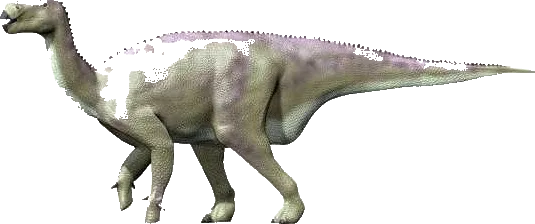
Iguanodon new NT.jpg — Nobu Tamura email:nobu.tamura@yahoo.com http://spi · CC BY-SA 4.0
Pictures
Spin it in 3D
3D model description: a 3D model of Iguanodon shaped from a scientific life reconstruction painting, with the painting's colours and skin texture wrapped around it. It is not a scan of a real fossil.
About this model
This model is shaped from a scientific life reconstruction by Nobu Tamura email:nobu.tamura@yahoo.com http://spinops.blogspot.com/: the painting's outline gives the 3D body and the painting itself is its skin. It is sized to the real animal's length (about 10.0 m), so in AR it appears life-size!
It looks best from the side, like the painting it comes from. It is not a fossil scan — museums such as the Smithsonian 3D collection share real fossil scans you can explore.
What might it sound like?
Transcript: Low, nasal bellow, about 3 seconds long
🤔 Nobody knows exactly how dinosaurs sounded
This is a scientific guess: no one knows how Iguanodon sounded. It had no hollow crest like later duck-bills, so it may have used simple low calls, made with a closed mouth like birds and crocodiles.
Voice boxes and soft tissue almost never fossilise, so sound reconstructions use clues: body size (bigger animals make lower sounds), the calls of living relatives (crocodiles boom with closed mouths; birds coo and hiss), and hollow structures such as hadrosaur crests that could have worked like a trumpet.
Sound: synthesised by DinoVerse from these scientific ideas (CC0). It is a creative guess, not a recording.
Food and habits
Herbivore
Plant-eater
How it ate
Snipped plants with a toothless horny beak, then ground them up with rows of ridged cheek teeth, using a flexible upper jaw that moved sideways as it chewed.
🔍 How do we know?
- leaf-shaped cheek teeth like a giant iguana's
- tooth wear from grinding
- horny beak and cheek pouches for chewing
- grasping fifth finger for gathering plants
It ate…
- Horsetails
- Ferns
- Cycads
- Conifers
- Early flowering plants
Iguanodon
…and was eaten by
- Neovenator
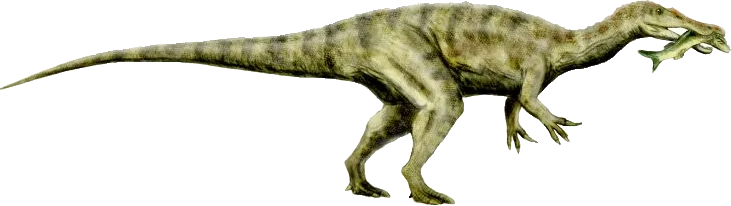 Baryonyx
Arrows show energy moving up the food chain: from food to eater.
Watch it feed
Quick facts
| 📏 Length | 9–11 m (30–36 ft) |
|---|---|
| ↕️ Height | 2.5–3.5 m (8–11 ft) |
| ⚖️ Weight | 3,000–5,000 kg (6,610–11,020 lb) |
| ⏳ When it lived | 126–122 million years ago (Early Cretaceous) |
| 📍 Fossils found | Bernissart coal mine, Hainaut, Belgium; Nehden, North Rhine-Westphalia, Germany; Morella, Castellón, Spain; Tilgate Forest, Sussex, England (first teeth) |
| 🔎 Discovered | 1822 by Gideon Mantell (and possibly Mary Ann Mantell); named 1825 |
| 🧬 Group | Ornithopods — Ornithischia › Neornithischia › Ornithopoda |
Where scientists disagree, we show a range. Sizes are for adults.
How big was it?
Where and when
- 📍 Bernissart coal mine, Hainaut, Belgium (Europe)
- 📍 Nehden, North Rhine-Westphalia, Germany (Europe)
- 📍 Morella, Castellón, Spain (Europe)
- 📍 Tilgate Forest, Sussex, England (first teeth) (Europe)
Lived 126–122 million years ago
That's about 124 million years before you were born! Humans have only existed for about 0.3 million years.
See it on the big timeline →Did you know?
- 1Iguanodon had a pointy spike on each thumb, about as long as your hand!
- 2Its teeth looked like giant iguana teeth, which is how it got its name.
- 3It could walk on four legs or stand up on two.
- 4In 1878, miners in Belgium found dozens of Iguanodon skeletons deep inside a coal mine!
- Iguanodon was named by Gideon Mantell in 1825, only a year after Megalosaurus, making it the second dinosaur genus ever named.
- Its hand was remarkably varied: three middle fingers bore hoof-like claws for walking, the thumb was a conical spike possibly used for defence, and the fifth finger could grasp food.
- The Bernissart mine in Belgium yielded at least 38 skeletons, many complete, which Louis Dollo used to reconstruct the animal with a far more accurate shape.
- Many species once placed in Iguanodon have since been moved to other genera such as Mantellisaurus, leaving I. bernissartensis as the one well-supported species.
Myth vs fact
❌ MythIguanodon had a horn on its nose like a rhinoceros.
✅ FactGideon Mantell had only scattered bones and placed the spike on the nose. Complete skeletons from Belgium later showed it was a thumb spike.
❌ MythIguanodon stood upright like a kangaroo, with its tail on the ground.
✅ FactDollo's 1880s mounts stood upright, but the tail had to be broken to fit. Today scientists think it usually held its back level and often walked on all fours.
Mini quiz
1. Where was Iguanodon's spike really found?
2. What does 'Iguanodon' mean?
3. Where were dozens of Iguanodon skeletons found in 1878?
Related animals
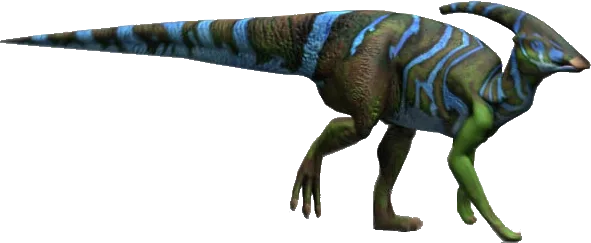
Parasaurolophus
OrnithopodLate CretaceousHerbivore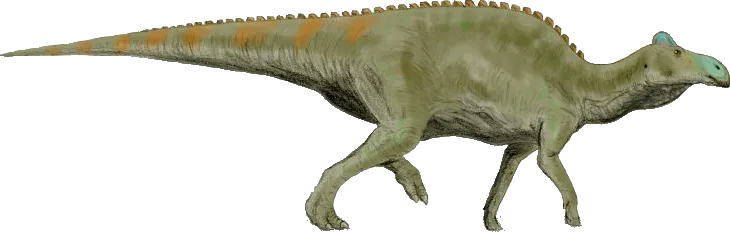
Edmontosaurus
OrnithopodLate CretaceousHerbivoreBaryonyx
TheropodEarly CretaceousPiscivore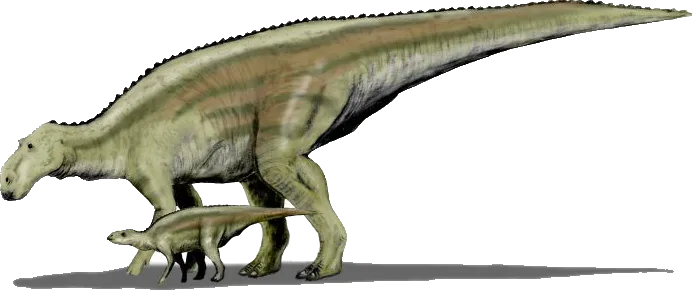
Maiasaura
OrnithopodLate CretaceousHerbivore
Sources
Media on this page
- Iguanodon new NT.jpg — Nobu Tamura email:nobu.tamura@yahoo.com http://spinops.blogspot.com/ · CC BY-SA 4.0
- Fern in forest by I. Levitan (1895, N. Novgorod).jpg — Isaac Levitan · Public domain
- Iguanodon 3D model, shaped from the life reconstruction "Iguanodon new NT.jpg" — Nobu Tamura email:nobu.tamura@yahoo.com http://spinops.blogspot.com/ (artwork); 3D shaping · CC BY-SA 4.0
- Iguanodon reconstructed call (synthesised) — DinoVerse (synthesised) · CC0 1.0
- Iguanodon de Bernissart IRSNB 01.JPG — Ben2 · CC BY-SA 3.0
- "Paulodon" (Iguanodon) galvensis.png — Connor Ashbridge · CC BY 4.0
- Bernissart Iguanodon mounted skeleton.jpg — Aimé Rutot (museum curator in 1882, geologist) · Public domain
- Gustave Lavalette ; 9 januari 1885; Iguanodon bernissartensis.jpg — Auguste Lavalette · Public domain