Kentrosaurus
Name means “Prickle lizard”
Kentrosaurus was a small cousin of Stegosaurus from Africa. It had plates on its front half and long, sharp spikes on its back half and tail.
Kentrosaurus was a stegosaurid from the Late Jurassic Tendaguru beds of Tanzania, known from more than a thousand bones from many individuals. Narrow plates on its neck and back gave way to paired spikes along the hips and tail, plus a long spike on each shoulder.
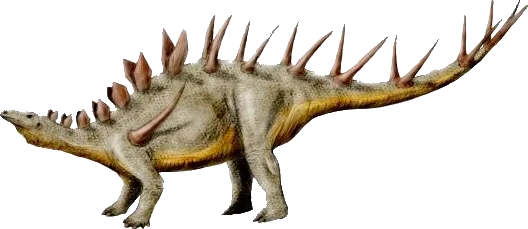
Kentrosaurus NT.jpg — Nobu Tamura · CC BY-SA 3.0
Pictures
Spin it in 3D
3D model description: a 3D model of Kentrosaurus shaped from a scientific life reconstruction painting, with the painting's colours and skin texture wrapped around it. It is not a scan of a real fossil.
About this model
This model is shaped from a scientific life reconstruction by Nobu Tamura: the painting's outline gives the 3D body and the painting itself is its skin. It is sized to the real animal's length (about 4.3 m), so in AR it appears life-size!
It looks best from the side, like the painting it comes from. It is not a fossil scan — museums such as the Smithsonian 3D collection share real fossil scans you can explore.
What might it sound like?
Transcript: Gruff, huffing grunts as it swings its tail
🤔 Nobody knows exactly how dinosaurs sounded
This is a scientific guess. Kentrosaurus's closest living relatives, birds and crocodiles, make low grunts and closed-mouth calls, so a cow-sized plant-eater may have grunted in a similar way.
Voice boxes and soft tissue almost never fossilise, so sound reconstructions use clues: body size (bigger animals make lower sounds), the calls of living relatives (crocodiles boom with closed mouths; birds coo and hiss), and hollow structures such as hadrosaur crests that could have worked like a trumpet.
Sound: synthesised by DinoVerse from these scientific ideas (CC0). It is a creative guess, not a recording.
Food and habits
Herbivore
Plant-eater
How it ate
Plucked low plants with a narrow beak and chewed lightly with small, ridged cheek teeth, probably feeding no higher than about a metre off the ground.
🔍 How do we know?
- small leaf-shaped teeth
- narrow beaked snout
- low head position
It ate…
- ferns
- cycads
- horsetails
- low conifer shoots
Kentrosaurus
…and was eaten by
- Veterupristisaurus
- large ceratosaurs
Arrows show energy moving up the food chain: from food to eater.
Watch it walk
Quick facts
| 📏 Length | 4–4.5 m (13–15 ft) |
|---|---|
| ↕️ Height | 1.2–1.6 m (4–5 ft) |
| ⚖️ Weight | 700–1,600 kg (1,540–3,530 lb) |
| ⏳ When it lived | 155–150 million years ago (Late Jurassic) |
| 📍 Fossils found | Tendaguru Formation, Lindi Region, Tanzania |
| 🔎 Discovered | 1915 by Edwin Hennig (fossils dug up by the German Tendaguru expedition, 1909–1912) |
| 🧬 Group | Stegosaurs — Ornithischia › Thyreophora › Stegosauria |
Where scientists disagree, we show a range. Sizes are for adults.
How big was it?
Where and when
- 📍 Tendaguru Formation, Lindi Region, Tanzania (Africa)
Lived 155–150 million years ago
That's about 153 million years before you were born! Humans have only existed for about 0.3 million years.
See it on the big timeline →Did you know?
- 1Kentrosaurus had more spikes than Stegosaurus — including one on each shoulder!
- 2It was about as long as a car.
- 3Its tail could swing in a wide arc, like a spiky whip.
- 4It lived in Africa, in what is now Tanzania.
- Computer models of its tail by Heinrich Mallison suggest Kentrosaurus could swing its spiked tail through a wide arc at speeds fast enough to break bones or cause deep wounds.
- Hennig originally placed the long spike over the hip, but later studies favour the shoulder; a few researchers still argue the evidence is not conclusive.
- Much of the original Kentrosaurus material was destroyed during the Second World War, but a mounted skeleton survives at the Museum für Naturkunde in Berlin.
- Differences in thigh bones from the Tendaguru quarry may reflect two body types, which some researchers interpret as males and females.
Myth vs fact
❌ MythKentrosaurus is just a baby Stegosaurus.
✅ FactKentrosaurus is a different, smaller genus from Africa with narrower plates and many more spikes.
Mini quiz
1. On which continent did Kentrosaurus live?
2. Which famous dinosaur was Kentrosaurus a cousin of?
3. Where did Kentrosaurus have a long spike that Stegosaurus did not?
Related animals
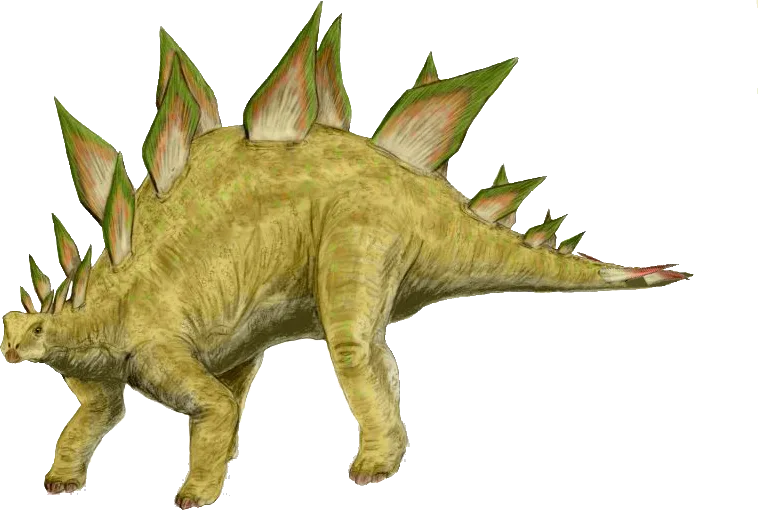
Stegosaurus
StegosaurLate JurassicHerbivore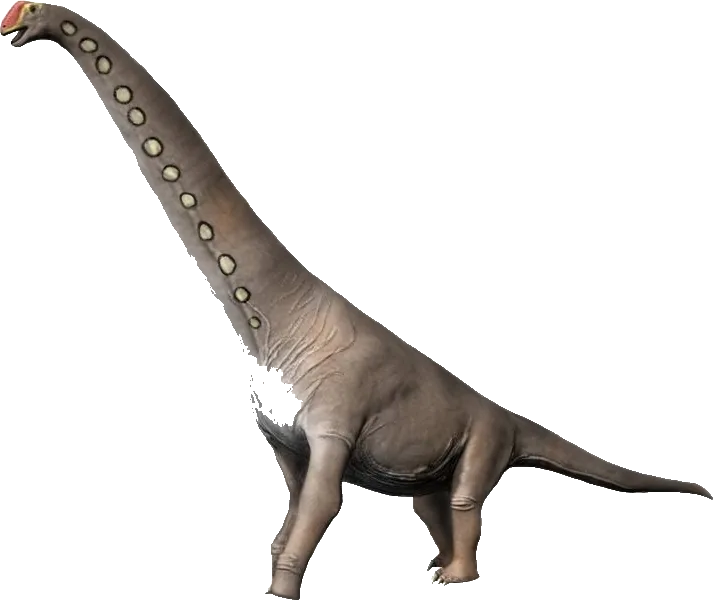
Brachiosaurus
SauropodLate JurassicHerbivore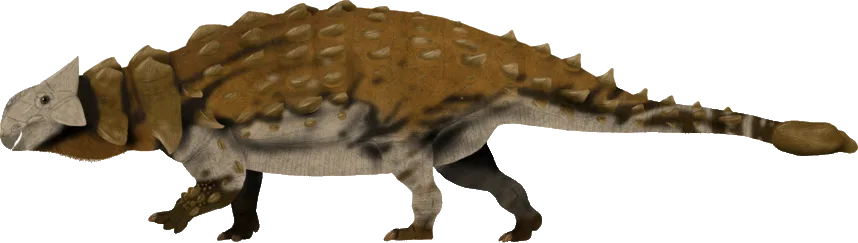
Ankylosaurus
AnkylosaurLate CretaceousHerbivore
Sources
Media on this page
- Kentrosaurus NT.jpg — Nobu Tamura · CC BY-SA 3.0
- Fern in forest by I. Levitan (1895, N. Novgorod).jpg — Isaac Levitan · Public domain
- Kentrosaurus 3D model, shaped from the life reconstruction "Kentrosaurus NT.jpg" — Nobu Tamura (artwork); 3D shaping by DinoVerse · CC BY-SA 3.0
- Kentrosaurus reconstructed call (synthesised) — DinoVerse (synthesised) · CC0 1.0
- Berlin Naturkundemuseum Dino Eingangshalle.jpg — LoKiLeCh · CC BY 3.0
- Fossil Kentrosaurus aethiopicus in Museum für Naturkunde Berlin 001.JPG — Sebastian Wallroth · Public domain
- Fossil Kentrosaurus aethiopicus in Museum für Naturkunde Berlin 002.JPG — Sebastian Wallroth · Public domain
- KentrosaurusBraincase(HMN St 460).jpg — Edwin Hennig · Public domain