Stegosaurus
Name means “Roof lizard”
Stegosaurus had two rows of big bony plates along its back and four sharp spikes on its tail. It was a bus-length plant-eater with a surprisingly small head.
Stegosaurus was a large thyreophoran from the Late Jurassic Morrison Formation of North America, with possible remains in Portugal. Its alternating back plates were probably for display, while its tail spikes were real weapons, as shown by a wounded Allosaurus bone.
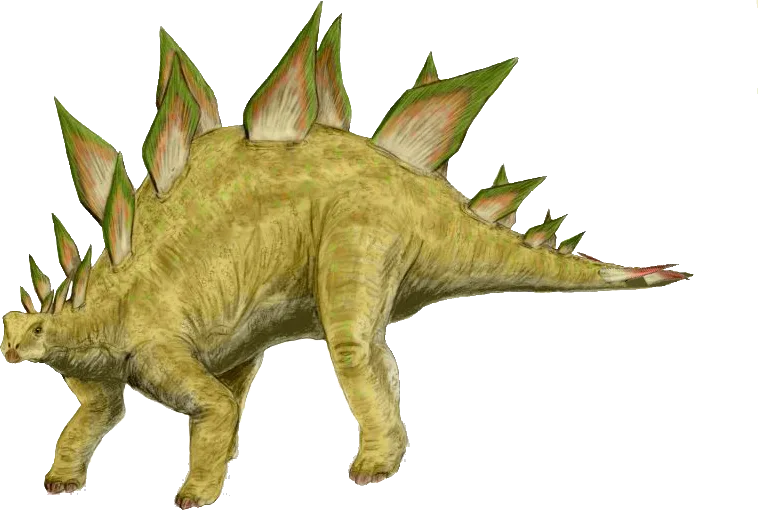
Stegosaurus BW.jpg — Nobu Tamura (http://spinops.blogspot.com) · CC BY 2.5
Pictures
Spin it in 3D
3D model description: a 3D model of Stegosaurus shaped from a scientific life reconstruction painting, with the painting's colours and skin texture wrapped around it. It is not a scan of a real fossil.
About this model
This model is shaped from a scientific life reconstruction by Nobu Tamura (http://spinops.blogspot.com): the painting's outline gives the 3D body and the painting itself is its skin. It is sized to the real animal's length (about 8.0 m), so in AR it appears life-size!
It looks best from the side, like the painting it comes from. It is not a fossil scan — museums such as the Smithsonian 3D collection share real fossil scans you can explore.
What might it sound like?
Transcript: Low, hollow bellow, rising and then fading away
🤔 Nobody knows exactly how dinosaurs sounded
This is a scientific guess. No Stegosaurus voice box has fossilised, but its living relatives, birds and crocodiles, make deep closed-mouth calls and bellows, so a large plant-eater like Stegosaurus probably made low sounds too.
Voice boxes and soft tissue almost never fossilise, so sound reconstructions use clues: body size (bigger animals make lower sounds), the calls of living relatives (crocodiles boom with closed mouths; birds coo and hiss), and hollow structures such as hadrosaur crests that could have worked like a trumpet.
Sound: synthesised by DinoVerse from these scientific ideas (CC0). It is a creative guess, not a recording.
Food and habits
Herbivore
Plant-eater
How it ate
Nipped off low-growing plants with a toothless beak at the front of its narrow snout and mashed them lightly with small, leaf-shaped cheek teeth.
🔍 How do we know?
- small leaf-shaped teeth
- weak bite estimates
- head held close to the ground
It ate…
- ferns
- horsetails
- cycads
- mosses
- low conifer shoots
Stegosaurus
…and was eaten by
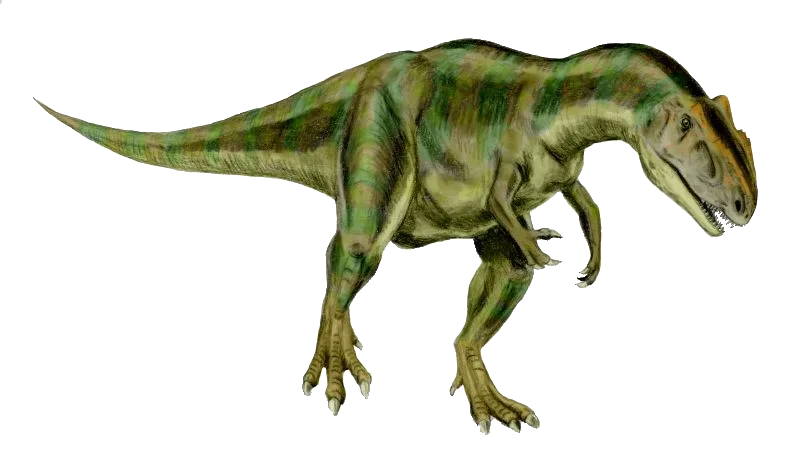 Allosaurus
- Ceratosaurus
- Torvosaurus
Arrows show energy moving up the food chain: from food to eater.
Watch it feed
Quick facts
| 📏 Length | 7–9 m (23–30 ft) |
|---|---|
| ↕️ Height | 2.8–4 m (9–13 ft) |
| ⚖️ Weight | 3,500–7,000 kg (7,720–15,430 lb) |
| ⏳ When it lived | 155–145 million years ago (Late Jurassic) |
| 📍 Fossils found | Garden Park, Colorado, USA; Como Bluff, Wyoming, USA; Dinosaur National Monument, Utah, USA; Lourinhã Formation, Portugal |
| 🔎 Discovered | 1877 by Othniel Charles Marsh (fossil found by Arthur Lakes) |
| 🧬 Group | Stegosaurs — Ornithischia › Thyreophora › Stegosauria |
Where scientists disagree, we show a range. Sizes are for adults.
How big was it?
Where and when
- 📍 Garden Park, Colorado, USA (North America)
- 📍 Como Bluff, Wyoming, USA (North America)
- 📍 Dinosaur National Monument, Utah, USA (North America)
- 📍 Lourinhã Formation, Portugal (Europe)
Lived 155–145 million years ago
That's about 150 million years before you were born! Humans have only existed for about 0.3 million years.
See it on the big timeline →Did you know?
- 1Stegosaurus had a head about the size of a horse's head on a body as long as a bus!
- 2The biggest plates on its back were taller than a kitchen chair.
- 3Its tail spikes are nicknamed the 'thagomizer', after a funny cartoon.
- 4Scientists found an Allosaurus bone with a hole poked in it by a Stegosaurus tail spike!
- An Allosaurus tail vertebra from the Morrison Formation has a healed puncture that matches the shape and size of a Stegosaurus tail spike, showing the 'thagomizer' was used in defence.
- The plates were covered in keratin and riddled with blood vessels; ideas for their use include display, species recognition and temperature control, with display currently the favoured explanation.
- 'Sophie', at the Natural History Museum in London, is the most complete Stegosaurus skeleton known, and has helped scientists study how it moved and fed.
- Bite-force studies suggest Stegosaurus had a weak bite, so it probably ate soft, low plants rather than tough branches.
- Scientists debate how many Stegosaurus species are valid, and whether the name for the main species should be S. stenops or S. ungulatus.
Myth vs fact
❌ MythStegosaurus had a 'second brain' in its hips to help control its back legs.
✅ FactThe space in its hips probably held a glycogen body — an energy store also found in the hips of birds — not a brain.
❌ MythStegosaurus plates lay flat on its back like roof tiles.
✅ FactIts name means 'roof lizard' because of that early idea, but the plates actually stood upright in two alternating rows.
Mini quiz
1. What were Stegosaurus tail spikes used for?
2. When did Stegosaurus live?
3. What was in Stegosaurus's hips that people once thought was a 'second brain'?
Related animals
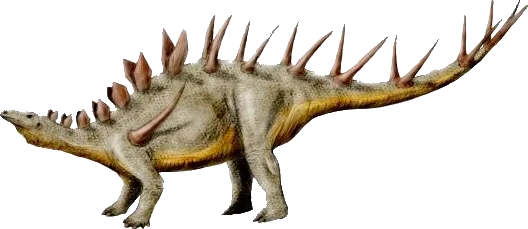
Kentrosaurus
StegosaurLate JurassicHerbivoreAllosaurus
TheropodLate JurassicCarnivore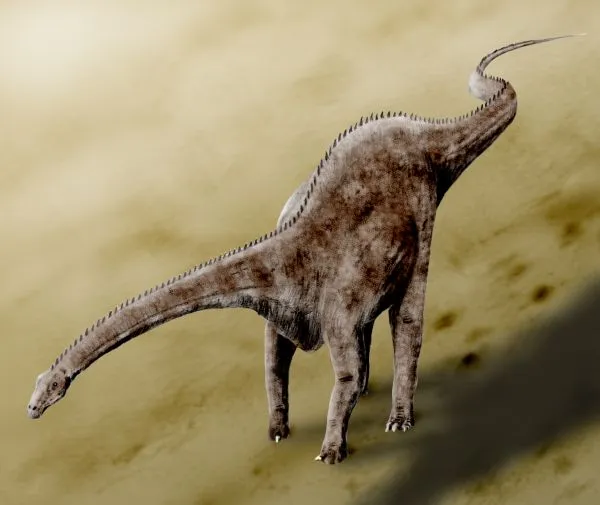
Diplodocus
SauropodLate JurassicHerbivore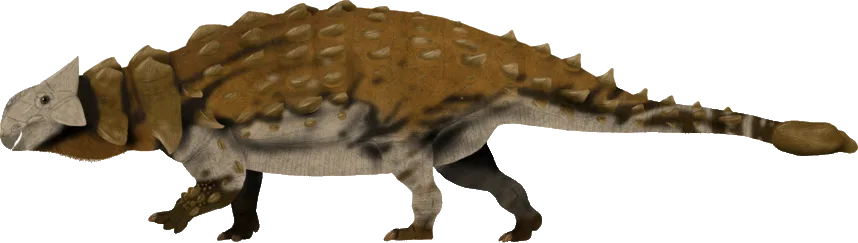
Ankylosaurus
AnkylosaurLate CretaceousHerbivore
Sources
Media on this page
- Stegosaurus BW.jpg — Nobu Tamura (http://spinops.blogspot.com) · CC BY 2.5
- Fern in forest by I. Levitan (1895, N. Novgorod).jpg — Isaac Levitan · Public domain
- Stegosaurus 3D model, shaped from the life reconstruction "Stegosaurus BW.jpg" — Nobu Tamura (http://spinops.blogspot.com) (artwork); 3D shaping by DinoVerse · CC BY 2.5
- Stegosaurus reconstructed call (synthesised) — DinoVerse (synthesised) · CC0 1.0
- Journal.pone.0138352.g001A.jpg — Susannah Maidment et al. & Natural History Museum, London · CC BY 4.0
- Allosaurus attacks Stegosaurus.jpg — mrwynd from Denver, USA · CC BY 2.0
- HMNS Stegosaurus.jpg — Evolutionnumber9 · CC BY-SA 4.0
- Sophie Stegosaurus excavation site, Red Canyon Ranch, Shell Wyoming, July 2004.jpg — Robert "Bosco" Boscarelli · CC BY 4.0