Allosaurus
Name means “Different lizard”
Allosaurus was the top hunter of the Jurassic, long before T. rex. It had little bumps above its eyes and big three-fingered hands with sharp claws.
Allosaurus was a large allosaurid theropod and the most common big predator of North America's Late Jurassic Morrison Formation. Its lightly built skull, hatchet-like bite and grasping three-fingered hands made it a fast, agile hunter of plated dinosaurs and young sauropods.
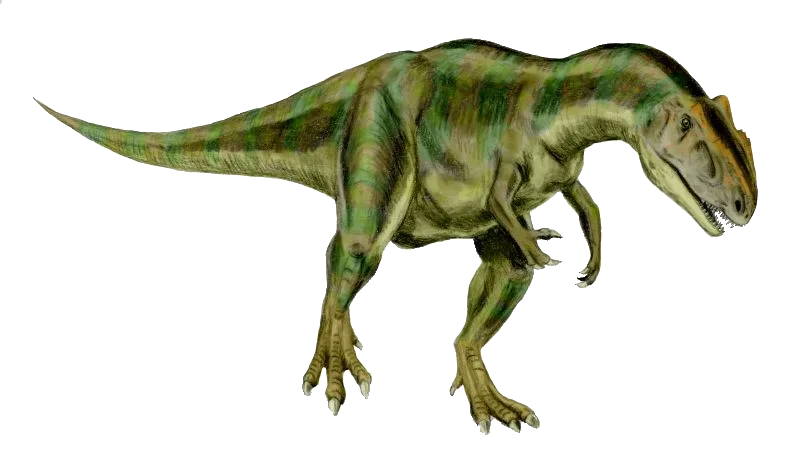
Allosaurus BW.jpg — Nobu Tamura (http://spinops.blogspot.com) · CC BY 2.5
Pictures
Spin it in 3D
3D model description: a 3D model of Allosaurus shaped from a scientific life reconstruction painting, with the painting's colours and skin texture wrapped around it. It is not a scan of a real fossil.
About this model
This model is shaped from a scientific life reconstruction by Nobu Tamura (http://spinops.blogspot.com): the painting's outline gives the 3D body and the painting itself is its skin. It is sized to the real animal's length (about 9.3 m), so in AR it appears life-size!
It looks best from the side, like the painting it comes from. It is not a fossil scan — museums such as the Smithsonian 3D collection share real fossil scans you can explore.
What might it sound like?
Transcript: Deep, rasping growl that rises and fades, about 3 seconds
🤔 Nobody knows exactly how dinosaurs sounded
This is a scientific guess. Allosaurus was big, so it probably made low sounds, and its closest living relatives, birds and crocodiles, often growl, hiss or boom with closed mouths. No soft tissue from its throat survives, so the real sound is unknown.
Voice boxes and soft tissue almost never fossilise, so sound reconstructions use clues: body size (bigger animals make lower sounds), the calls of living relatives (crocodiles boom with closed mouths; birds coo and hiss), and hollow structures such as hadrosaur crests that could have worked like a trumpet.
Sound: synthesised by DinoVerse from these scientific ideas (CC0). It is a creative guess, not a recording.
Food and habits
Carnivore
Meat-eater
How it ate
Opened its jaws very wide and slammed its upper teeth down like a hatchet, slicing flesh with knife-like serrated teeth and pulling back with its strong neck.
🔍 How do we know?
- Allosaurus bite marks on sauropod and Stegosaurus bones
- a Stegosaurus spike wound in an Allosaurus tail bone
- Allosaurus tooth marks on other Allosaurus bones
- blade-shaped serrated teeth
Arrows show energy moving up the food chain: from food to eater.
Watch it call
Quick facts
| 📏 Length | 8.5–10 m (28–33 ft) |
|---|---|
| ↕️ Height | 2.3–3 m (8–10 ft) |
| ⚖️ Weight | 1,500–2,500 kg (3,310–5,510 lb) |
| ⏳ When it lived | 155–145 million years ago (Late Jurassic) |
| 📍 Fossils found | Cleveland-Lloyd Dinosaur Quarry, Utah, USA; Garden Park, Colorado, USA; Como Bluff, Wyoming, USA; Lourinhã Formation, Portugal |
| 🔎 Discovered | 1877 by Othniel Charles Marsh |
| 🧬 Group | Theropods — Saurischia › Theropoda |
Where scientists disagree, we show a range. Sizes are for adults.
How big was it?
Where and when
- 📍 Cleveland-Lloyd Dinosaur Quarry, Utah, USA (North America)
- 📍 Garden Park, Colorado, USA (North America)
- 📍 Como Bluff, Wyoming, USA (North America)
- 📍 Lourinhã Formation, Portugal (Europe)
Lived 155–145 million years ago
That's about 150 million years before you were born! Humans have only existed for about 0.3 million years.
See it on the big timeline →Did you know?
- 1Allosaurus lived about 80 million years before T. rex, so they never met.
- 2It had small horns above its eyes, like little eyebrows.
- 3A famous Allosaurus called 'Big Al' had lots of broken bones and infections, but kept going for a long time.
- 4Allosaurus may have attacked Stegosaurus, and sometimes got hurt by its spiky tail!
- Computer models of the skull suggest Allosaurus had a relatively weak bite for its size but a very strong skull, so it may have attacked with a fast 'hatchet' strike of the upper jaw rather than a crushing bite.
- A tail vertebra pierced by a Stegosaurus thagomizer spike, and a Stegosaurus neck plate with an Allosaurus-shaped bite, record real fights between these two animals.
- The specimen 'Big Al', found in Wyoming in 1991, shows at least 19 injuries and infections, giving rare insight into how hard life was for a large predator.
- Bite marks made by Allosaurus on other Allosaurus bones suggest it sometimes scavenged or cannibalised its own kind, especially when food was scarce.
- Several species are now recognised, including Allosaurus fragilis, A. jimmadseni (named in 2020) and A. europaeus from Portugal.
Myth vs fact
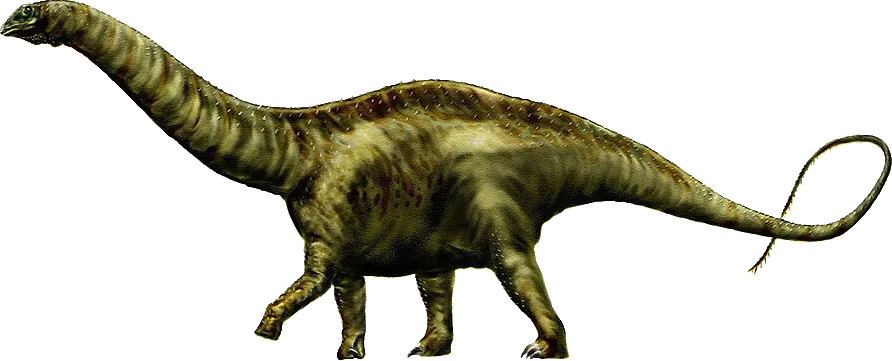
❌ MythAllosaurus hunted giant adult sauropods like Diplodocus by itself.
✅ FactHealthy adult sauropods were probably too large. Allosaurus most likely targeted young, sick or smaller animals, and scavenged big carcasses.
Mini quiz
1. When did Allosaurus live?
2. What was the famous injured Allosaurus nicknamed?
3. Which spiky plant-eater sometimes fought Allosaurus?
Related animals
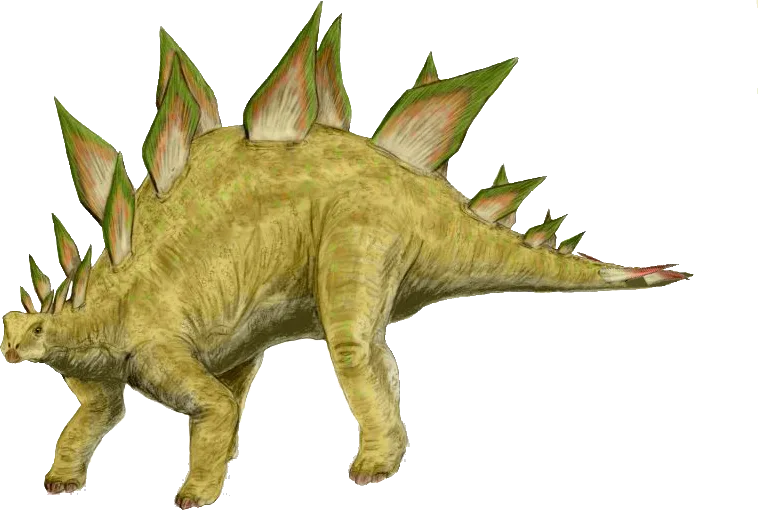
Stegosaurus
StegosaurLate JurassicHerbivore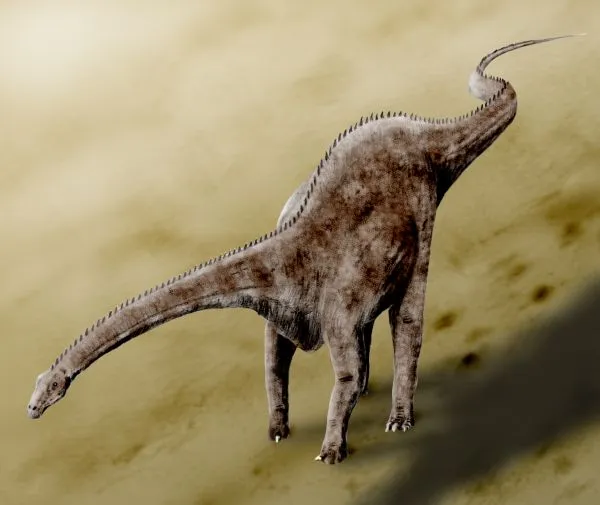
Diplodocus
SauropodLate JurassicHerbivore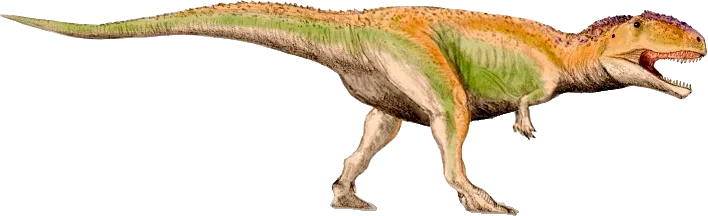
Giganotosaurus
TheropodLate CretaceousCarnivore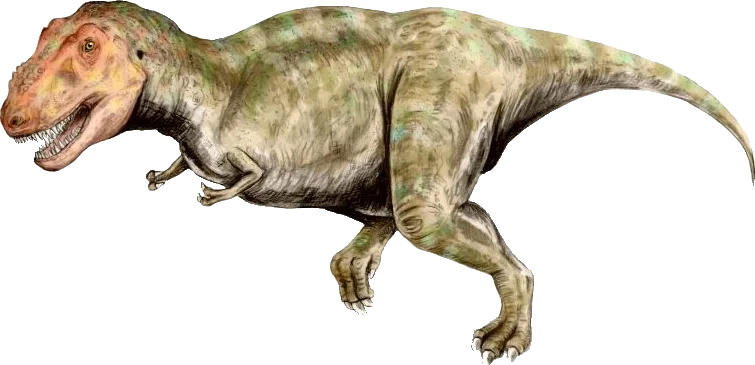
Tyrannosaurus rex
TheropodLate CretaceousCarnivore
Sources
Media on this page
- Allosaurus BW.jpg — Nobu Tamura (http://spinops.blogspot.com) · CC BY 2.5
- Fern in forest by I. Levitan (1895, N. Novgorod).jpg — Isaac Levitan · Public domain
- Allosaurus 3D model, shaped from the life reconstruction "Allosaurus BW.jpg" — Nobu Tamura (http://spinops.blogspot.com) (artwork); 3D shaping by DinoVerse · CC BY 2.5
- Allosaurus reconstructed call (synthesised) — DinoVerse (synthesised) · CC0 1.0
- WLA hmns Allosaurus White Background.jpg — The_Wookies · CC BY 2.5
- AMNH Allosaurus.jpg — ScottRobertAnselmo · CC BY-SA 3.0
- Allosaurus-fragilis-Klauen.JPG — Domser · CC BY-SA 3.0
- Allosaurus4.jpg — Charles Robert Knight · Public domain