Giganotosaurus
Name means “Giant southern lizard”
Giganotosaurus was one of the biggest meat-eating dinosaurs ever, as long as T. rex. It lived in South America and had a long head full of knife-like teeth.
Giganotosaurus carolinii was a carcharodontosaurid theropod from the early Late Cretaceous of Patagonia and rivals Tyrannosaurus as one of the largest land predators known. Unlike T. rex it had a narrower skull and thin slicing teeth, suggesting it wounded large prey with cutting bites rather than crushing bone.
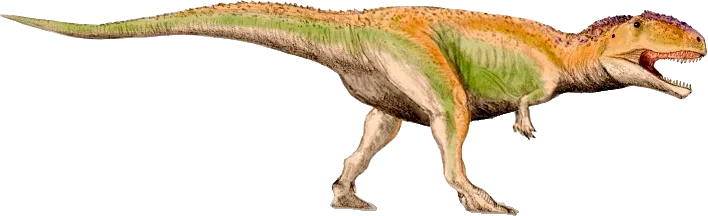
Giganotosaurus BW.jpg — Nobu Tamura (http://spinops.blogspot.com) · CC BY 2.5
Pictures
Spin it in 3D
3D model description: a 3D model of Giganotosaurus shaped from a scientific life reconstruction painting, with the painting's colours and skin texture wrapped around it. It is not a scan of a real fossil.
About this model
This model is shaped from a scientific life reconstruction by Nobu Tamura (http://spinops.blogspot.com): the painting's outline gives the 3D body and the painting itself is its skin. It is sized to the real animal's length (about 12.5 m), so in AR it appears life-size!
It looks best from the side, like the painting it comes from. It is not a fossil scan — museums such as the Smithsonian 3D collection share real fossil scans you can explore.
What might it sound like?
Transcript: Very deep, rumbling closed-mouth boom that you might feel more than hear, about 4 seconds
🤔 Nobody knows exactly how dinosaurs sounded
This is a scientific guess. Huge animals tend to make very low sounds, and dinosaurs' living relatives, crocodiles and birds such as emus and bitterns, make deep booms with their mouths closed. No dinosaur voice box has been found for Giganotosaurus.
Voice boxes and soft tissue almost never fossilise, so sound reconstructions use clues: body size (bigger animals make lower sounds), the calls of living relatives (crocodiles boom with closed mouths; birds coo and hiss), and hollow structures such as hadrosaur crests that could have worked like a trumpet.
Sound: synthesised by DinoVerse from these scientific ideas (CC0). It is a creative guess, not a recording.
Food and habits
Carnivore
Meat-eater
How it ate
Sliced big chunks of flesh from large prey with thin, blade-like serrated teeth, using a long, narrow skull rather than a bone-crushing bite.
🔍 How do we know?
- flat, blade-shaped serrated teeth built for slicing
- lower-jaw shape suited to cutting bites
- large sauropods found in the same rocks
It ate…
- Limaysaurus
- Andesaurus
- young titanosaurs
- ornithopods
Giganotosaurus
…and was eaten by
👑 Probably nothing, once fully grown — a top predator or too big to tackle!
Arrows show energy moving up the food chain: from food to eater.
Watch it call
Quick facts
| 📏 Length | 12–13 m (39–43 ft) |
|---|---|
| ↕️ Height | 3.5–4 m (11–13 ft) |
| ⚖️ Weight | 6,000–8,000 kg (13,230–17,640 lb) |
| ⏳ When it lived | 99–97 million years ago (Late Cretaceous) |
| 📍 Fossils found | Candeleros Formation, near Villa El Chocón, Neuquén, Argentina |
| 🔎 Discovered | 1993 by Rubén Carolini (named by Rodolfo Coria and Leonardo Salgado in 1995) |
| 🧬 Group | Theropods — Saurischia › Theropoda |
Where scientists disagree, we show a range. Sizes are for adults.
How big was it?
Where and when
- 📍 Candeleros Formation, near Villa El Chocón, Neuquén, Argentina (South America)
Lived 99–97 million years ago
That's about 98 million years before you were born! Humans have only existed for about 0.3 million years.
See it on the big timeline →Did you know?
- 1Giganotosaurus was about as long as a school bus.
- 2A man named Rubén Carolini found it while driving around looking for fossils in Argentina.
- 3Its teeth were thin and sharp, like steak knives.
- 4Be careful with spelling: 'Gigantosaurus' (with a T) is a totally different dinosaur, a long-necked plant-eater!
- Size estimates for the main specimen have ranged widely, from about 4 to over 13 tonnes in different studies, but most recent work places it around 6 to 8 tonnes, similar to large T. rex individuals.
- Its brain was relatively small for its body, and its braincase shows it had a strong sense of smell, a trait shared with other carcharodontosaurids.
- Studies of its lower jaw suggest a bite good at slicing soft tissue but much weaker than T. rex's bone-crushing bite.
- It belongs to the carcharodontosaurids, a family of 'shark-toothed' giants that also includes Carcharodontosaurus from Africa and Mapusaurus from Argentina.
Myth vs fact
❌ MythGiganotosaurus hunted the giant sauropod Argentinosaurus.
✅ FactArgentinosaurus comes from slightly younger rocks (the Huincul Formation), so they probably never met. A close relative, Mapusaurus, did share its world.
❌ MythGiganotosaurus and T. rex fought each other.
✅ FactThey lived about 30 million years apart on different continents.
Mini quiz
1. In which country was Giganotosaurus found?
2. What were Giganotosaurus's teeth like?
3. What does 'Giganotosaurus' mean?
Related animals
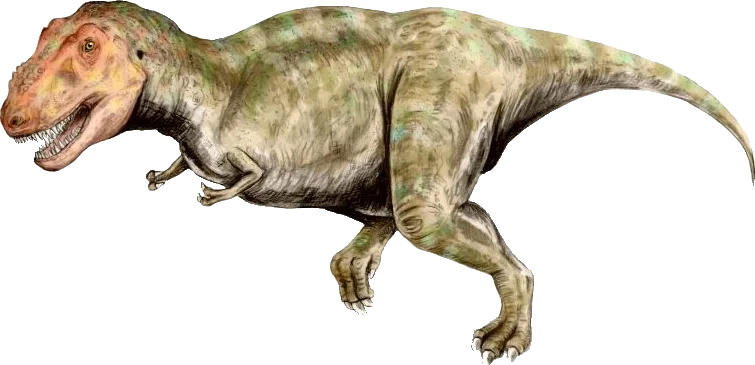
Tyrannosaurus rex
TheropodLate CretaceousCarnivore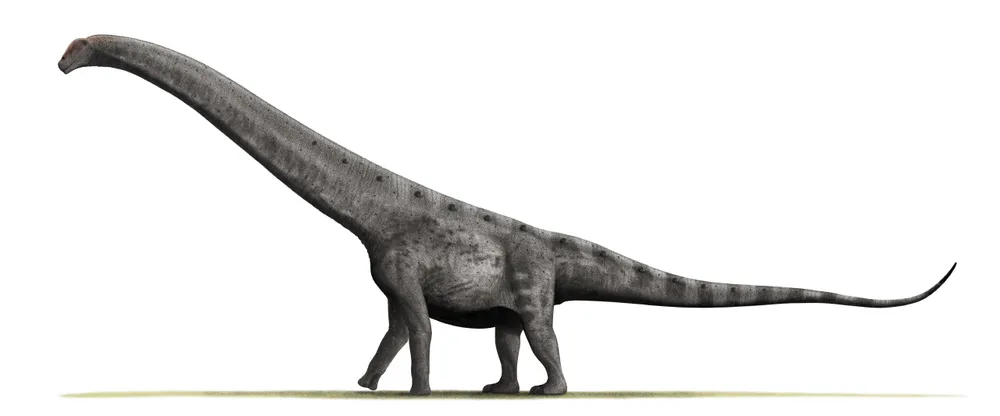
Argentinosaurus
SauropodLate CretaceousHerbivore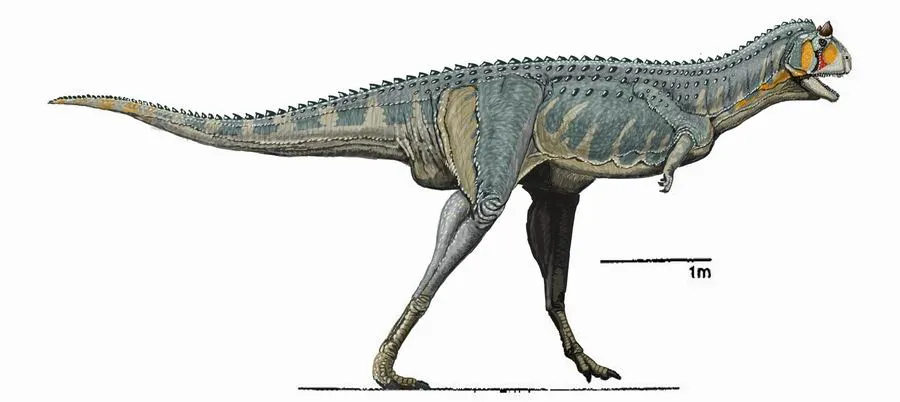
Carnotaurus
TheropodLate CretaceousCarnivore
Spinosaurus
TheropodLate CretaceousPiscivore
Sources
Media on this page
- Giganotosaurus BW.jpg — Nobu Tamura (http://spinops.blogspot.com) · CC BY 2.5
- Fern in forest by I. Levitan (1895, N. Novgorod).jpg — Isaac Levitan · Public domain
- Giganotosaurus 3D model, shaped from the life reconstruction "Giganotosaurus BW.jpg" — Nobu Tamura (http://spinops.blogspot.com) (artwork); 3D shaping by DinoVerse · CC BY 2.5
- Giganotosaurus reconstructed call (synthesised) — DinoVerse (synthesised) · CC0 1.0
- Giganotosaurus at Fernbank.jpg — Jonathan Chen · CC BY-SA 4.0
- 205 Arg ElChocon Museo Giganotosauro.JPG — Simona.cerrato · CC BY-SA 3.0
- Dientes fósiles de Giganotosaurus en el museo de El Chocón.JPG — Neloadino · CC BY-SA 4.0
- Fernbank Museum- Argentine Dinosaur Exhibit Giganotosaurus from above.jpg — Gary Todd · Public domain