Carnotaurus
Name means “Meat-eating bull”
Carnotaurus was a speedy meat-eater with two horns above its eyes, like a bull. Its arms were super tiny, even smaller than T. rex's.
Carnotaurus sastrei was an abelisaurid theropod from Late Cretaceous Patagonia, known from a single remarkably complete skeleton with large patches of skin impressions. Its thick brow horns, deep short skull, stubby forelimbs and powerful tail muscles make it one of the most unusual large predators known.
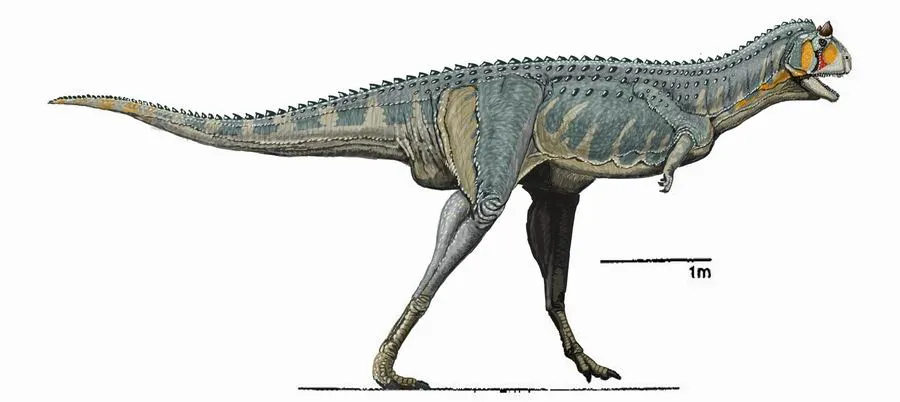
Carnotaurus DB.jpg — DiBgd at English Wikipedia · CC BY 2.5
Pictures
Spin it in 3D
3D model description: a smooth, rounded model of Carnotaurus built from the DinoVerse illustration, showing its overall body shape and proportions. It is not a scan of a real fossil.
About this model
This is a simplified body-shape model, sized to the real animal's length (about 7.8 m). In AR it appears life-size!
It looks best from the side, like the painting it comes from. It is not a fossil scan — museums such as the Smithsonian 3D collection share real fossil scans you can explore.
What might it sound like?
Transcript: Short, gravelly growl followed by a snorting huff, about 2 seconds
🤔 Nobody knows exactly how dinosaurs sounded
This is a scientific guess. Like other large theropods, Carnotaurus was related to birds and crocodiles, which make closed-mouth growls, hisses and booms. Its size suggests a fairly deep voice, but no one knows the real sound.
Voice boxes and soft tissue almost never fossilise, so sound reconstructions use clues: body size (bigger animals make lower sounds), the calls of living relatives (crocodiles boom with closed mouths; birds coo and hiss), and hollow structures such as hadrosaur crests that could have worked like a trumpet.
Sound: synthesised by DinoVerse from these scientific ideas (CC0). It is a creative guess, not a recording.
Food and habits
Carnivore
Meat-eater
How it ate
Probably made quick, snapping bites at smaller prey with a short, deep skull and many slender teeth, since its tiny arms could not help it grab.
🔍 How do we know?
- long, narrow serrated teeth
- skull shape suited to fast bites
- large predator body plan
It ate…
- young titanosaurs
- ornithopods
- small reptiles
- carcasses
Carnotaurus
…and was eaten by
👑 Probably nothing, once fully grown — a top predator or too big to tackle!
Arrows show energy moving up the food chain: from food to eater.
Watch it walk
Quick facts
| 📏 Length | 7.5–8 m (25–26 ft) |
|---|---|
| ↕️ Height | 2–2.5 m (7–8 ft) |
| ⚖️ Weight | 1,300–2,100 kg (2,870–4,630 lb) |
| ⏳ When it lived | 72–69 million years ago (Late Cretaceous) |
| 📍 Fossils found | La Colonia Formation, Chubut Province, Argentina |
| 🔎 Discovered | 1984 by José Bonaparte's expedition (named by Bonaparte in 1985) |
| 🧬 Group | Theropods — Saurischia › Theropoda |
Where scientists disagree, we show a range. Sizes are for adults.
How big was it?
Where and when
- 📍 La Colonia Formation, Chubut Province, Argentina (South America)
Lived 72–69 million years ago
That's about 71 million years before you were born! Humans have only existed for about 0.3 million years.
See it on the big timeline →Did you know?
- 1Carnotaurus had two thick horns over its eyes, just like a bull.
- 2Its arms were so tiny they were almost useless, even smaller than T. rex's arms!
- 3We know what its skin looked like because the fossil kept prints of its bumpy scales.
- 4It had very strong tail muscles, so it may have been one of the fastest big meat-eaters.
- The only known skeleton, found in 1984, preserves extensive skin impressions showing small, non-overlapping scales scattered with larger cone-shaped feature scales, and no sign of feathers.
- Its forearm bones were extremely shortened; the hand bones were fused and probably could barely move, an extreme version of a trend seen in many abelisaurids.
- Enlarged tail ribs anchored a very large caudofemoralis muscle, which suggests strong running ability in a straight line, although its turning ability was probably limited.
- The purpose of the horns is debated: proposals include head-butting or shoving rivals, display to mates, or both.
Myth vs fact
❌ MythCarnotaurus could change colour like a chameleon.
✅ FactThis idea came from fiction. Its skin fossils show the texture of its scales but not their colour, and there is no evidence it could change colour.
Mini quiz
1. What does 'Carnotaurus' mean?
2. Which continent did Carnotaurus live on?
3. What did scientists find with the Carnotaurus skeleton that tells us about its skin?
Related animals
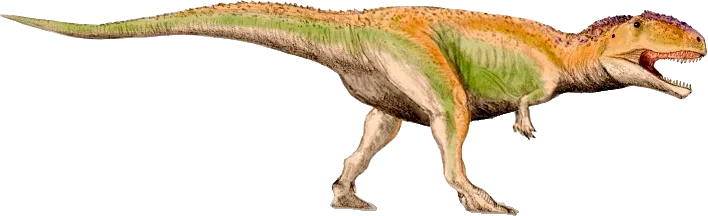
Giganotosaurus
TheropodLate CretaceousCarnivore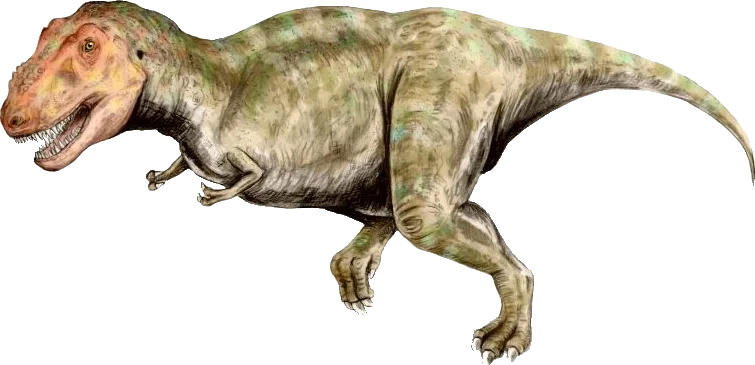
Tyrannosaurus rex
TheropodLate CretaceousCarnivore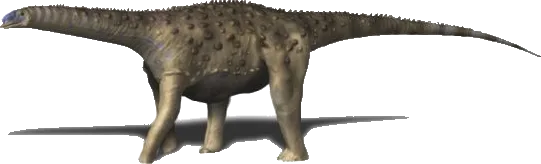
Saltasaurus
SauropodLate CretaceousHerbivore
Sources
Media on this page
- Carnotaurus DB.jpg — DiBgd at English Wikipedia · CC BY 2.5
- Fern in forest by I. Levitan (1895, N. Novgorod).jpg — Isaac Levitan · Public domain
- Carnotaurus simplified 3D model — DinoVerse (generated from original artwork) · CC0 1.0
- Carnotaurus reconstructed call (synthesised) — DinoVerse (synthesised) · CC0 1.0
- Carnotaurus, Chlupáč Museum, Prague-2.jpg — Carnotaurus, Chlupáč Museum, Prague-2.jpg: Czech Wikipedia user Packa derivative work: Hic · CC BY-SA 3.0
- Carnotaurus-tail-vertebra-caudal-ribs.png — Persons, W. S.; Currie, P. J. · CC BY 2.5
- Carnotaurus Los Angeles County Museum 15.jpg — Jens Lallensack · CC BY-SA 4.0
- Carnotaurus Reconstruction (2022).png — Fred Wierum · CC BY-SA 4.0