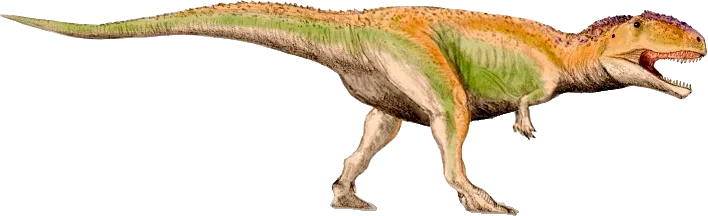
Say it: JIG-a-NOTE-oh-SORE-us · Name means: “Giant southern lizard”
Key facts about Giganotosaurus
⏳ Lived
99–97 million years ago Late Cretaceous
🥩 Diet
Carnivore (meat-eater)
📏 Length
12–13 m (39–43 ft)
↕️ Height
3.5–4 m (11–13 ft)
⚖️ Weight
6,000–8,000 kg (13,230–17,640 lb)
📍 Found in
South America
🔎 Discovered
1993 by Rubén Carolini (named by Rodolfo Coria and Leonardo Salgado in 1995)
About Giganotosaurus
Giganotosaurus was one of the biggest meat-eating dinosaurs ever, as long as T. rex. It lived in South America and had a long head full of knife-like teeth.
Giganotosaurus carolinii was a carcharodontosaurid theropod from the early Late Cretaceous of Patagonia and rivals Tyrannosaurus as one of the largest land predators known. Unlike T. rex it had a narrower skull and thin slicing teeth, suggesting it wounded large prey with cutting bites rather than crushing bone.
Drawn to scale next to a 1.7 m adult and a 12 m school bus.
Did you know?
Giganotosaurus was about as long as a school bus.
A man named Rubén Carolini found it while driving around looking for fossils in Argentina.
Its teeth were thin and sharp, like steak knives.
Be careful with spelling: 'Gigantosaurus' (with a T) is a totally different dinosaur, a long-necked plant-eater!
Size estimates for the main specimen have ranged widely, from about 4 to over 13 tonnes in different studies, but most recent work places it around 6 to 8 tonnes, similar to large T. rex individuals.
Its brain was relatively small for its body, and its braincase shows it had a strong sense of smell, a trait shared with other carcharodontosaurids.
Studies of its lower jaw suggest a bite good at slicing soft tissue but much weaker than T. rex's bone-crushing bite.
It belongs to the carcharodontosaurids, a family of 'shark-toothed' giants that also includes Carcharodontosaurus from Africa and Mapusaurus from Argentina.
DinoVerse· Giganotosaurus fact sheet
Theropods
🥩 What did it eat?
Food: Limaysaurus, Andesaurus, young titanosaurs, ornithopods.
Sliced big chunks of flesh from large prey with thin, blade-like serrated teeth, using a long, narrow skull rather than a bone-crushing bite.
Clues scientists use: flat, blade-shaped serrated teeth built for slicing; lower-jaw shape suited to cutting bites; large sauropods found in the same rocks.
🗺️ Where fossils were found
Candeleros Formation, near Villa El Chocón, Neuquén, Argentina (South America)
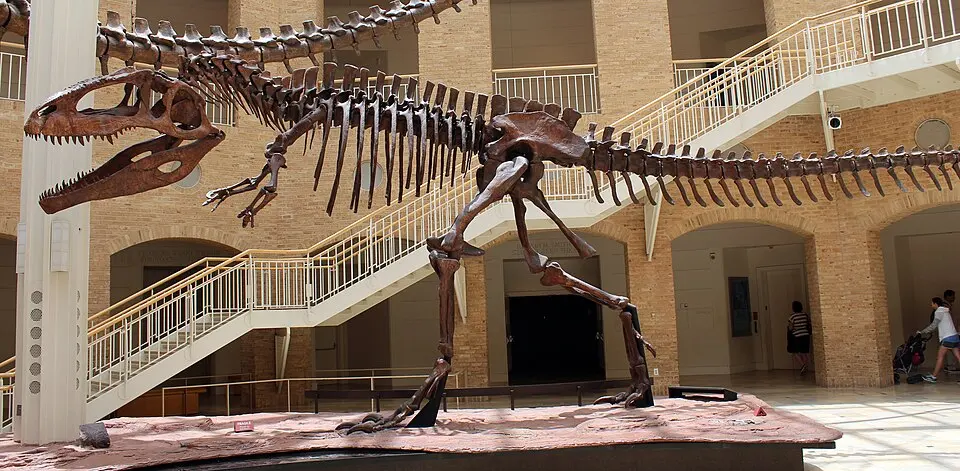
Skeleton / museum mount of Giganotosaurus: Giganotosaurus skeleton mount at the Fernbank Museum of Natural…
Myth or fact?
✗ Myth: Giganotosaurus hunted the giant sauropod Argentinosaurus.
✓ Fact: Argentinosaurus comes from slightly younger rocks (the Huincul Formation), so they probably never met. A close relative, Mapusaurus, did share its world.
✗ Myth: Giganotosaurus and T. rex fought each other.
✓ Fact: They lived about 30 million years apart on different continents.
✏️ Quick quiz
Circle the right answer. Name: ______________________
In which country was Giganotosaurus found?
A China
B Argentina
C USA
D Egypt
What were Giganotosaurus's teeth like?
A Flat like a cow's
B Thin and sharp like knives
C Round like pebbles
D It had no teeth
What does 'Giganotosaurus' mean?
A Tiny northern lizard
B Fast hunter
C Giant southern lizard
D Shark tooth
Answers: 1–B 2–B 3–C
Sources and picture credits
Natural History Museum London — Giganotosaurus — www.nhm.ac.uk/discover/dino-directory/giganotosaurus.html
Wikipedia — Giganotosaurus — en.wikipedia.org/wiki/Giganotosaurus
 DinoVerse · Dinosaur fact sheet