Argentinosaurus
Name means “Argentina lizard”
Argentinosaurus was one of the biggest animals ever to walk on land. It was a long-necked plant-eater that weighed more than ten elephants.
Argentinosaurus huinculensis was a giant titanosaur sauropod from the early Late Cretaceous of Patagonia, Argentina. Although known only from a handful of vertebrae, ribs and limb pieces, it is among the strongest candidates for the heaviest land animal ever found.
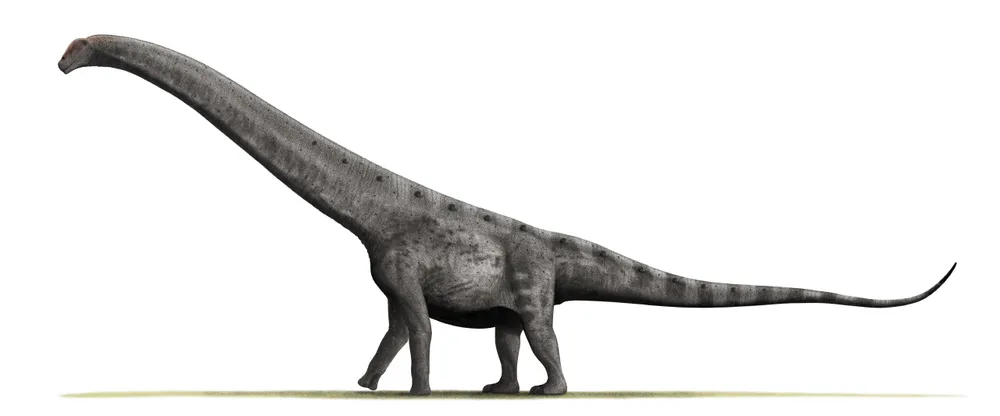
Argentinosaurus BW.jpg — Nobu Tamura (http://spinops.blogspot.com) · CC BY 3.0
Pictures
Spin it in 3D
3D model description: a 3D model of Argentinosaurus shaped from a scientific life reconstruction painting, with the painting's colours and skin texture wrapped around it. It is not a scan of a real fossil.
About this model
This model is shaped from a scientific life reconstruction by Dinosaur Zoo: the painting's outline gives the 3D body and the painting itself is its skin. It is sized to the real animal's length (about 32.5 m), so in AR it appears life-size!
It looks best from the side, like the painting it comes from. It is not a fossil scan — museums such as the Smithsonian 3D collection share real fossil scans you can explore.
What might it sound like?
Transcript: Extremely deep, slow rumbling boom, about 5 seconds long
🤔 Nobody knows exactly how dinosaurs sounded
Nobody knows what Argentinosaurus sounded like. The bigger an animal is, the deeper its voice tends to be, and dinosaurs' living relatives, birds and crocodiles, make closed-mouth booms, so scientists guess it made some of the lowest sounds of any dinosaur.
Voice boxes and soft tissue almost never fossilise, so sound reconstructions use clues: body size (bigger animals make lower sounds), the calls of living relatives (crocodiles boom with closed mouths; birds coo and hiss), and hollow structures such as hadrosaur crests that could have worked like a trumpet.
Sound: synthesised by DinoVerse from these scientific ideas (CC0). It is a creative guess, not a recording.
Food and habits
Herbivore
Plant-eater
How it ate
Used its long neck to sweep over a wide area of plants without moving its gigantic body, biting off leaves and swallowing them unchewed to be fermented in its enormous gut.
🔍 How do we know?
- comparison with related titanosaurs' teeth and skulls
- huge body cavity for slow plant digestion
- plant fossils from the same rock layers
It ate…
- Conifer leaves (monkey-puzzle relatives)
- Ferns
- Cycads
- Early flowering plants
Argentinosaurus
…and was eaten by
- Mapusaurus
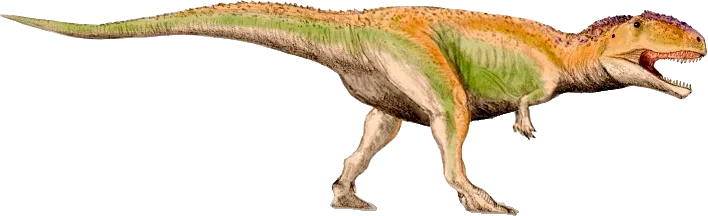 Giganotosaurus
Arrows show energy moving up the food chain: from food to eater.
Watch it feed
Quick facts
| 📏 Length | 30–35 m (98–115 ft) |
|---|---|
| ↕️ Height | 6–8 m (20–26 ft) |
| ⚖️ Weight | 50,000–95,000 kg (110,230–209,440 lb) |
| ⏳ When it lived | 97–93 million years ago (Late Cretaceous) |
| 📍 Fossils found | Huincul Formation, near Plaza Huincul, Neuquén, Argentina |
| 🔎 Discovered | 1987 by Guillermo Heredia (named by José Bonaparte and Rodolfo Coria, 1993) |
| 🧬 Group | Sauropods — Saurischia › Sauropodomorpha › Sauropoda |
Where scientists disagree, we show a range. Sizes are for adults.
How big was it?
Where and when
- 📍 Huincul Formation, near Plaza Huincul, Neuquén, Argentina (South America)
Lived 97–93 million years ago
That's about 95 million years before you were born! Humans have only existed for about 0.3 million years.
See it on the big timeline →Did you know?
- 1One of Argentinosaurus's backbones was taller than a grown-up person!
- 2The farmer who found the first bone thought it was a piece of stone wood.
- 3Like other titanosaurs, it probably hatched from an egg not much bigger than a coconut and grew into a giant.
- 4It may have weighed as much as 15 elephants!
- Only a few bones are known, including vertebrae up to about 1.6 m tall, ribs and part of a thigh bone, so its size is estimated by comparison with more complete titanosaurs.
- Published mass estimates range from about 50 tonnes to over 90 tonnes; much of the disagreement comes from whether scientists scale from limb bones or build 3D volume models.
- A 2013 computer simulation suggested it could walk at only about 2 metres per second (roughly 7 km/h), limited by the stress on its leg joints.
- The large carcharodontosaurid Mapusaurus shared its environment; bonebeds of several Mapusaurus individuals have led some to suggest group hunting, though this is debated.
Myth vs fact
❌ MythGiant sauropods like Argentinosaurus lived in lakes so the water could hold up their weight.
✅ FactTitanosaurs had sturdy pillar-like legs and wide-gauge trackways show they walked on land. Water pressure would have made breathing nearly impossible.
❌ MythWe know exactly how big Argentinosaurus was.
✅ FactBecause so few bones have been found, its size is shown as a range. Scientists still argue about whether it, Patagotitan or another titanosaur was the heaviest.
Mini quiz
1. On which continent was Argentinosaurus found?
2. What did the farmer first think the giant bone was?
3. What kind of food did Argentinosaurus eat?
Related animals
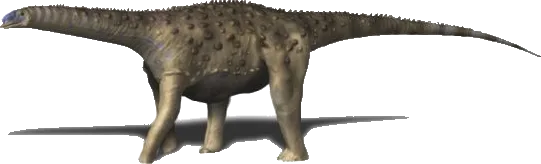
Saltasaurus
SauropodLate CretaceousHerbivoreGiganotosaurus
TheropodLate CretaceousCarnivore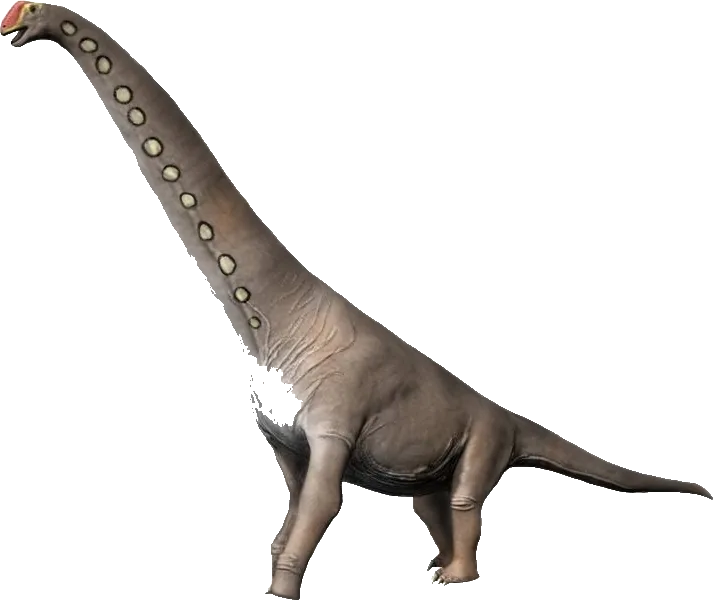
Brachiosaurus
SauropodLate JurassicHerbivore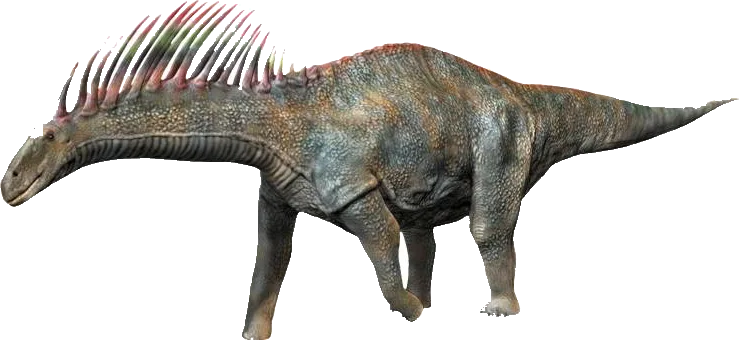
Amargasaurus
SauropodEarly CretaceousHerbivore
Sources
Media on this page
- Argentinosaurus BW.jpg — Nobu Tamura (http://spinops.blogspot.com) · CC BY 3.0
- Fern in forest by I. Levitan (1895, N. Novgorod).jpg — Isaac Levitan · Public domain
- Argentinosaurus 3D model, shaped from the life reconstruction "Argentinosaurus digital clay reconstruction.png" — Dinosaur Zoo (artwork); 3D shaping by DinoVerse · CC BY-SA 3.0
- Argentinosaurus reconstructed call (synthesised) — DinoVerse (synthesised) · CC0 1.0
- Argentinosaurus skeleton, PLoS ONE.png — William Irvin Sellers, Lee Margetts, Rodolfo Aníbal Coria, Phillip Lars Manning · CC BY 2.5
- Argentinosaurus.jpg — James Emery from Douglasville, United States · CC BY 2.0
- Argentinosaurus BW.jpg — Nobu Tamura (http://spinops.blogspot.com) · CC BY 3.0
- Argentinosaurus LACM.jpg — Matt J. Wedel · CC BY 3.0