Say it: AR-jen-TEEN-oh-SORE-us · Name means: “Argentina lizard”
Key facts about Argentinosaurus
⏳ Lived
97–93 million years ago Late Cretaceous
🌿 Diet
Herbivore (plant-eater)
📏 Length
30–35 m (98–115 ft)
↕️ Height
6–8 m (20–26 ft)
⚖️ Weight
50,000–95,000 kg (110,230–209,440 lb)
📍 Found in
South America
🔎 Discovered
1987 by Guillermo Heredia (named by José Bonaparte and Rodolfo Coria, 1993)
About Argentinosaurus
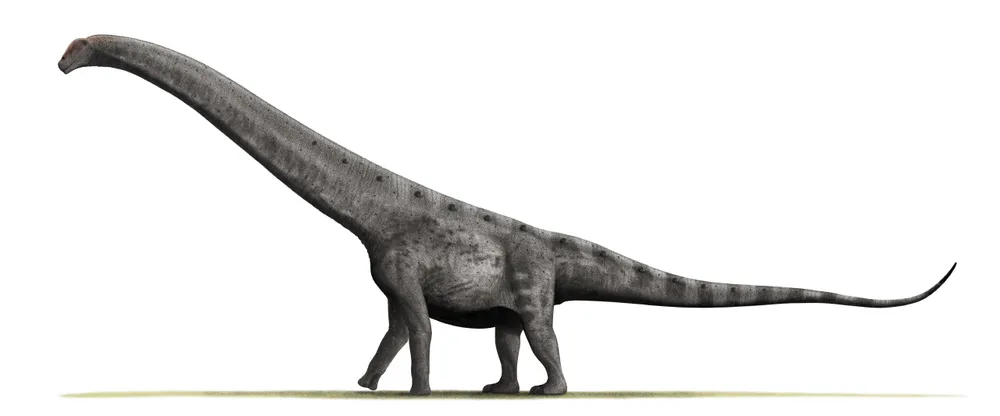
Argentinosaurus was one of the biggest animals ever to walk on land. It was a long-necked plant-eater that weighed more than ten elephants.
Argentinosaurus huinculensis was a giant titanosaur sauropod from the early Late Cretaceous of Patagonia, Argentina. Although known only from a handful of vertebrae, ribs and limb pieces, it is among the strongest candidates for the heaviest land animal ever found.
Drawn to scale next to a 1.7 m adult and a 12 m school bus.
Did you know?
One of Argentinosaurus's backbones was taller than a grown-up person!
The farmer who found the first bone thought it was a piece of stone wood.
Like other titanosaurs, it probably hatched from an egg not much bigger than a coconut and grew into a giant.
It may have weighed as much as 15 elephants!
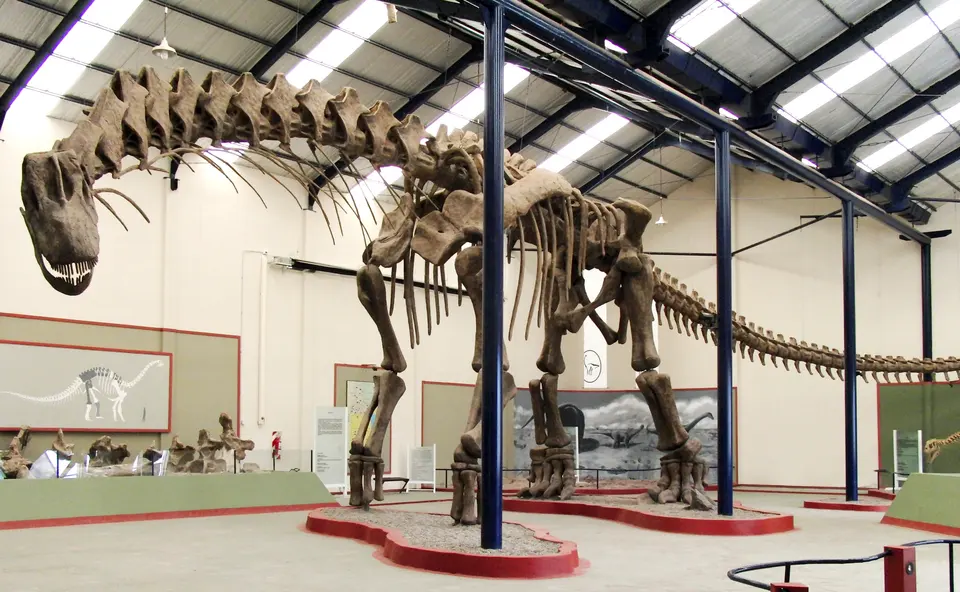
Only a few bones are known, including vertebrae up to about 1.6 m tall, ribs and part of a thigh bone, so its size is estimated by comparison with more complete titanosaurs.
Published mass estimates range from about 50 tonnes to over 90 tonnes; much of the disagreement comes from whether scientists scale from limb bones or build 3D volume models.
A 2013 computer simulation suggested it could walk at only about 2 metres per second (roughly 7 km/h), limited by the stress on its leg joints.
The large carcharodontosaurid Mapusaurus shared its environment; bonebeds of several Mapusaurus individuals have led some to suggest group hunting, though this is debated.
DinoVerse· Argentinosaurus fact sheet
Sauropods
🌿 What did it eat?
Food: Conifer leaves (monkey-puzzle relatives), Ferns, Cycads, Early flowering plants.
Used its long neck to sweep over a wide area of plants without moving its gigantic body, biting off leaves and swallowing them unchewed to be fermented in its enormous gut.
Clues scientists use: comparison with related titanosaurs' teeth and skulls; huge body cavity for slow plant digestion; plant fossils from the same rock layers.
Who might have hunted it: Mapusaurus, Giganotosaurus.
🗺️ Where fossils were found
Huincul Formation, near Plaza Huincul, Neuquén, Argentina (South America)
Skeleton / museum mount of Argentinosaurus: Argentinosaurus huinculensis reconstruction at Museo Municipal…
Myth or fact?
✗ Myth: Giant sauropods like Argentinosaurus lived in lakes so the water could hold up their weight.
✓ Fact: Titanosaurs had sturdy pillar-like legs and wide-gauge trackways show they walked on land. Water pressure would have made breathing nearly impossible.
✗ Myth: We know exactly how big Argentinosaurus was.
✓ Fact: Because so few bones have been found, its size is shown as a range. Scientists still argue about whether it, Patagotitan or another titanosaur was the heaviest.
✏️ Quick quiz
Circle the right answer. Name: ______________________
On which continent was Argentinosaurus found?
A Africa
B Asia
C South America
D Australia
What did the farmer first think the giant bone was?
A A dragon tooth
B Petrified (stone) wood
C A whale skull
D A meteorite
What kind of food did Argentinosaurus eat?
A Plants
B Fish
C Other dinosaurs
D Insects
Answers: 1–C 2–B 3–A
Sources and picture credits
Natural History Museum London — Argentinosaurus — www.nhm.ac.uk/discover/dino-directory/argentinosaurus.html
Wikipedia — Argentinosaurus — en.wikipedia.org/wiki/Argentinosaurus
 DinoVerse · Dinosaur fact sheet