Diplodocus
Name means “Double beam”
Diplodocus was one of the longest dinosaurs ever, longer than two buses parked end to end. Most of that length was its super-long neck and whip-like tail.
Diplodocus was a diplodocid sauropod from the Late Jurassic Morrison Formation of western North America and one of the best-known dinosaurs thanks to many casts of the Carnegie Museum skeleton. Its long, low-slung neck, peg-like front teeth and enormously long tail made it a specialist at sweeping up and stripping plants.
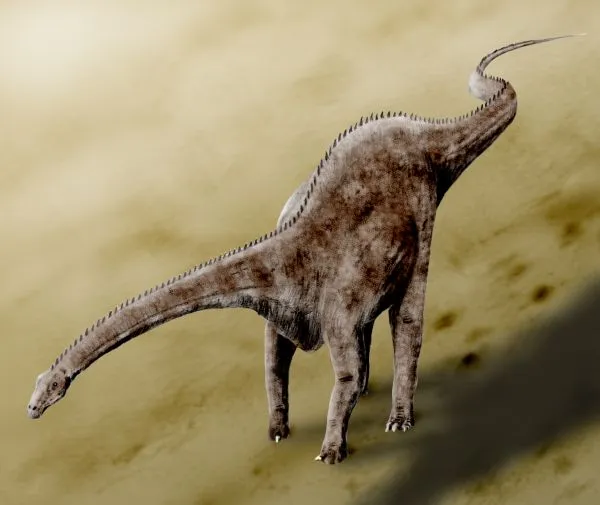
Diplodocus BW.jpg — Nobu Tamura (http://spinops.blogspot.com) · CC BY 3.0
Pictures
Spin it in 3D
3D model description: a 3D model of Diplodocus shaped from a scientific life reconstruction painting, with the painting's colours and skin texture wrapped around it. It is not a scan of a real fossil.
About this model
This model is shaped from a scientific life reconstruction by Creator:Dmitry Bogdanov: the painting's outline gives the 3D body and the painting itself is its skin. It is sized to the real animal's length (about 28.0 m), so in AR it appears life-size!
It looks best from the side, like the painting it comes from. It is not a fossil scan — museums such as the Smithsonian 3D collection share real fossil scans you can explore.
What might it sound like?
Transcript: Low, rolling closed-mouth boom, about 4 seconds long
🤔 Nobody knows exactly how dinosaurs sounded
No dinosaur voice has ever been recorded, so this is a scientific guess. Large animals generally make deep sounds, and Diplodocus's living relatives, birds and crocodiles, can boom with their mouths closed.
Voice boxes and soft tissue almost never fossilise, so sound reconstructions use clues: body size (bigger animals make lower sounds), the calls of living relatives (crocodiles boom with closed mouths; birds coo and hiss), and hollow structures such as hadrosaur crests that could have worked like a trumpet.
Sound: synthesised by DinoVerse from these scientific ideas (CC0). It is a creative guess, not a recording.
Food and habits
Herbivore
Plant-eater
How it ate
Combed leaves off branches with a row of thin, peg-like teeth at the front of its broad snout, pulling its head back to strip the plants, and swallowed them without chewing.
🔍 How do we know?
- peg-like teeth at the front of the jaws
- scratches and pits in tooth wear
- very fast tooth replacement
- skull shape suited to branch-stripping
It ate…
- Ferns
- Horsetails
- Conifer branches
- Cycads
- Ginkgo leaves
Diplodocus
…and was eaten by
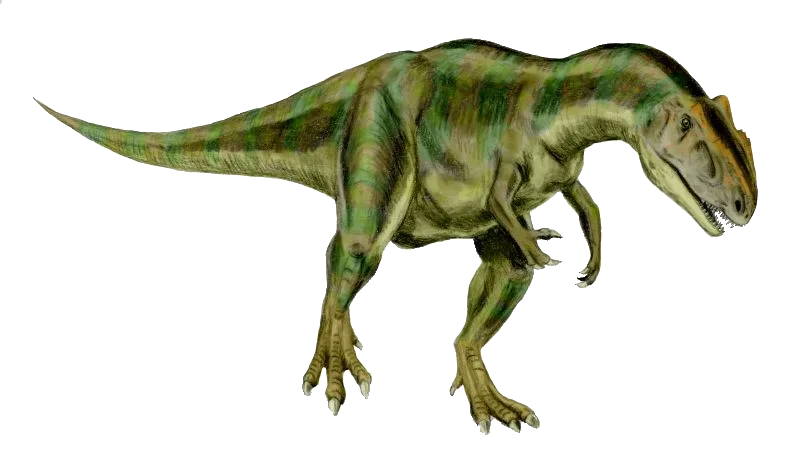 Allosaurus
- Torvosaurus
- Ceratosaurus
Arrows show energy moving up the food chain: from food to eater.
Watch it feed
Quick facts
| 📏 Length | 24–32 m (79–105 ft) |
|---|---|
| ↕️ Height | 4–5 m (13–16 ft) |
| ⚖️ Weight | 11,000–23,000 kg (24,250–50,710 lb) |
| ⏳ When it lived | 154–149 million years ago (Late Jurassic) |
| 📍 Fossils found | Garden Park, Cañon City, Colorado, USA; Sheep Creek, Albany County, Wyoming, USA; Dinosaur National Monument, Utah, USA; Montana, USA |
| 🔎 Discovered | 1877 by Benjamin Mudge and Samuel Wendell Williston (named by O. C. Marsh, 1878) |
| 🧬 Group | Sauropods — Saurischia › Sauropodomorpha › Sauropoda |
Where scientists disagree, we show a range. Sizes are for adults.
How big was it?
Where and when
- 📍 Garden Park, Cañon City, Colorado, USA (North America)
- 📍 Sheep Creek, Albany County, Wyoming, USA (North America)
- 📍 Dinosaur National Monument, Utah, USA (North America)
- 📍 Montana, USA (North America)
Lived 154–149 million years ago
That's about 152 million years before you were born! Humans have only existed for about 0.3 million years.
See it on the big timeline →Did you know?
- 1Diplodocus was about as long as three school buses in a row!
- 2Its tail was so long and thin at the end that it looked like a whip.
- 3Its teeth were shaped like little pegs and it grew new ones about once a month.
- 4A famous Diplodocus skeleton cast called 'Dippy' has toured museums around the world.
- The name 'double beam' refers to the paired, skid-like chevron bones under its tail, which may have protected blood vessels when the tail touched the ground.
- A 1997 computer model suggested the tail tip could crack faster than sound, but a 2022 study using a more detailed model found it probably reached only about 30 metres per second, well below supersonic speed.
- Studies of tooth replacement show each tooth position could be replaced roughly every 35 days, an adaptation to wear from tough, gritty plants.
- Scientists still debate neck posture: neck-joint studies favour a mostly horizontal neck sweeping across low vegetation, while others argue it could also raise its head to browse higher.
- Fossil skin impressions show a row of narrow, keratin-covered spines along the back and tail, so its back may have looked a little like an iguana's.
Myth vs fact
❌ MythDiplodocus spent its life in swamps so the water could hold up its heavy body.
✅ FactIts slim legs, compact feet and trackways on dry ground show it walked on land. Deep water would have pressed on its chest so hard it could barely breathe.
❌ MythDiplodocus dragged its long tail along the ground.
✅ FactTrackways almost never show tail-drag marks. Its tail was held up off the ground, balancing the long neck.
Mini quiz
1. What does 'Diplodocus' mean?
2. What shape were Diplodocus's teeth?
3. What is the name of the famous Diplodocus cast that toured museums?
Related animals
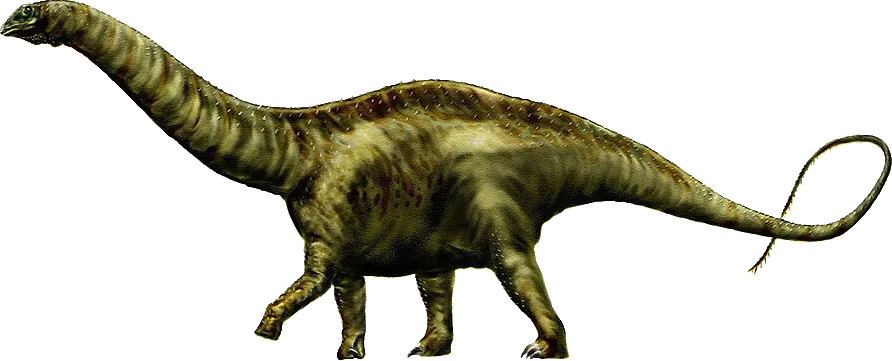
Apatosaurus
SauropodLate JurassicHerbivore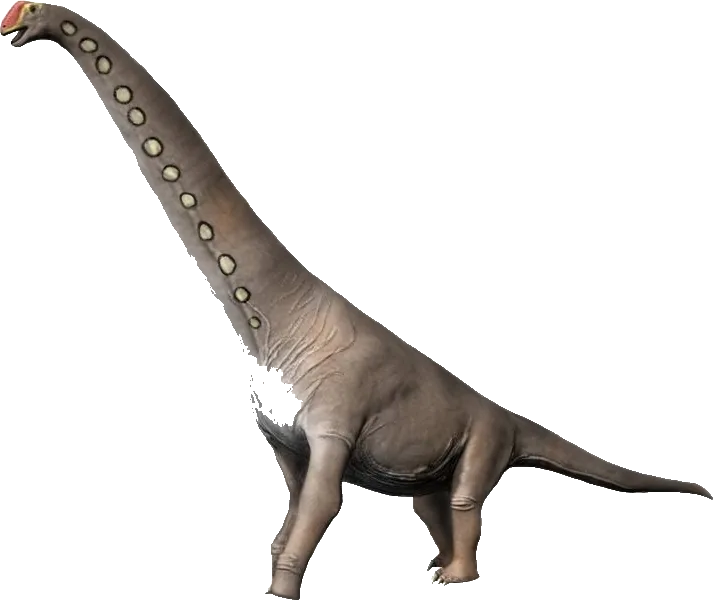
Brachiosaurus
SauropodLate JurassicHerbivoreAllosaurus
TheropodLate JurassicCarnivore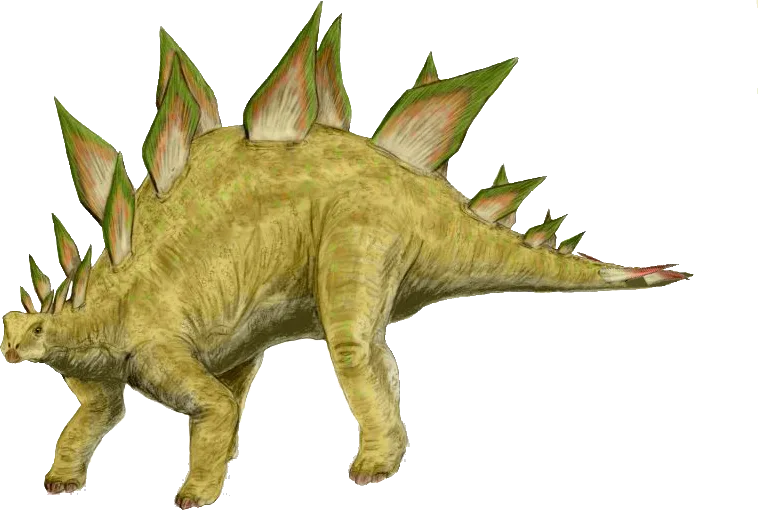
Stegosaurus
StegosaurLate JurassicHerbivore
Sources
Media on this page
- Diplodocus BW.jpg — Nobu Tamura (http://spinops.blogspot.com) · CC BY 3.0
- Fern in forest by I. Levitan (1895, N. Novgorod).jpg — Isaac Levitan · Public domain
- Diplodocus 3D model, shaped from the life reconstruction "Diplodocus longus(2).jpg" — Creator:Dmitry Bogdanov (artwork); 3D shaping by DinoVerse · CC BY 3.0
- Diplodocus reconstructed call (synthesised) — DinoVerse (synthesised) · CC0 1.0
- CM Diplodocus.jpg — ScottRobertAnselmo · CC BY-SA 3.0
- Calco de Diplodocus Museo Ciencias Naturales La Plata.JPG — Alexrebolledo · CC BY-SA 3.0
- Cranial ontogeny in Diplodocus.webp — Published by D. Cary Woodruff, Thomas D. Carr, Glenn W. Storrs, Katja Waskow, John B. Scan · CC BY 4.0
- Diplodocus (replica).001 - London.JPG — Fernando Losada Rodríguez · CC BY-SA 4.0