Dimetrodon
Name means “Two measures of teeth”
🚫 Not a dinosaur!
Dimetrodon was a synapsid — part of the group that later gave rise to mammals, so it is more closely related to you than to any dinosaur. It also lived more than 30 million years before the first dinosaurs appeared.
Dimetrodon had a big sail on its back and sharp teeth, but it was NOT a dinosaur. It was actually an ancient relative of mammals — including you!
Dimetrodon was a predatory synapsid from the Early Permian of North America and Europe, living tens of millions of years before dinosaurs. As an early member of the lineage leading to mammals, it shows early stages of features like differentiated teeth and a single skull opening behind the eye.
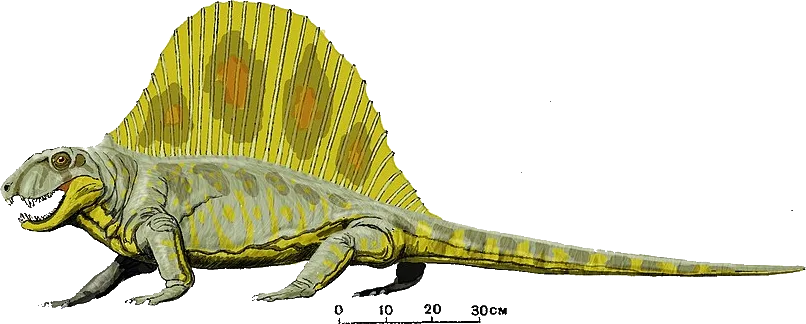
Dimetrodon milleri1.jpg — Creator: Dmitry Bogdanov · CC BY 3.0
Pictures
Spin it in 3D
3D model description: a 3D model of Dimetrodon shaped from a scientific life reconstruction painting, with the painting's colours and skin texture wrapped around it. It is not a scan of a real fossil.
About this model
This model is shaped from a scientific life reconstruction by Creator: Dmitry Bogdanov: the painting's outline gives the 3D body and the painting itself is its skin. It is sized to the real animal's length (about 3.1 m), so in AR it appears life-size!
It looks best from the side, like the painting it comes from. It is not a fossil scan — museums such as the Smithsonian 3D collection share real fossil scans you can explore.
What might it sound like?
Transcript: Long, low, throaty hiss
🤔 Nobody knows exactly how dinosaurs sounded
This is a scientific guess. Early synapsids like Dimetrodon probably lacked the complex voice tools of later mammals, so a simple hiss — the kind many living reptiles make when threatened — is a reasonable idea.
Voice boxes and soft tissue almost never fossilise, so sound reconstructions use clues: body size (bigger animals make lower sounds), the calls of living relatives (crocodiles boom with closed mouths; birds coo and hiss), and hollow structures such as hadrosaur crests that could have worked like a trumpet.
Sound: synthesised by DinoVerse from these scientific ideas (CC0). It is a creative guess, not a recording.
Food and habits
Carnivore
Meat-eater
How it ate
Grabbed prey with long, dagger-like front teeth and sliced it with serrated, blade-like teeth further back — one of the first land animals with teeth of different kinds.
🔍 How do we know?
- serrated, knife-like teeth
- bite-marked Diplocaulus skulls from the same rock beds
- powerful skull and jaw build
It ate…
- Diplocaulus
- Eryops
- Xenacanthus sharks
- other synapsids
- large amphibians
Dimetrodon
…and was eaten by
👑 Probably nothing, once fully grown — a top predator or too big to tackle!
Arrows show energy moving up the food chain: from food to eater.
Watch it walk
Quick facts
| 📏 Length | 1.7–4.6 m (6–15 ft) |
|---|---|
| ↕️ Height | 1–1.5 m (3–5 ft) |
| ⚖️ Weight | 28–250 kg (60–550 lb) |
| ⏳ When it lived | 295–272 million years ago (Early Permian) |
| 📍 Fossils found | Texas Red Beds, Archer County, Texas, USA; Baylor County, Texas, USA; Oklahoma, USA; Bromacker quarry, Thuringia, Germany |
| 🔎 Discovered | 1878 by Edward Drinker Cope |
| 🧬 Group | Synapsids — Amniota › Synapsida |
Where scientists disagree, we show a range. Sizes are for adults.
How big was it?
Where and when
- 📍 Texas Red Beds, Archer County, Texas, USA (North America)
- 📍 Baylor County, Texas, USA (North America)
- 📍 Oklahoma, USA (North America)
- 📍 Bromacker quarry, Thuringia, Germany (Europe)
Lived 295–272 million years ago
That's about 284 million years before you were born! Humans have only existed for about 0.3 million years.
See it on the big timeline →Did you know?
- 1Dimetrodon is NOT a dinosaur, even though it's often in dinosaur toy sets!
- 2It is more closely related to people than to T. rex.
- 3Its sail was held up by long spines growing from its backbone.
- 4It lived even before the first dinosaurs — way before!
- The sail was once thought to help it warm up in the morning sun, but studies of the spines' blood supply and of small species with tall sails suggest display is a more likely main use; the debate is not fully settled.
- Its name refers to its two kinds of teeth — large canine-like fangs and smaller cutting teeth — an early step towards the varied teeth of mammals.
- Dimetrodon was the top predator in its ecosystem, where prey on land was scarce, and probably also fed on aquatic animals like amphibians and freshwater sharks.
- Like mammals, it had a single opening in the skull behind each eye (the synapsid opening), which anchored strong jaw muscles.
Myth vs fact
❌ MythDimetrodon was a dinosaur.
✅ FactDimetrodon was a synapsid, closer to mammals than to dinosaurs, and it died out long before the first dinosaurs evolved.
❌ MythDimetrodon lived alongside Tyrannosaurus and Triceratops.
✅ FactIt lived about 295–272 million years ago — more than 200 million years before T. rex.
Mini quiz
1. Is Dimetrodon a dinosaur?
2. When did Dimetrodon live?
3. What was on Dimetrodon's back?
Related animals
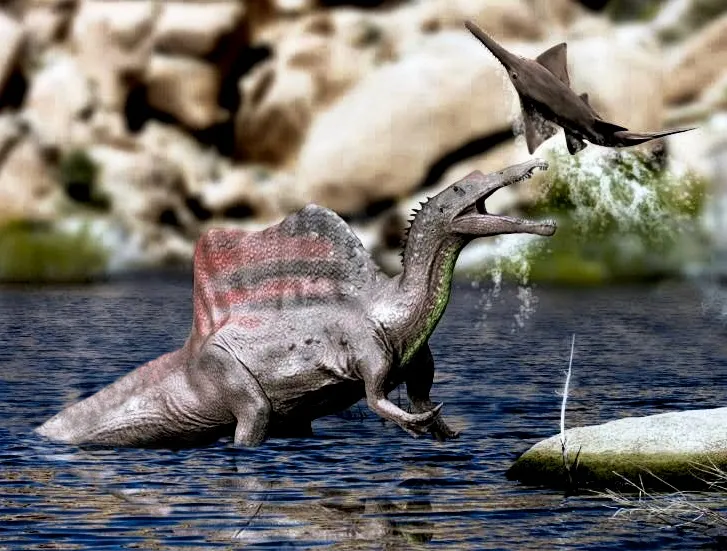
Spinosaurus
TheropodLate CretaceousPiscivore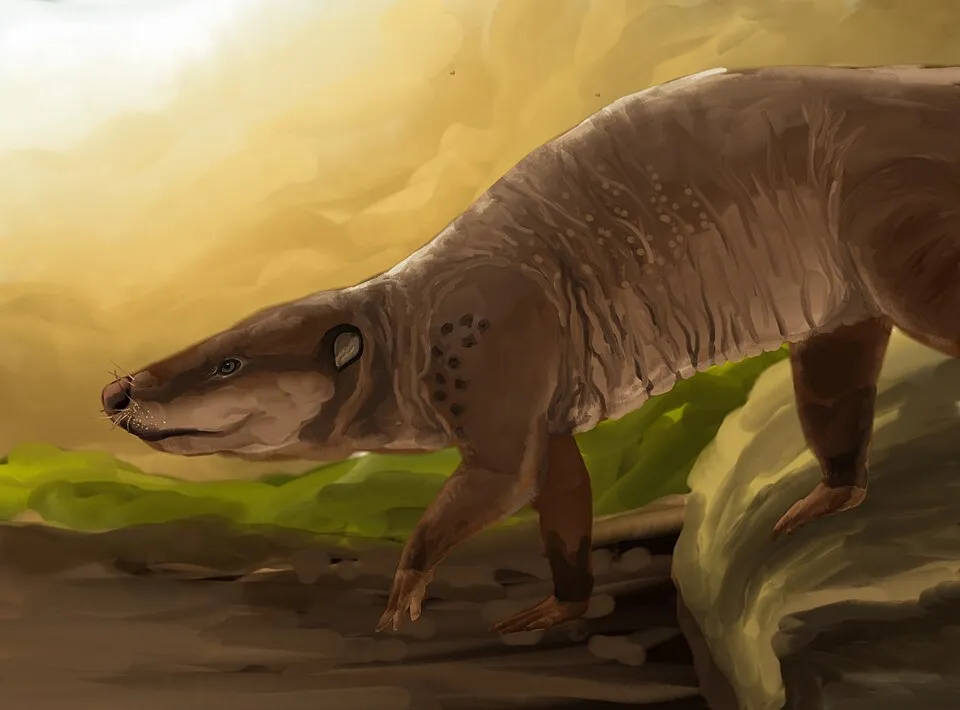 Not a dinosaur
Repenomamus
MammalEarly CretaceousCarnivore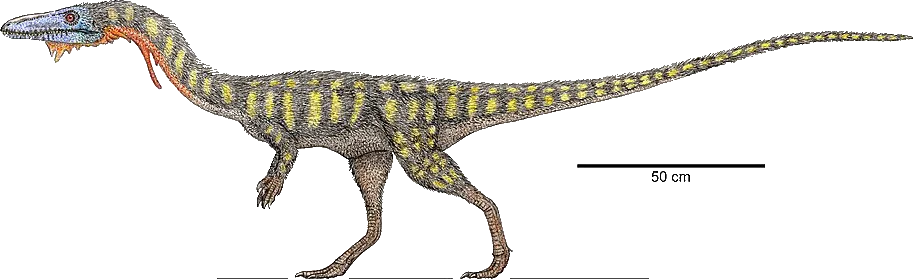
Coelophysis
TheropodLate TriassicCarnivore
Media on this page
- Dimetrodon milleri1.jpg — Creator: Dmitry Bogdanov · CC BY 3.0
- Fern in forest by I. Levitan (1895, N. Novgorod).jpg — Isaac Levitan · Public domain
- Dimetrodon 3D model, shaped from the life reconstruction "Dimetrodon milleri1.jpg" — Creator: Dmitry Bogdanov (artwork); 3D shaping by DinoVerse · CC BY 3.0
- Dimetrodon reconstructed call (synthesised) — DinoVerse (synthesised) · CC0 1.0
- Dimetrodon incisivum 01.jpg — H. Zell · CC BY-SA 3.0
- Dimetr eryopsDB.jpg — Dmitry Bogdanov · CC BY 3.0
- Dimetrodon8DB.jpg — Dmitry Bogdanov · CC BY 3.0
- DimetrodonKnight.jpg — Charles Robert Knight · Public domain