Dilophosaurus
Name means “Two-crested lizard”
Dilophosaurus was a big meat-eater with two thin bony crests on top of its head. It lived long before most famous dinosaurs.
Dilophosaurus wetherilli was one of the largest land predators of the Early Jurassic, known from fossils in Arizona's Kayenta Formation. A 2020 restudy showed it was a strongly built hunter, not the weak-jawed scavenger once imagined, with a pair of delicate head crests probably used for display.
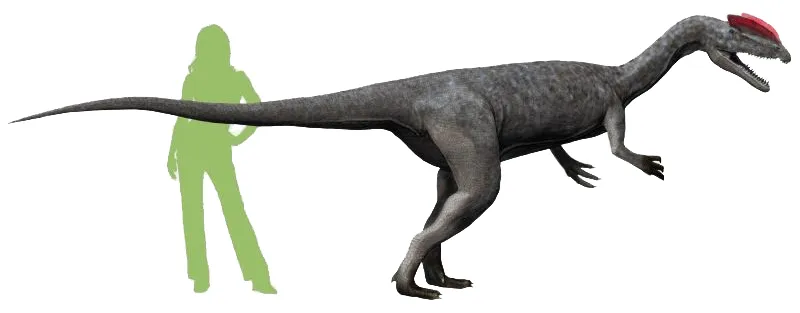
Dilophosaurus NT.jpg — Nobu Tamura · CC BY-SA 4.0
Pictures
Spin it in 3D
3D model description: a 3D model of Dilophosaurus shaped from a scientific life reconstruction painting, with the painting's colours and skin texture wrapped around it. It is not a scan of a real fossil.
About this model
This model is shaped from a scientific life reconstruction by Petr Menshikov (https://twitter.com/Petr75113553; https://vk.com/prehistoricproduction): the painting's outline gives the 3D body and the painting itself is its skin. It is sized to the real animal's length (about 6.5 m), so in AR it appears life-size!
It looks best from the side, like the painting it comes from. It is not a fossil scan — museums such as the Smithsonian 3D collection share real fossil scans you can explore.
What might it sound like?
Transcript: Rough, drawn-out hiss with a low throaty undertone, about 2 seconds
🤔 Nobody knows exactly how dinosaurs sounded
This is a scientific guess. Birds and crocodiles, the living relatives of dinosaurs, both hiss and make closed-mouth sounds. Dilophosaurus was medium-sized, so its voice was probably lower than a small raptor's but higher than a giant like T. rex.
Voice boxes and soft tissue almost never fossilise, so sound reconstructions use clues: body size (bigger animals make lower sounds), the calls of living relatives (crocodiles boom with closed mouths; birds coo and hiss), and hollow structures such as hadrosaur crests that could have worked like a trumpet.
Sound: synthesised by DinoVerse from these scientific ideas (CC0). It is a creative guess, not a recording.
Food and habits
Carnivore
Meat-eater
How it ate
Grabbed prey with clawed hands and strong jaws, slicing with long serrated teeth; a notch near the front of its upper jaw may have helped it grip wriggling animals.
🔍 How do we know?
- curved, serrated tooth shape
- strong grasping hands with large claws
- remains of small plant-eaters in the same rocks
It ate…
- Scutellosaurus
- Sarahsaurus
- small reptiles
- early mammal relatives
- fish
Dilophosaurus
…and was eaten by
👑 Probably nothing, once fully grown — a top predator or too big to tackle!
Arrows show energy moving up the food chain: from food to eater.
Watch it call
Quick facts
| 📏 Length | 6–7 m (20–23 ft) |
|---|---|
| ↕️ Height | 1.5–2 m (5–7 ft) |
| ⚖️ Weight | 300–450 kg (660–990 lb) |
| ⏳ When it lived | 196–183 million years ago (Early Jurassic) |
| 📍 Fossils found | Kayenta Formation, Navajo Nation, Arizona, USA |
| 🔎 Discovered | 1942 by Jesse Williams (Navajo) with Samuel Welles and the University of California team |
| 🧬 Group | Theropods — Saurischia › Theropoda |
Where scientists disagree, we show a range. Sizes are for adults.
How big was it?
Where and when
- 📍 Kayenta Formation, Navajo Nation, Arizona, USA (North America)
Lived 196–183 million years ago
That's about 190 million years before you were born! Humans have only existed for about 0.3 million years.
See it on the big timeline →Did you know?
- 1Dilophosaurus had two thin, rounded crests on its head, like a pair of fancy fins.
- 2It was about as long as a big car and could run fast on two legs.
- 3It lived more than 180 million years ago, in what is now Arizona.
- 4It did NOT spit poison or have a frill around its neck. That was made up for a movie!
- A detailed 2020 study by Adam Marsh and Timothy Rowe found that Dilophosaurus had air sacs in its bones and strong muscle attachments, overturning the old idea that its jaws were too weak to tackle large prey.
- Its crests were thin plates of bone, too fragile for fighting, so most scientists think they were used for display to rivals or mates.
- The first skeletons were found in 1942 on Navajo land after Jesse Williams, a Navajo man, showed palaeontologists where bones had been spotted.
- It was first named as a species of Megalosaurus in 1954, and given its own genus, Dilophosaurus, in 1970 once its crests were recognised.
- Fossil footprints from the Early Jurassic, including a resting trace from Utah, are often linked to Dilophosaurus-like animals.
Myth vs fact
❌ MythDilophosaurus spat venom and had a frill that opened around its neck.
✅ FactThere is no evidence for either. No living dinosaur relatives spit venom, and its fossils show no bones that could support a frill. Both ideas came from the Jurassic Park film.
❌ MythDilophosaurus was only as big as a dog.
✅ FactIt was about 6 to 7 metres long, one of the biggest predators of its time.
Mini quiz
1. What did Dilophosaurus have on top of its head?
2. Could Dilophosaurus really spit venom?
3. In which US state were Dilophosaurus fossils found?
Related animals
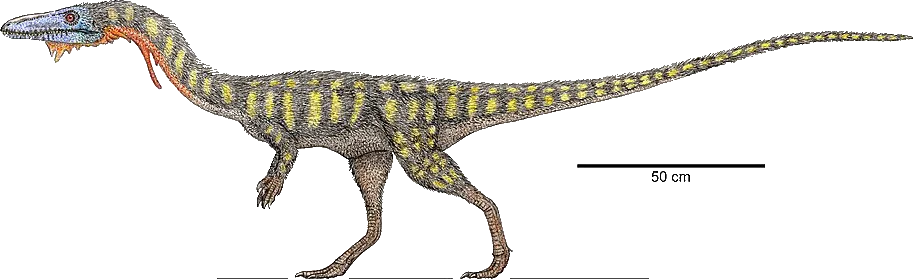
Coelophysis
TheropodLate TriassicCarnivore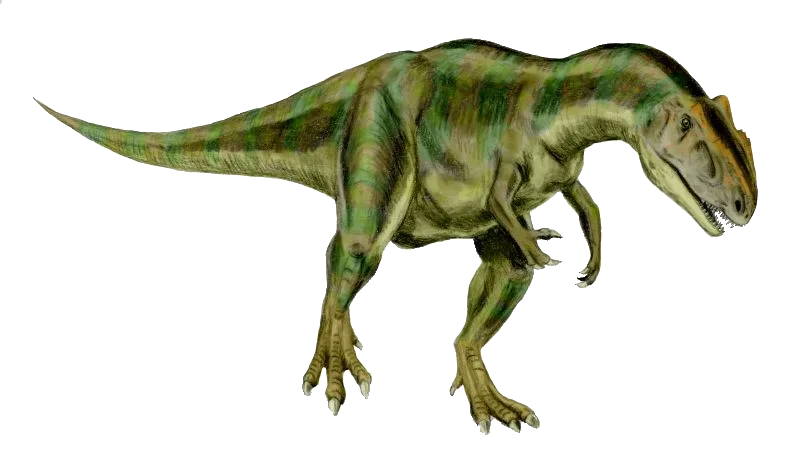
Allosaurus
TheropodLate JurassicCarnivore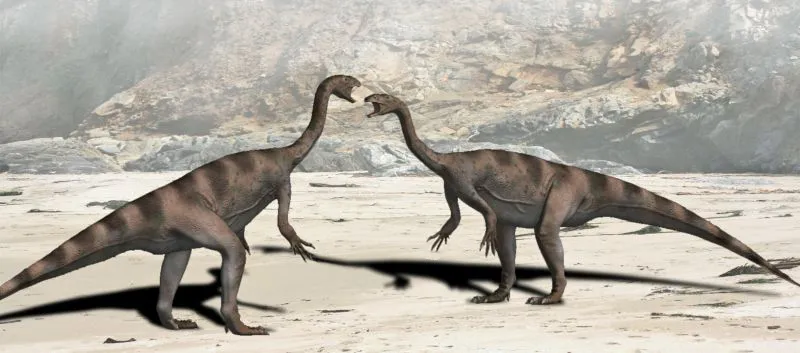
Plateosaurus
SauropodLate TriassicHerbivore
Sources
Media on this page
- Dilophosaurus NT.jpg — Nobu Tamura · CC BY-SA 4.0
- Fern in forest by I. Levitan (1895, N. Novgorod).jpg — Isaac Levitan · Public domain
- Dilophosaurus 3D model, shaped from the life reconstruction "Dilophosaurus PM.png" — Petr Menshikov (https://twitter.com/Petr75113553; https://vk.com/prehistoricproduction) (a · CC BY 4.0
- Dilophosaurus reconstructed call (synthesised) — DinoVerse (synthesised) · CC0 1.0
- DilophosaurusROM1.JPG — Eduard Solà · CC BY-SA 3.0
- DilophosaurusROM2.JPG — Eduard Solà · CC BY-SA 3.0
- Dilophosaurus (1).jpg — Craig Pemberton · CC BY-SA 2.0
- Dilophosaurus Nong Nooch Dinosaur Valley, Thailand.jpg — Tomás Del Coro · CC BY-SA 2.0