DinoVerse · Dinosaur fact sheet
Dilophosaurus
Say it: die-LOAF-oh-SORE-us · Name means: “Two-crested lizard”
| ⏳ Lived | 196–183 million years ago Early Jurassic |
|---|---|
| 🥩 Diet | Carnivore (meat-eater) |
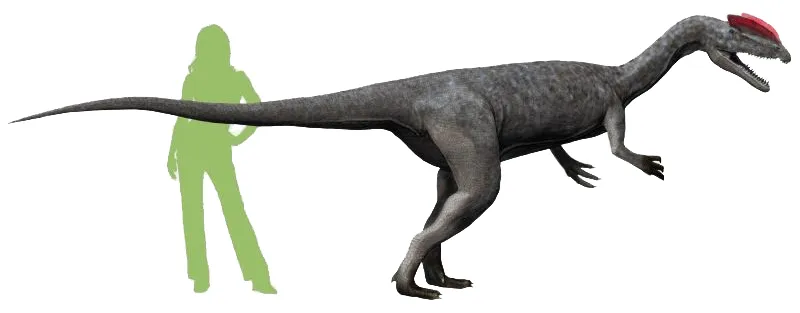
| 📏 Length | 6–7 m (20–23 ft) |
| ↕️ Height | 1.5–2 m (5–7 ft) |
| ⚖️ Weight | 300–450 kg (660–990 lb) |
| 📍 Found in | North America |
| 🔎 Discovered | 1942 by Jesse Williams (Navajo) with Samuel Welles and the University of California team |
About Dilophosaurus
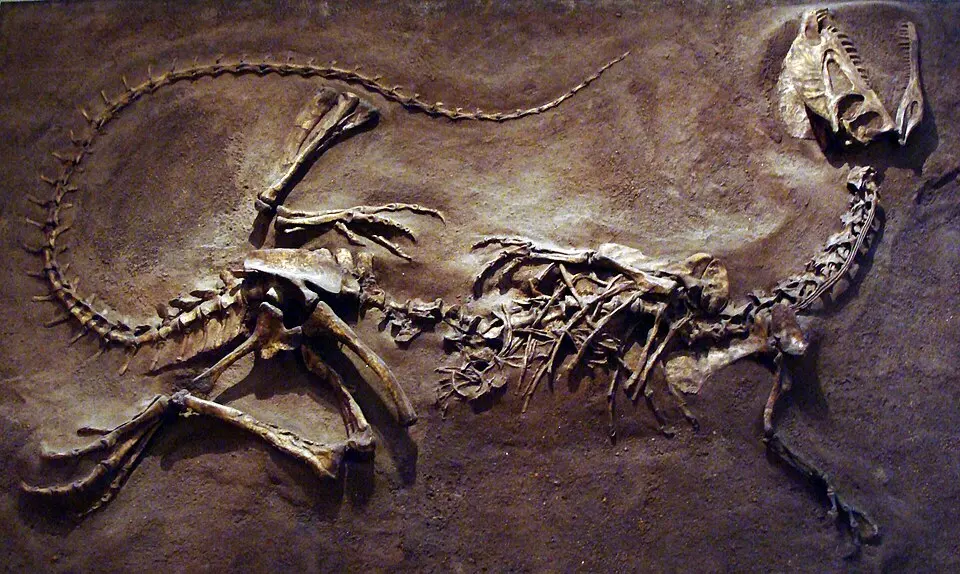
Dilophosaurus was a big meat-eater with two thin bony crests on top of its head. It lived long before most famous dinosaurs.
Dilophosaurus wetherilli was one of the largest land predators of the Early Jurassic, known from fossils in Arizona's Kayenta Formation. A 2020 restudy showed it was a strongly built hunter, not the weak-jawed scavenger once imagined, with a pair of delicate head crests probably used for display.
How big was it?
Drawn to scale next to a 1.7 m adult and a 12 m school bus.
Did you know?
- Dilophosaurus had two thin, rounded crests on its head, like a pair of fancy fins.
- It was about as long as a big car and could run fast on two legs.
- It lived more than 180 million years ago, in what is now Arizona.
- It did NOT spit poison or have a frill around its neck. That was made up for a movie!
- A detailed 2020 study by Adam Marsh and Timothy Rowe found that Dilophosaurus had air sacs in its bones and strong muscle attachments, overturning the old idea that its jaws were too weak to tackle large prey.
- Its crests were thin plates of bone, too fragile for fighting, so most scientists think they were used for display to rivals or mates.
- The first skeletons were found in 1942 on Navajo land after Jesse Williams, a Navajo man, showed palaeontologists where bones had been spotted.
- It was first named as a species of Megalosaurus in 1954, and given its own genus, Dilophosaurus, in 1970 once its crests were recognised.
- Fossil footprints from the Early Jurassic, including a resting trace from Utah, are often linked to Dilophosaurus-like animals.