Deinonychus
Name means “Terrible claw”
Deinonychus was a feathered hunter about as long as a car, with a huge hooked claw on each foot. It helped scientists realise dinosaurs were active and bird-like.
Deinonychus antirrhopus was a mid-sized dromaeosaurid from the Early Cretaceous of North America. John Ostrom's 1969 description of its agile, bird-like skeleton sparked the 'Dinosaur Renaissance', which reshaped dinosaurs from sluggish reptiles into active animals closely related to birds.
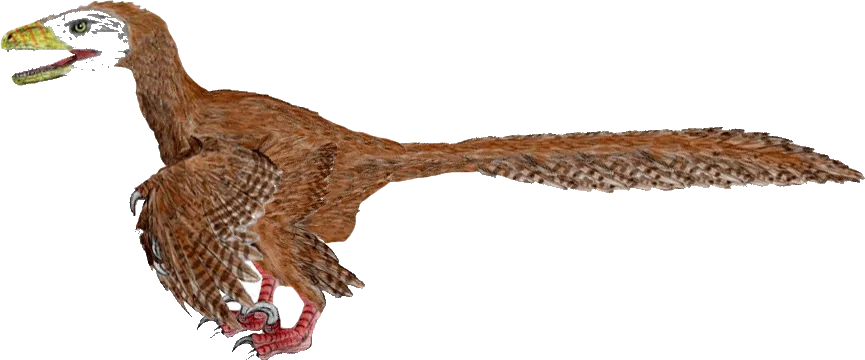
Deinonychus BW-2.png — Deinonychus_BW.jpg: Nobu Tamura email:nobu.tamura@ · CC BY 2.5
Pictures
Spin it in 3D
3D model description: a 3D model of Deinonychus shaped from a scientific life reconstruction painting, with the painting's colours and skin texture wrapped around it. It is not a scan of a real fossil.
About this model
This model is shaped from a scientific life reconstruction by Deinonychus_BW.jpg: Nobu Tamura email:nobu.tamura@yahoo.com www.palaeocritti.com derivative work: Dinoguy2 (talk): the painting's outline gives the 3D body and the painting itself is its skin. It is sized to the real animal's length (about 3.2 m), so in AR it appears life-size!
It looks best from the side, like the painting it comes from. It is not a fossil scan — museums such as the Smithsonian 3D collection share real fossil scans you can explore.
What might it sound like?
Transcript: Harsh, rasping screech that breaks into a hiss, about 2 seconds
🤔 Nobody knows exactly how dinosaurs sounded
This is a scientific guess. Deinonychus was closely related to birds, and many birds of prey and large ground birds hiss or make harsh calls. Its medium size suggests a voice between a small bird's and a big theropod's, but no one knows for sure.
Voice boxes and soft tissue almost never fossilise, so sound reconstructions use clues: body size (bigger animals make lower sounds), the calls of living relatives (crocodiles boom with closed mouths; birds coo and hiss), and hollow structures such as hadrosaur crests that could have worked like a trumpet.
Sound: synthesised by DinoVerse from these scientific ideas (CC0). It is a creative guess, not a recording.
Food and habits
Carnivore
Meat-eater
How it ate
Leapt onto prey and gripped it with its feet, using the large sickle claw on each second toe to pin it down while tearing off flesh with curved, serrated teeth.
🔍 How do we know?
- Deinonychus teeth and skeletons found with Tenontosaurus remains
- bite marks on Tenontosaurus bones
- hooked serrated teeth and grasping claws
- tooth chemistry showing what young and adults ate
It ate…
- Tenontosaurus
- Zephyrosaurus
- small mammals
- turtles
Deinonychus
…and was eaten by
- Acrocanthosaurus
Arrows show energy moving up the food chain: from food to eater.
Watch it call
Quick facts
| 📏 Length | 3–3.4 m (10–11 ft) |
|---|---|
| ↕️ Height | 0.8–1 m (3 ft) |
| ⚖️ Weight | 60–100 kg (130–220 lb) |
| ⏳ When it lived | 115–108 million years ago (Early Cretaceous) |
| 📍 Fossils found | Cloverly Formation, Montana, USA; Cloverly Formation, Wyoming, USA; Antlers Formation, Oklahoma, USA |
| 🔎 Discovered | 1964 by John Ostrom and Grant Meyer |
| 🧬 Group | Theropods — Saurischia › Theropoda |
Where scientists disagree, we show a range. Sizes are for adults.
How big was it?
Where and when
- 📍 Cloverly Formation, Montana, USA (North America)
- 📍 Cloverly Formation, Wyoming, USA (North America)
- 📍 Antlers Formation, Oklahoma, USA (North America)
Lived 115–108 million years ago
That's about 112 million years before you were born! Humans have only existed for about 0.3 million years.
See it on the big timeline →Did you know?
- 1Deinonychus's foot claw was about as long as your hand.
- 2It was the real-life size of the 'raptors' in famous dinosaur movies.
- 3Discovering Deinonychus helped scientists see that birds are living dinosaurs.
- 4It probably had feathers all over its body, like a giant, toothy bird.
- John Ostrom and Grant Meyer collected the first good specimens in Montana in 1964; Ostrom's 1969 description argued it was warm-blooded and agile, kick-starting the Dinosaur Renaissance.
- Several Deinonychus have been found with the remains of the large plant-eater Tenontosaurus, which was once taken as evidence of cooperative pack hunting.
- A 2020 study of tooth chemistry found that juveniles and adults ate different food, which fits better with loose groups or mobbing, like Komodo dragons or birds, than with wolf-like packs where everyone shares.
- Studies of the sickle claw suggest it was used to grip and pin prey, like the talons of an eagle, rather than slash open victims.
- Barnum Brown had found Deinonychus bones as early as 1931 but never formally named them.
Myth vs fact
❌ MythDeinonychus used its sickle claw to slice prey open like a knife.
✅ FactThe claw's shape and tests with model claws suggest it punctured and gripped rather than sliced, holding prey down while the jaws did the work.
Mini quiz
1. What does 'Deinonychus' mean?
2. Which plant-eater has often been found with Deinonychus fossils?
3. What did discovering Deinonychus help scientists understand?
Related animals
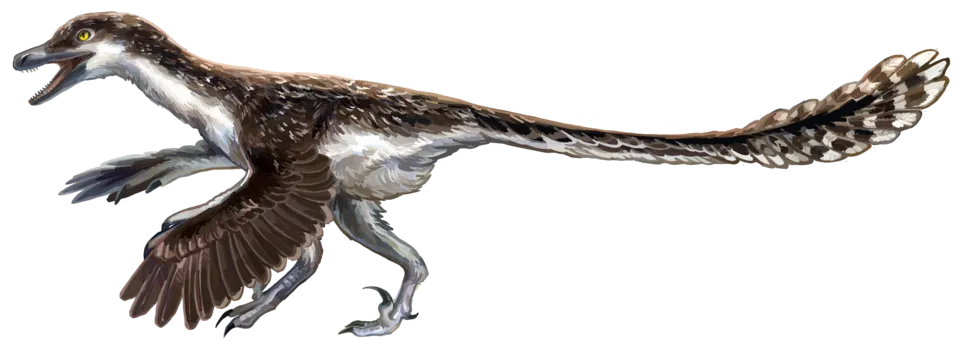
Velociraptor
TheropodLate CretaceousCarnivore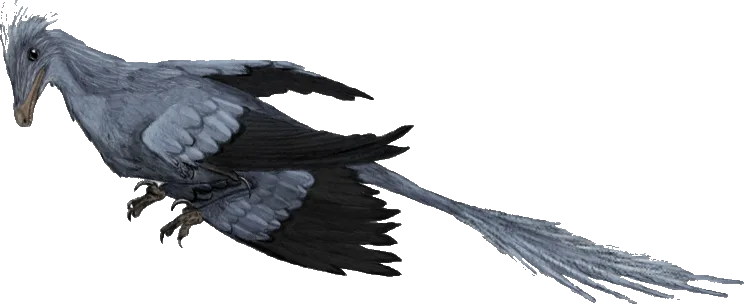
Microraptor
TheropodEarly CretaceousCarnivore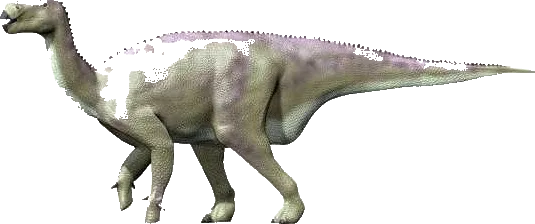
Iguanodon
OrnithopodEarly CretaceousHerbivore
Sources
Media on this page
- Deinonychus BW-2.png — Deinonychus_BW.jpg: Nobu Tamura email:nobu.tamura@yahoo.com www.palaeocritti.com derivativ · CC BY 2.5
- Fern in forest by I. Levitan (1895, N. Novgorod).jpg — Isaac Levitan · Public domain
- Deinonychus 3D model, shaped from the life reconstruction "Deinonychus BW-2.png" — Deinonychus_BW.jpg: Nobu Tamura email:nobu.tamura@yahoo.com www.palaeocritti.com derivativ · CC BY 2.5
- Deinonychus reconstructed call (synthesised) — DinoVerse (synthesised) · CC0 1.0
- Deinonychus FMNH.jpg — Jonathan Chen · CC BY-SA 4.0
- Climbing Deinonychus.jpg — Davide Meloni · CC BY-SA 2.0
- Deinonychus (Raptor Prey Restraint).jpg — Emily Willoughby (e.deinonychus@gmail.com http://emilywilloughby.artworkfolio.com/) · CC BY-SA 3.0
- Deinonychus Restoration.png — Fred Wierum · CC BY-SA 4.0