Coelophysis
Name means “Hollow form”
Coelophysis was one of the earliest dinosaurs, a skinny, speedy hunter about as long as a car. Hundreds of them were found together in New Mexico.
Coelophysis bauri was a slender coelophysoid theropod from the Late Triassic of the American Southwest and one of the best-known early dinosaurs. A single quarry at Ghost Ranch has produced hundreds to possibly over a thousand skeletons, giving scientists a rare look at growth and variation within one species.
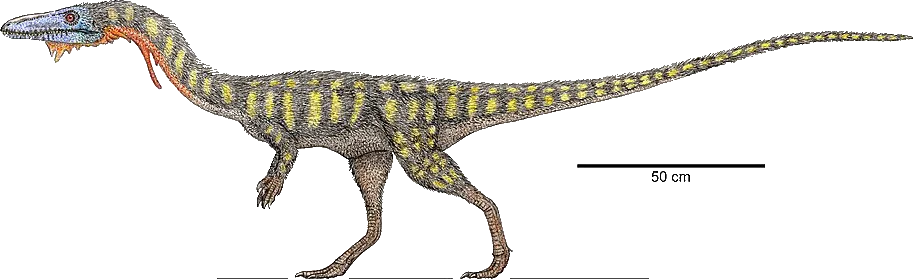
Coelophysis Jeff Martz.jpg — Park Ranger, artist Jeff Martz · Public domain
Pictures
Spin it in 3D
3D model description: a 3D model of Coelophysis shaped from a scientific life reconstruction painting, with the painting's colours and skin texture wrapped around it. It is not a scan of a real fossil.
About this model
This model is shaped from a scientific life reconstruction by Park Ranger, artist Jeff Martz: the painting's outline gives the 3D body and the painting itself is its skin. It is sized to the real animal's length (about 2.8 m), so in AR it appears life-size!
It looks best from the side, like the painting it comes from. It is not a fossil scan — museums such as the Smithsonian 3D collection share real fossil scans you can explore.
What might it sound like?
Transcript: Quick series of raspy chirps and a short hiss, about 1.5 seconds
🤔 Nobody knows exactly how dinosaurs sounded
This is a scientific guess. Coelophysis was small and lightly built, so its calls were probably higher than those of big predators. Its living relatives, birds and crocodiles, chirp, hiss and grunt, so it may have made similar sounds.
Voice boxes and soft tissue almost never fossilise, so sound reconstructions use clues: body size (bigger animals make lower sounds), the calls of living relatives (crocodiles boom with closed mouths; birds coo and hiss), and hollow structures such as hadrosaur crests that could have worked like a trumpet.
Sound: synthesised by DinoVerse from these scientific ideas (CC0). It is a creative guess, not a recording.
Food and habits
Carnivore
Meat-eater
How it ate
Darted after small animals on long slender legs and snapped them up with a narrow snout lined with many small, curved, serrated teeth.
🔍 How do we know?
- small serrated teeth
- remains of small crocodile-like reptiles inside Coelophysis skeletons
- light, fast-running build
It ate…
- small crocodile relatives such as Hesperosuchus
- lizard-like reptiles
- fish
- insects
Coelophysis
…and was eaten by
- phytosaurs
- Postosuchus
Arrows show energy moving up the food chain: from food to eater.
Watch it walk
Quick facts
| 📏 Length | 2.5–3 m (8–10 ft) |
|---|---|
| ↕️ Height | 0.6–1 m (2–3 ft) |
| ⚖️ Weight | 15–25 kg (30–60 lb) |
| ⏳ When it lived | 216–203 million years ago (Late Triassic) |
| 📍 Fossils found | Ghost Ranch, Chinle Formation, New Mexico, USA |
| 🔎 Discovered | 1881 by David Baldwin (named by Edward Drinker Cope in 1889) |
| 🧬 Group | Theropods — Saurischia › Theropoda |
Where scientists disagree, we show a range. Sizes are for adults.
How big was it?
Where and when
- 📍 Ghost Ranch, Chinle Formation, New Mexico, USA (North America)
Lived 216–203 million years ago
That's about 210 million years before you were born! Humans have only existed for about 0.3 million years.
See it on the big timeline →Did you know?
- 1Coelophysis lived over 200 million years ago, near the very start of the dinosaur age.
- 2Its bones were hollow, like a bird's, which made it light and fast.
- 3A Coelophysis skull went into space on a Space Shuttle in 1998!
- 4Hundreds of Coelophysis skeletons were found piled up in one spot in New Mexico.
- The Ghost Ranch quarry, excavated from 1947, contains a dense mass of Coelophysis skeletons, probably animals gathered near water that died together during a drought or flood.
- Adults seem to come in two body types, 'robust' and 'gracile', which was once thought to show males and females but may instead reflect normal individual variation in growth.
- A Coelophysis skull from the Carnegie Museum flew aboard Space Shuttle Endeavour in 1998 to the Mir space station, making it one of the first dinosaurs in space.
- It is the state fossil of New Mexico.
Myth vs fact
❌ MythCoelophysis ate its own babies.
✅ FactBones once thought to be baby Coelophysis inside adults were restudied in 2006 and turned out to be small crocodile-like reptiles, or bones lying underneath the skeleton.
Mini quiz
1. Which period did Coelophysis live in?
2. Where did a Coelophysis skull travel in 1998?
3. What were Coelophysis's bones like?
Related animals
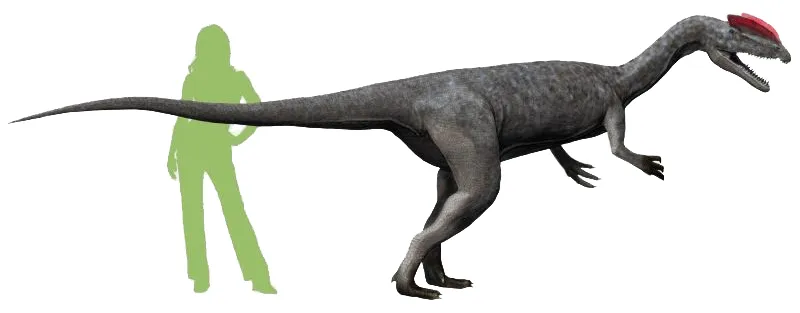
Dilophosaurus
TheropodEarly JurassicCarnivore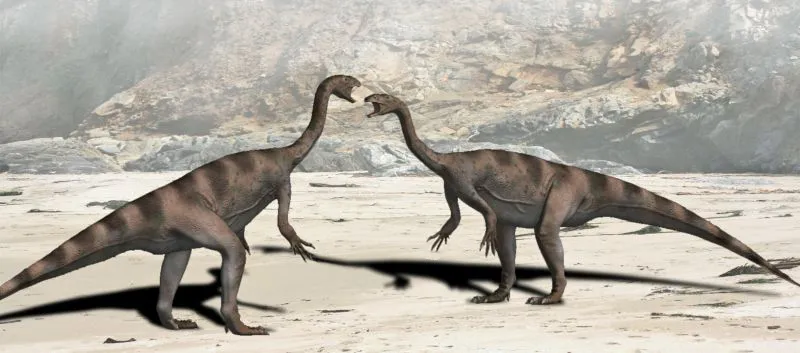
Plateosaurus
SauropodLate TriassicHerbivore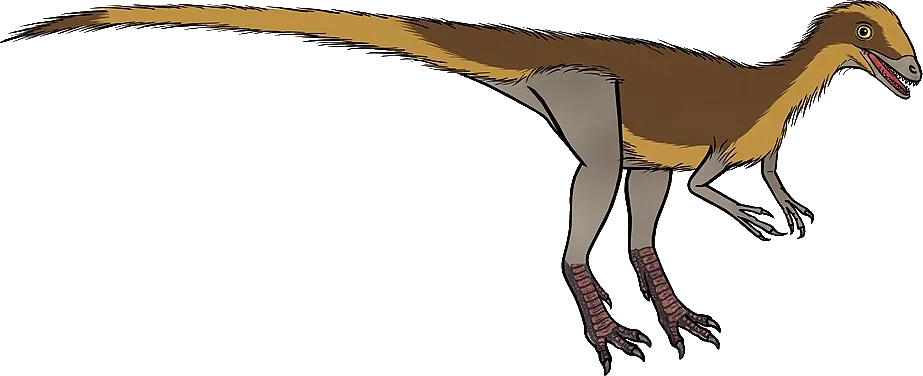
Compsognathus
TheropodLate JurassicCarnivore
Sources
Media on this page
- Coelophysis Jeff Martz.jpg — Park Ranger, artist Jeff Martz · Public domain
- Fern in forest by I. Levitan (1895, N. Novgorod).jpg — Isaac Levitan · Public domain
- Coelophysis 3D model, shaped from the life reconstruction "Coelophysis Jeff Martz.jpg" — Park Ranger, artist Jeff Martz (artwork); 3D shaping by DinoVerse · Public domain
- Coelophysis reconstructed call (synthesised) — DinoVerse (synthesised) · CC0 1.0
- Coelophysis bauri mount.jpg — James St. John · CC BY 2.0
- CMNH Coelophysis Block.jpg — Paleeoguy · CC BY-SA 4.0
- Coelophysis Hortalotarsus Huene.png — Friedrich von Huene · Public domain
- Coelophysis Jeff Martz.jpg — Park Ranger, artist Jeff Martz · Public domain