Compsognathus
Name means “Elegant jaw”
Compsognathus was a tiny, speedy meat-eater about the size of a chicken. It snapped up lizards and bugs.
Compsognathus longipes was a small compsognathid theropod from Late Jurassic lagoon islands in what is now Germany and France. For over a century it was the smallest dinosaur known, and one of its two skeletons preserves a swallowed lizard in its belly.
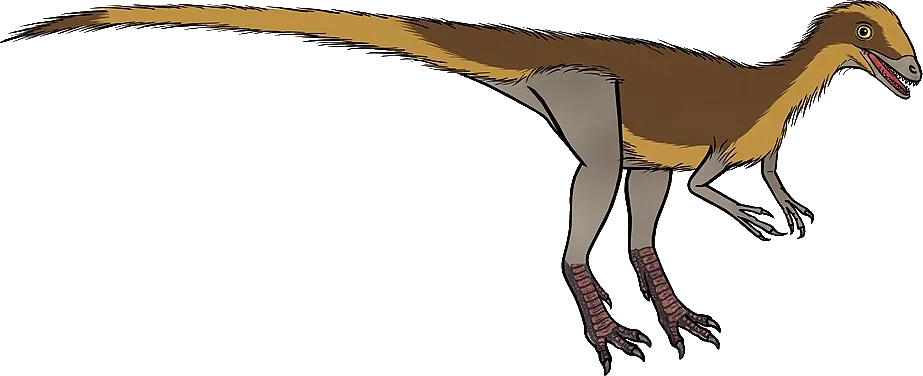
Compsognathus 95898.jpg — Conty · CC BY-SA 4.0
Pictures
Spin it in 3D
3D model description: a 3D model of Compsognathus shaped from a scientific life reconstruction painting, with the painting's colours and skin texture wrapped around it. It is not a scan of a real fossil.
About this model
This model is shaped from a scientific life reconstruction by Conty: the painting's outline gives the 3D body and the painting itself is its skin. It is sized to the real animal's length (about 1.1 m), so in AR it appears life-size!
It looks best from the side, like the painting it comes from. It is not a fossil scan — museums such as the Smithsonian 3D collection share real fossil scans you can explore.
What might it sound like?
Transcript: Quick, squeaky chirps with a tiny hiss, about 1.5 seconds
🤔 Nobody knows exactly how dinosaurs sounded
This is a scientific guess. Compsognathus was small, and small animals usually make high-pitched sounds. Its living relatives, birds and crocodiles, chirp, peep and hiss, but its real call is unknown.
Voice boxes and soft tissue almost never fossilise, so sound reconstructions use clues: body size (bigger animals make lower sounds), the calls of living relatives (crocodiles boom with closed mouths; birds coo and hiss), and hollow structures such as hadrosaur crests that could have worked like a trumpet.
Sound: synthesised by DinoVerse from these scientific ideas (CC0). It is a creative guess, not a recording.
Food and habits
Carnivore
Meat-eater
How it ate
Chased down quick little animals on long legs and swallowed them whole, using small, sharp teeth to grab hold.
🔍 How do we know?
- a whole lizard (Bavarisaurus) preserved inside the German skeleton
- small, sharp, curved teeth
- fast-running, lightly built body
It ate…
- Bavarisaurus (lizard)
- small lizards
- insects
- small animals
Compsognathus
…and was eaten by
👑 Probably nothing, once fully grown — a top predator or too big to tackle!
Arrows show energy moving up the food chain: from food to eater.
Watch it walk
Quick facts
| 📏 Length | 0.9–1.3 m (3–4 ft) |
|---|---|
| ↕️ Height | 0.3–0.3 m (1 ft) |
| ⚖️ Weight | 0.8–3.5 kg (1.8–10 lb) |
| ⏳ When it lived | 152–148 million years ago (Late Jurassic) |
| 📍 Fossils found | Solnhofen limestone, Bavaria, Germany; Canjuers, Provence, France |
| 🔎 Discovered | 1859 by Johann Andreas Wagner (fossil collected by Joseph Oberndorfer) |
| 🧬 Group | Theropods — Saurischia › Theropoda |
Where scientists disagree, we show a range. Sizes are for adults.
How big was it?
Where and when
- 📍 Solnhofen limestone, Bavaria, Germany (Europe)
- 📍 Canjuers, Provence, France (Europe)
Lived 152–148 million years ago
That's about 150 million years before you were born! Humans have only existed for about 0.3 million years.
See it on the big timeline →Did you know?
- 1Compsognathus was about the size of a chicken.
- 2One fossil has a whole lizard inside its tummy, its very last meal!
- 3It lived on islands in a warm, shallow sea in what is now Germany.
- 4It had long legs and a long tail to help it zip around.
- Only two good skeletons are known: a small German specimen, probably a juvenile, and a larger French specimen about 1.25 metres long.
- The German skeleton contains the lizard Bavarisaurus in its gut, a fast-running lizard, which suggests Compsognathus was a quick, sharp-eyed hunter.
- It was once thought to have only two fingers per hand, but restudy of the French specimen showed it had three.
- No feathers are preserved on Compsognathus itself, but close relatives such as Sinosauropteryx were covered in simple filaments, so it was probably fuzzy.
Myth vs fact
❌ MythCompsognathus was the smallest dinosaur ever.
✅ FactIt was once the smallest known, but many smaller dinosaurs have since been found, and hummingbirds, which are living dinosaurs, are far smaller.
❌ MythCompsognathus hunted in big packs and could take down people-sized animals.
✅ FactThere is no evidence of pack hunting. It ate small prey like lizards and insects.
Mini quiz
1. About how big was Compsognathus?
2. What was found inside a Compsognathus fossil?
3. In which country was the first Compsognathus found?
Related animals
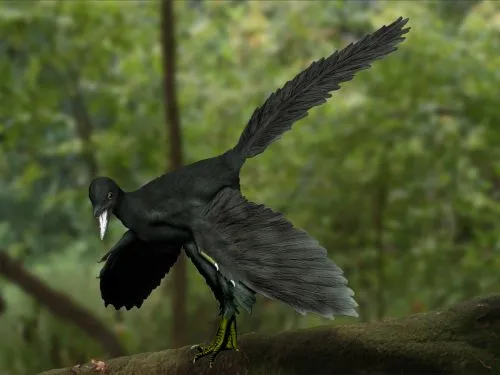
Archaeopteryx
TheropodLate JurassicCarnivore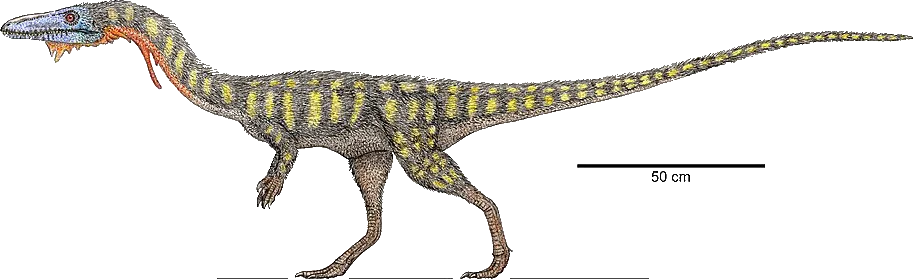
Coelophysis
TheropodLate TriassicCarnivore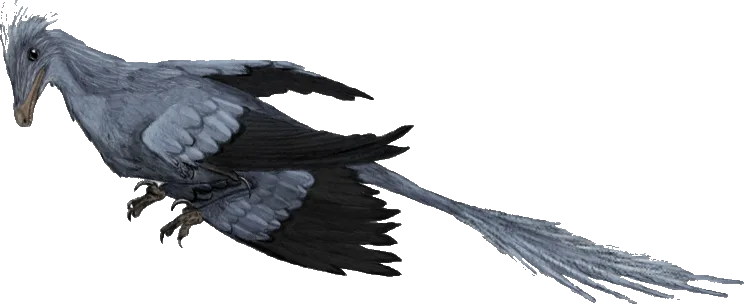
Microraptor
TheropodEarly CretaceousCarnivore
Sources
Media on this page
- Compsognathus 95898.jpg — Conty · CC BY-SA 4.0
- Fern in forest by I. Levitan (1895, N. Novgorod).jpg — Isaac Levitan · Public domain
- Compsognathus 3D model, shaped from the life reconstruction "Compsognathus 95898.jpg" — Conty (artwork); 3D shaping by DinoVerse · CC BY-SA 4.0
- Compsognathus reconstructed call (synthesised) — DinoVerse (synthesised) · CC0 1.0
- Compy.jpg — Zach Tirrell from Plymouth, USA · CC BY-SA 2.0
- Archaeopteryx, Compsognathus and Rhamphorhynchus by Knight.jpg — Charles R. Knight · Public domain
- Compsognathidae.jpg — Jaime A. Headden (User:Qilong) · CC BY 3.0
- Compsognathus BW.jpg — Nobu Tamura (http://spinops.blogspot.com) · CC BY 2.5