Plateosaurus
Name means “Broad lizard”
Plateosaurus was an early long-necked plant-eater that walked on two legs. It lived over 200 million years ago, near the start of the age of dinosaurs.
Plateosaurus was a plateosaurid sauropodomorph from the Late Triassic of central and northern Europe, and one of the best-known early dinosaurs from dozens of skeletons. It was a bipedal plant-eater and an early relative of the giant sauropods, though not their direct ancestor.
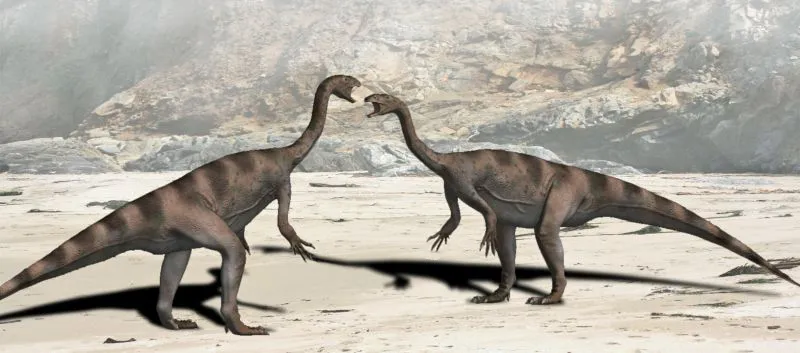
Plateosaurus BW.jpg — Nobu Tamura (http://spinops.blogspot.com) · CC BY 3.0
Pictures
Spin it in 3D
3D model description: a smooth, rounded model of Plateosaurus built from the DinoVerse illustration, showing its overall body shape and proportions. It is not a scan of a real fossil.
About this model
This is a simplified body-shape model, sized to the real animal's length (about 7.5 m). In AR it appears life-size!
It looks best from the side, like the painting it comes from. It is not a fossil scan — museums such as the Smithsonian 3D collection share real fossil scans you can explore.
What might it sound like?
Transcript: Short, honking bellow, about 2 seconds long
🤔 Nobody knows exactly how dinosaurs sounded
No one knows exactly how Plateosaurus sounded, so this is a scientific guess. It was much smaller than later sauropods, so its voice was probably higher, and like birds and crocodiles it may have called with its mouth closed.
Voice boxes and soft tissue almost never fossilise, so sound reconstructions use clues: body size (bigger animals make lower sounds), the calls of living relatives (crocodiles boom with closed mouths; birds coo and hiss), and hollow structures such as hadrosaur crests that could have worked like a trumpet.
Sound: synthesised by DinoVerse from these scientific ideas (CC0). It is a creative guess, not a recording.
Food and habits
Herbivore
Plant-eater
How it ate
Walked on its hind legs and used its long, flexible neck and clawed hands to reach and pull down plants, slicing them with leaf-shaped, coarsely serrated teeth.
🔍 How do we know?
- leaf-shaped serrated teeth like those of modern plant-eating lizards
- low jaw joint that gave a strong, scissor-like bite
- tooth wear
- long neck for reaching high vegetation
It ate…
- Conifers
- Cycads
- Ferns
- Horsetails
- Seed ferns
Plateosaurus
…and was eaten by
- Liliensternus
Arrows show energy moving up the food chain: from food to eater.
Watch it feed
Quick facts
| 📏 Length | 5–10 m (16–33 ft) |
|---|---|
| ↕️ Height | 2–3 m (7–10 ft) |
| ⚖️ Weight | 600–4,000 kg (1,320–8,820 lb) |
| ⏳ When it lived | 214–204 million years ago (Late Triassic) |
| 📍 Fossils found | Trossingen, Baden-Württemberg, Germany; Frick, Aargau, Switzerland; Halberstadt, Saxony-Anhalt, Germany; Fleming Fjord Formation, East Greenland |
| 🔎 Discovered | 1834 by Johann Friedrich Engelhardt (named by Hermann von Meyer, 1837) |
| 🧬 Group | Sauropods — Saurischia › Sauropodomorpha › Sauropoda |
Where scientists disagree, we show a range. Sizes are for adults.
How big was it?
Where and when
- 📍 Trossingen, Baden-Württemberg, Germany (Europe)
- 📍 Frick, Aargau, Switzerland (Europe)
- 📍 Halberstadt, Saxony-Anhalt, Germany (Europe)
- 📍 Fleming Fjord Formation, East Greenland (North America)
Lived 214–204 million years ago
That's about 209 million years before you were born! Humans have only existed for about 0.3 million years.
See it on the big timeline →Did you know?
- 1Plateosaurus walked on its back legs, even though it was as long as a bus.
- 2Its hands had big claws that may have helped it grab branches and protect itself.
- 3Lots of Plateosaurus skeletons have been found in one German town called Trossingen.
- 4Some grown-up Plateosaurus were small and some were huge, like people of different heights.
- Studies of its arm bones in 2007 showed Plateosaurus could not turn its palms to face the ground, so it could not walk on all fours and was a full-time biped.
- Unusually for a dinosaur, it showed strong developmental plasticity: fully grown adults ranged from about 5 to 10 m long and 600 to 4,000 kg, perhaps depending on food supply and climate.
- Many skeletons at Trossingen and Frick appear to belong to individuals that became stuck in soft mud and died, rather than herds killed together by a single disaster.
- Its leaf-shaped teeth are strongly plant-adapted, but a few scientists have suggested early sauropodomorphs may have eaten small animals now and then; the evidence for that is weak.
Myth vs fact
❌ MythPlateosaurus walked on all fours like a big lizard.
✅ FactIts hands could not rotate to lie flat on the ground, and its back legs were about twice as long as its arms, so it walked on two legs.
❌ MythPlateosaurus herds died crossing a desert, all at the same time.
✅ FactMost researchers now think animals got stuck one by one in muddy ground over many years, which is why so many skeletons are found standing upright in the rock.
Mini quiz
1. How did Plateosaurus walk?
2. In which period did Plateosaurus live?
3. In which German town have lots of Plateosaurus skeletons been found?
Related animals
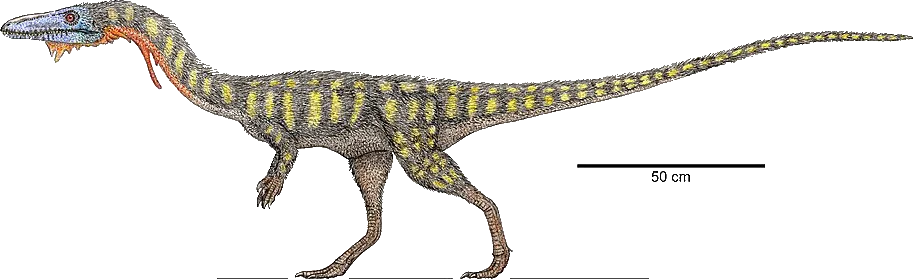
Coelophysis
TheropodLate TriassicCarnivore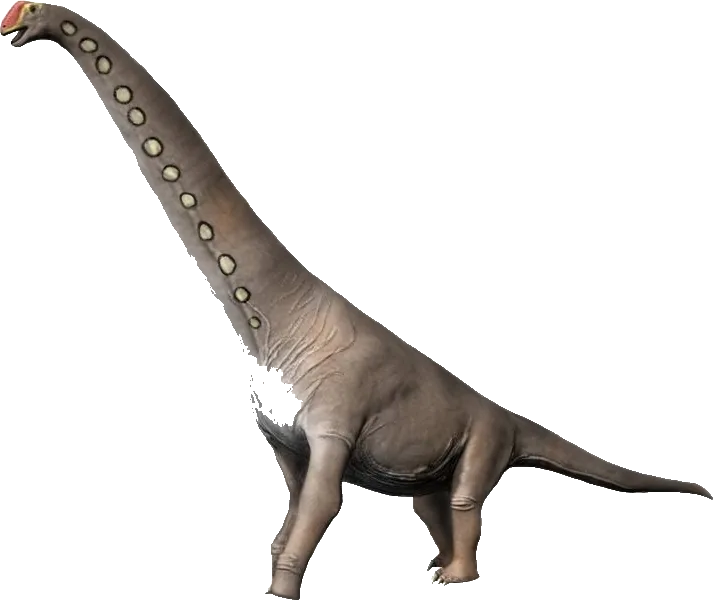
Brachiosaurus
SauropodLate JurassicHerbivore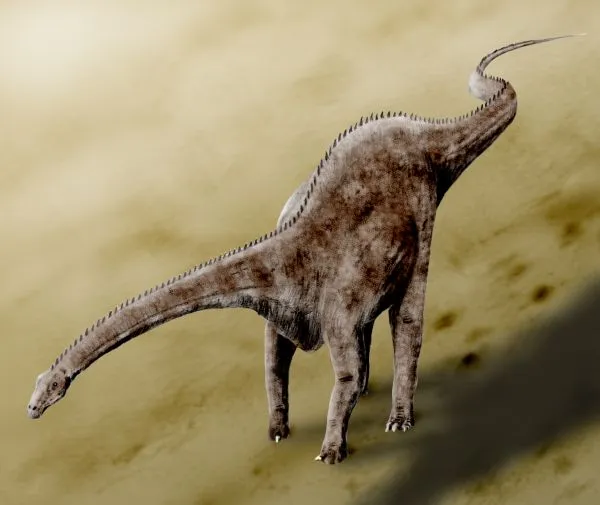
Diplodocus
SauropodLate JurassicHerbivore
Sources
Media on this page
- Plateosaurus BW.jpg — Nobu Tamura (http://spinops.blogspot.com) · CC BY 3.0
- Fern in forest by I. Levitan (1895, N. Novgorod).jpg — Isaac Levitan · Public domain
- Plateosaurus simplified 3D model — DinoVerse (generated from original artwork) · CC0 1.0
- Plateosaurus reconstructed call (synthesised) — DinoVerse (synthesised) · CC0 1.0
- Plateosaurus Skelett 2.jpg — FunkMonk · CC BY-SA 3.0
- Muscle reconstructions on Plateosaurus.PNG — Joep Schaeffer, Ewan Wolff, Florian Witzmann, Gabriel S. Ferreira, Rainer R. Schoch, Eudal · CC BY 2.5
- Plateosaurus MSF23.jpg — FunkMonk · CC BY-SA 3.0
- Plateosaurus SMNS F33.jpg — FunkMonk · CC BY-SA 3.0