Parasaurolophus
Name means “Near crested lizard”
Parasaurolophus was a duck-billed dinosaur with a long, hollow tube on its head. It may have used the tube like a trumpet to call to its friends.
Parasaurolophus was a lambeosaurine hadrosaurid from the Late Campanian of western North America. Its long, backward-curving crest contained looping nasal passages, and acoustic models suggest it could have produced deep, resonant calls.
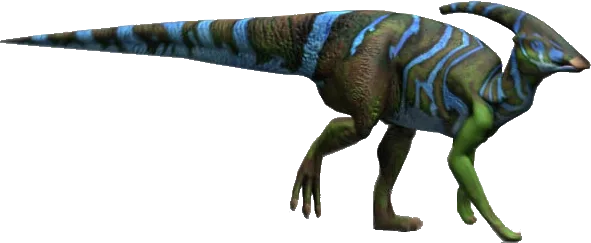
Parasaurolophus 3D rendered.jpg — Ryanz720 · Public domain
Pictures
Spin it in 3D
3D model description: a 3D model of Parasaurolophus shaped from a scientific life reconstruction painting, with the painting's colours and skin texture wrapped around it. It is not a scan of a real fossil.
About this model
This model is shaped from a scientific life reconstruction by Ryanz720: the painting's outline gives the 3D body and the painting itself is its skin. It is sized to the real animal's length (about 8.5 m), so in AR it appears life-size!
It looks best from the side, like the painting it comes from. It is not a fossil scan — museums such as the Smithsonian 3D collection share real fossil scans you can explore.
What might it sound like?
Transcript: Long, low trombone-like honk, about 4 seconds long
🤔 Nobody knows exactly how dinosaurs sounded
Parasaurolophus has some of the best sound evidence of any dinosaur. Its crest held long, looping air tubes, and computer models of the crest produce deep, foghorn-like tones. The exact sound is still a scientific guess, because soft tissues like the voice box are not preserved.
Voice boxes and soft tissue almost never fossilise, so sound reconstructions use clues: body size (bigger animals make lower sounds), the calls of living relatives (crocodiles boom with closed mouths; birds coo and hiss), and hollow structures such as hadrosaur crests that could have worked like a trumpet.
Sound: synthesised by DinoVerse from these scientific ideas (CC0). It is a creative guess, not a recording.
Food and habits
Herbivore
Plant-eater
How it ate
Cropped plants with a wide, toothless beak and ground them up with dental batteries, hundreds of tightly packed teeth that worked like a rough file, constantly replaced as they wore down.
🔍 How do we know?
- dental batteries with grinding surfaces
- tooth wear patterns
- fossilised gut contents and coprolites from related hadrosaurs
It ate…
- Conifer needles and twigs
- Flowering shrubs
- Ferns
- Horsetails
Parasaurolophus
…and was eaten by
- Gorgosaurus
- Daspletosaurus
Arrows show energy moving up the food chain: from food to eater.
Watch it call
Quick facts
| 📏 Length | 7.5–9.5 m (25–31 ft) |
|---|---|
| ↕️ Height | 2.5–3 m (8–10 ft) |
| ⚖️ Weight | 2,500–5,000 kg (5,510–11,020 lb) |
| ⏳ When it lived | 76.5–73 million years ago (Late Cretaceous) |
| 📍 Fossils found | Dinosaur Park Formation, Alberta, Canada; Kirtland and Fruitland formations, New Mexico, USA; Kaiparowits Formation, Utah, USA |
| 🔎 Discovered | 1920 by University of Toronto field party (named by William Parks, 1922) |
| 🧬 Group | Ornithopods — Ornithischia › Neornithischia › Ornithopoda |
Where scientists disagree, we show a range. Sizes are for adults.
How big was it?
Where and when
- 📍 Dinosaur Park Formation, Alberta, Canada (North America)
- 📍 Kirtland and Fruitland formations, New Mexico, USA (North America)
- 📍 Kaiparowits Formation, Utah, USA (North America)
Lived 76.5–73 million years ago
That's about 75 million years before you were born! Humans have only existed for about 0.3 million years.
See it on the big timeline →Did you know?
- 1The crest on Parasaurolophus's head was hollow inside, like a trumpet!
- 2Its crest could be longer than a grown-up's arm.
- 3It had hundreds of teeth packed together for grinding plants.
- 4Baby Parasaurolophus had only a tiny bump where the big crest would grow.
- Air breathed in through the nostrils travelled up through tubes inside the crest and back down to the throat, a path several metres long in total.
- Computer modelling of the crest has produced low-frequency sounds, and hadrosaur inner ears had a well-developed hearing region, supporting the idea that crests helped with long-distance communication.
- Besides sound, the crest probably helped individuals recognise their own species and may have differed between males and females, though crest variation could also reflect age.
- A juvenile nicknamed 'Joe', described in 2013 from Utah, showed that crest growth started early: at about one year old it already had a small, rounded crest.
Myth vs fact
❌ MythParasaurolophus used its crest as a snorkel to breathe underwater.
✅ FactThe crest had no hole at the top, so it could not work as a snorkel. Duck-bills were land animals that browsed on plants.
❌ MythDuck-billed dinosaurs lived mostly in water and ate soft water plants.
✅ FactTheir hoof-like feet, grinding teeth and fossil stomach contents show they lived on land and chewed tough plants like conifers.
Mini quiz
1. What was special about Parasaurolophus's crest?
2. What might Parasaurolophus have used its crest for?
3. What did Parasaurolophus eat?
Related animals
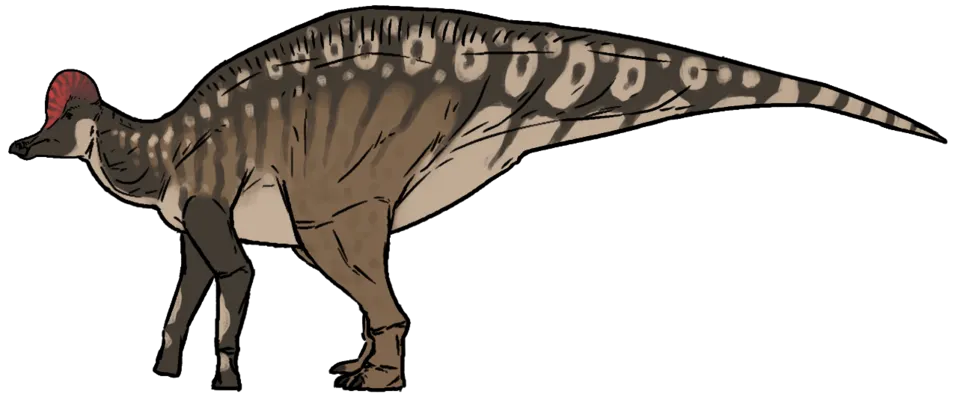
Corythosaurus
OrnithopodLate CretaceousHerbivore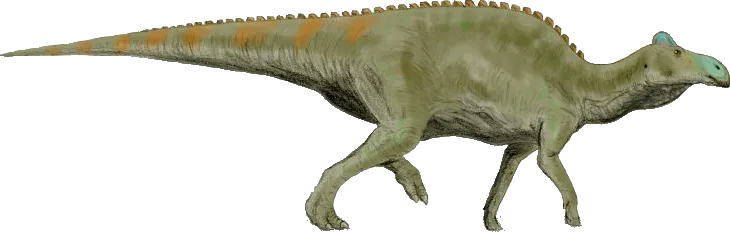
Edmontosaurus
OrnithopodLate CretaceousHerbivore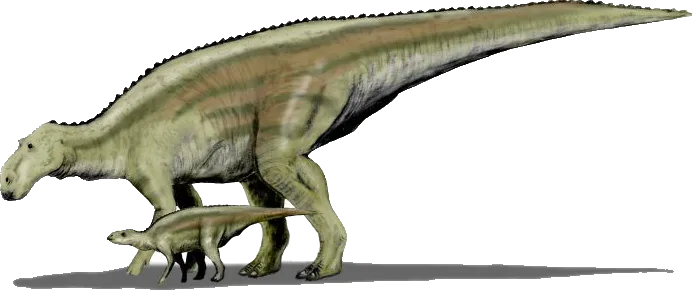
Maiasaura
OrnithopodLate CretaceousHerbivore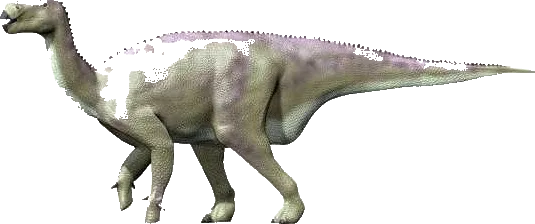
Iguanodon
OrnithopodEarly CretaceousHerbivore
Sources
Media on this page
- Parasaurolophus 3D rendered.jpg — Ryanz720 · Public domain
- Fern in forest by I. Levitan (1895, N. Novgorod).jpg — Isaac Levitan · Public domain
- Parasaurolophus 3D model, shaped from the life reconstruction "Parasaurolophus 3D rendered.jpg" — Ryanz720 (artwork); 3D shaping by DinoVerse · Public domain
- Parasaurolophus reconstructed call (synthesised) — DinoVerse (synthesised) · CC0 1.0
- FMNH Parasaurolophus fossil.jpg — Zissoudisctrucker · CC BY-SA 4.0
- Kaiparowits Formation Parasaurolophus.png — Terry A. Gates, David C. Evans, Joseph J.W. Sertich · CC BY 4.0
- Life reconstruction of Parasaurolophus walkeri.png — Connor Ashbridge · CC BY-SA 4.0
- ParasaurCMNBeak.jpg — LittleLazyLass · CC BY-SA 4.0