Pachycephalosaurus
Name means “Thick-headed lizard”
Pachycephalosaurus had a super-thick, dome-shaped head covered in bony bumps. It lived alongside T. rex at the very end of the age of dinosaurs.
Pachycephalosaurus wyomingensis was the largest known pachycephalosaur, living in western North America in the last few million years of the Cretaceous. Its skull roof was up to about 22 cm thick, and whether it used that dome for head-butting is one of the liveliest debates about dinosaur behaviour.
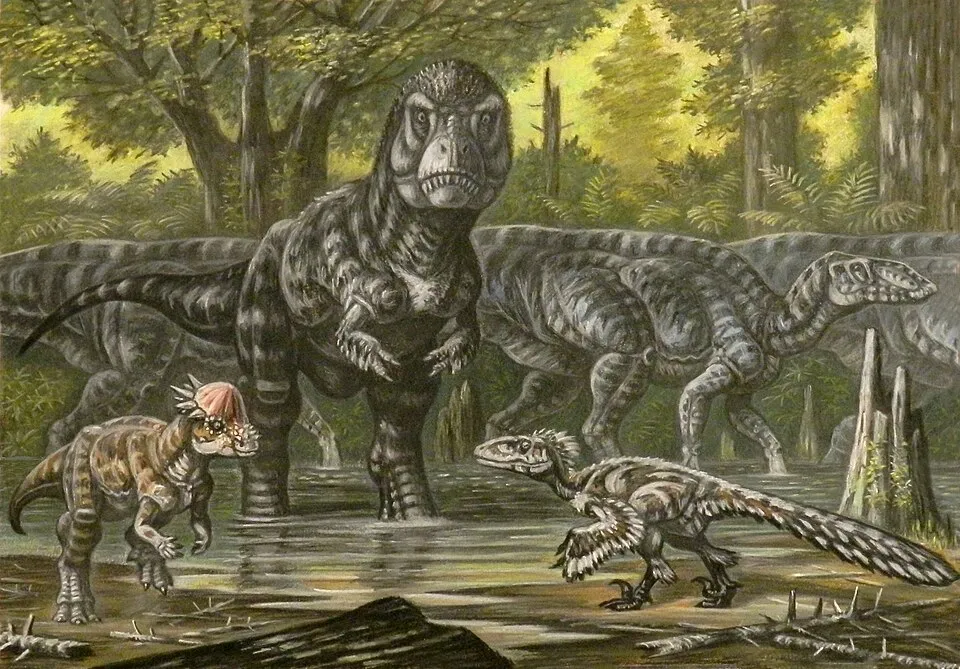
Dakotaraptor, Edmontosaurus, Pachycephalosaurus an — ABelov2014 · CC BY 3.0
Pictures
Spin it in 3D
3D model description: a 3D model of Pachycephalosaurus shaped from a scientific life reconstruction painting, with the painting's colours and skin texture wrapped around it. It is not a scan of a real fossil.
About this model
This model is shaped from a scientific life reconstruction by Unknown (see source): the painting's outline gives the 3D body and the painting itself is its skin. It is sized to the real animal's length (about 4.0 m), so in AR it appears life-size!
It looks best from the side, like the painting it comes from. It is not a fossil scan — museums such as the Smithsonian 3D collection share real fossil scans you can explore.
What might it sound like?
Transcript: Short, gruff grunting call, about 2 seconds long
🤔 Nobody knows exactly how dinosaurs sounded
Nobody knows how Pachycephalosaurus sounded. It had no hollow crest to amplify sound, so scientists guess it made simple grunts or rumbles, perhaps closed-mouth calls like those of birds and crocodiles.
Voice boxes and soft tissue almost never fossilise, so sound reconstructions use clues: body size (bigger animals make lower sounds), the calls of living relatives (crocodiles boom with closed mouths; birds coo and hiss), and hollow structures such as hadrosaur crests that could have worked like a trumpet.
Sound: synthesised by DinoVerse from these scientific ideas (CC0). It is a creative guess, not a recording.
Food and habits
Herbivore
Plant-eater
How it ate
Nipped off leaves, seeds and fruit with a narrow beak and small, leaf-shaped, ridged teeth that sliced rather than ground its food.
🔍 How do we know?
- small leaf-shaped serrated teeth
- narrow snout suited to picking selected plant parts
- tooth wear
- comparison with other pachycephalosaurs
It ate…
- Leaves of flowering shrubs
- Seeds and fruits
- Ferns
- Low conifers
Pachycephalosaurus
…and was eaten by
Arrows show energy moving up the food chain: from food to eater.
Watch it walk
Quick facts
| 📏 Length | 3.5–4.5 m (11–15 ft) |
|---|---|
| ↕️ Height | 1.2–1.8 m (4–6 ft) |
| ⚖️ Weight | 370–450 kg (820–990 lb) |
| ⏳ When it lived | 70–66 million years ago (Late Cretaceous) |
| 📍 Fossils found | Hell Creek Formation, Montana, USA; Hell Creek Formation, South Dakota, USA; Lance Formation, Wyoming, USA |
| 🔎 Discovered | 1943 by Barnum Brown and Erich Maren Schlaikjer |
| 🧬 Group | Pachycephalosaurs — Ornithischia › Marginocephalia › Pachycephalosauria |
Where scientists disagree, we show a range. Sizes are for adults.
How big was it?
Where and when
- 📍 Hell Creek Formation, Montana, USA (North America)
- 📍 Hell Creek Formation, South Dakota, USA (North America)
- 📍 Lance Formation, Wyoming, USA (North America)
Lived 70–66 million years ago
That's about 68 million years before you were born! Humans have only existed for about 0.3 million years.
See it on the big timeline →Did you know?
- 1The top of Pachycephalosaurus's head was about as thick as a big dictionary!
- 2Its dome was ringed with bony bumps and little spikes.
- 3It walked on two legs and was about as long as a car.
- 4It lived at the same time and place as T. rex and Triceratops.
- Most fossils are skull domes, because the thick bone survived better than the rest of the skeleton; the size of the whole animal is estimated from relatives.
- In 2004 a bone-tissue study argued the domes were too spongy for head-butting and were mainly for display, but later computer stress models and a 2013 survey of healed injuries on domes support some form of head or flank butting.
- Some scientists think Dracorex and Stygimoloch, which have flatter heads and longer spikes, may be juvenile Pachycephalosaurus, while others argue they are separate animals; the debate is unresolved.
- Its teeth were small and leaf-shaped, so most experts see it as a plant-eater, though a few have suggested it may also have eaten fruit, seeds or occasional small animals.
Myth vs fact
❌ MythPachycephalosaurus definitely charged and smashed heads head-on like rams.
✅ FactScientists are still debating. Healed injuries on some domes suggest butting, but they may have hit each other's sides or used the dome mainly for showing off.
❌ MythPachycephalosaurus was a fierce meat-eater with a battering-ram head.
✅ FactIts small, leaf-shaped teeth show it ate mostly plants.
Mini quiz
1. What was special about Pachycephalosaurus's head?
2. What does 'Pachycephalosaurus' mean?
3. Which famous predator lived alongside Pachycephalosaurus?
Related animals
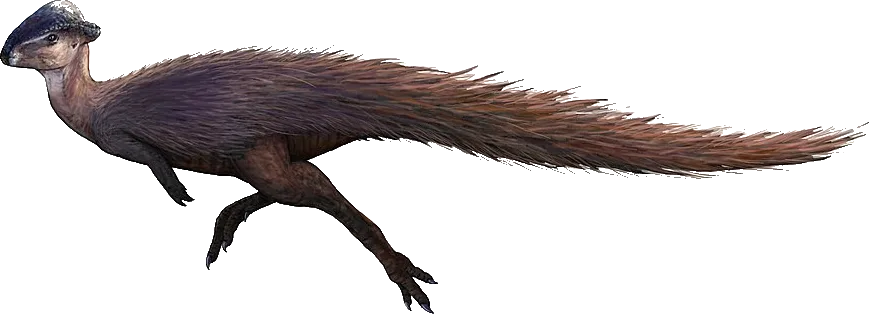
Stegoceras
PachycephalosaurLate CretaceousHerbivore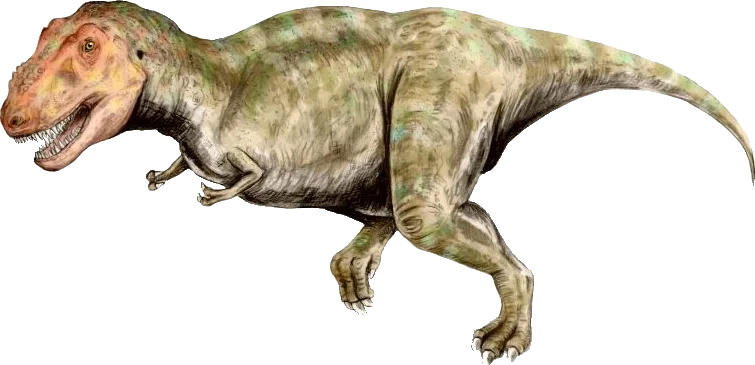
Tyrannosaurus rex
TheropodLate CretaceousCarnivore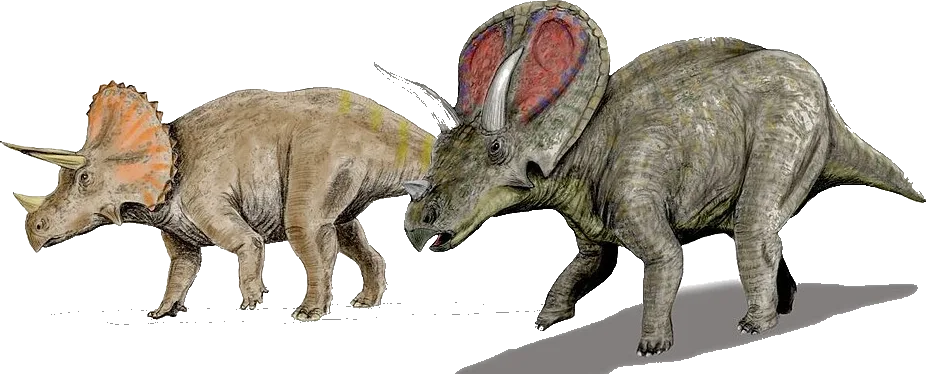
Triceratops
CeratopsianLate CretaceousHerbivore
Sources
Media on this page
- Dakotaraptor, Edmontosaurus, Pachycephalosaurus and Tyrannosaurus.jpg — ABelov2014 · CC BY 3.0
- Fern in forest by I. Levitan (1895, N. Novgorod).jpg — Isaac Levitan · Public domain
- Pachycephalosaurus 3D model, shaped from the life reconstruction "Pachycephalosaurus.jpg" — Unknown (see source) (artwork); 3D shaping by DinoVerse · CC BY 2.5
- Pachycephalosaurus reconstructed call (synthesised) — DinoVerse (synthesised) · CC0 1.0
- Pachycephalosaurus wyomingensis ROM.jpg — IJReid · CC BY 4.0
- AMNH 1696 Pachycephalosaurus.jpg — Skye McDavid · CC BY-SA 4.0
- Hell Creek pachycephalosaurs.jpg — ABelov2014 · CC BY-SA 3.0
- Holotype of Pachycephalosaurus wyomingensis.jpg — Michael Brett-Surman · CC0