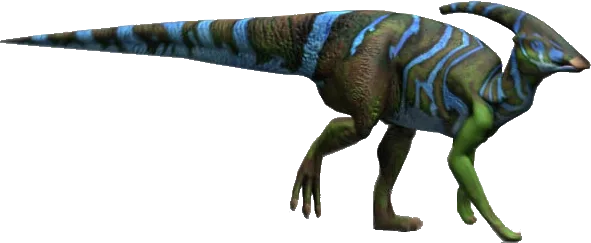
Say it: PAR-ah-SORE-oh-LOAF-us · Name means: “Near crested lizard”
Key facts about Parasaurolophus
⏳ Lived
76.5–73 million years ago Late Cretaceous
🌿 Diet
Herbivore (plant-eater)
📏 Length
7.5–9.5 m (25–31 ft)
↕️ Height
2.5–3 m (8–10 ft)
⚖️ Weight
2,500–5,000 kg (5,510–11,020 lb)
📍 Found in
North America
🔎 Discovered
1920 by University of Toronto field party (named by William Parks, 1922)
About Parasaurolophus
Parasaurolophus was a duck-billed dinosaur with a long, hollow tube on its head. It may have used the tube like a trumpet to call to its friends.
Parasaurolophus was a lambeosaurine hadrosaurid from the Late Campanian of western North America. Its long, backward-curving crest contained looping nasal passages, and acoustic models suggest it could have produced deep, resonant calls.
Drawn to scale next to a 1.7 m adult and a 12 m school bus.
Did you know?
The crest on Parasaurolophus's head was hollow inside, like a trumpet!
Its crest could be longer than a grown-up's arm.
It had hundreds of teeth packed together for grinding plants.
Baby Parasaurolophus had only a tiny bump where the big crest would grow.
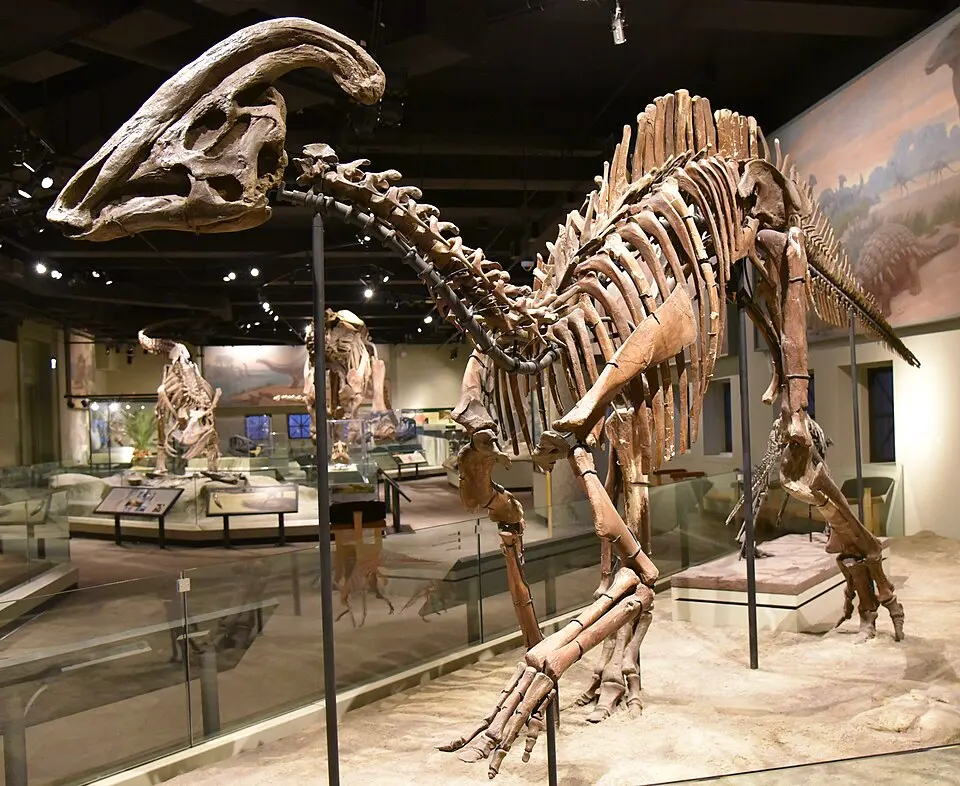
Air breathed in through the nostrils travelled up through tubes inside the crest and back down to the throat, a path several metres long in total.
Computer modelling of the crest has produced low-frequency sounds, and hadrosaur inner ears had a well-developed hearing region, supporting the idea that crests helped with long-distance communication.
Besides sound, the crest probably helped individuals recognise their own species and may have differed between males and females, though crest variation could also reflect age.
A juvenile nicknamed 'Joe', described in 2013 from Utah, showed that crest growth started early: at about one year old it already had a small, rounded crest.
DinoVerse· Parasaurolophus fact sheet
Ornithopods
🌿 What did it eat?
Food: Conifer needles and twigs, Flowering shrubs, Ferns, Horsetails.
Cropped plants with a wide, toothless beak and ground them up with dental batteries, hundreds of tightly packed teeth that worked like a rough file, constantly replaced as they wore down.
Clues scientists use: dental batteries with grinding surfaces; tooth wear patterns; fossilised gut contents and coprolites from related hadrosaurs.
Who might have hunted it: Gorgosaurus, Daspletosaurus.
🗺️ Where fossils were found
Dinosaur Park Formation, Alberta, Canada (North America)
Kirtland and Fruitland formations, New Mexico, USA (North America)
Kaiparowits Formation, Utah, USA (North America)
Skeleton / museum mount of Parasaurolophus: Photograph of Parasaurolophus fossil mount at the Field Museum of…
Myth or fact?
✗ Myth: Parasaurolophus used its crest as a snorkel to breathe underwater.
✓ Fact: The crest had no hole at the top, so it could not work as a snorkel. Duck-bills were land animals that browsed on plants.
✗ Myth: Duck-billed dinosaurs lived mostly in water and ate soft water plants.
✓ Fact: Their hoof-like feet, grinding teeth and fossil stomach contents show they lived on land and chewed tough plants like conifers.
✏️ Quick quiz
Circle the right answer. Name: ______________________
What was special about Parasaurolophus's crest?
A It was hollow inside
B It glowed
C It was made of feathers
D It was full of venom
What might Parasaurolophus have used its crest for?
A Digging holes
B Making sounds to call others
C Catching fish
D Flying
What did Parasaurolophus eat?
A Fish
B Insects
C Other dinosaurs
D Plants
Answers: 1–A 2–B 3–D
Sources and picture credits
Natural History Museum London — Parasaurolophus — www.nhm.ac.uk/discover/dino-directory/parasaurolophus.html
Wikipedia — Parasaurolophus — en.wikipedia.org/wiki/Parasaurolophus
 DinoVerse · Dinosaur fact sheet