Say it: dih-PLOD-oh-kus · Name means: “Double beam”
Key facts about Diplodocus
⏳ Lived
154–149 million years ago Late Jurassic
🌿 Diet
Herbivore (plant-eater)
📏 Length
24–32 m (79–105 ft)
↕️ Height
4–5 m (13–16 ft)
⚖️ Weight
11,000–23,000 kg (24,250–50,710 lb)
📍 Found in
North America
🔎 Discovered
1877 by Benjamin Mudge and Samuel Wendell Williston (named by O. C. Marsh, 1878)
About Diplodocus
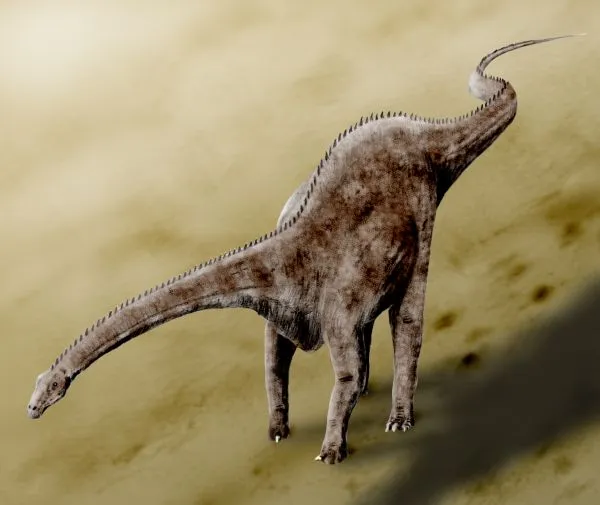
Diplodocus was one of the longest dinosaurs ever, longer than two buses parked end to end. Most of that length was its super-long neck and whip-like tail.
Diplodocus was a diplodocid sauropod from the Late Jurassic Morrison Formation of western North America and one of the best-known dinosaurs thanks to many casts of the Carnegie Museum skeleton. Its long, low-slung neck, peg-like front teeth and enormously long tail made it a specialist at sweeping up and stripping plants.
Drawn to scale next to a 1.7 m adult and a 12 m school bus.
Did you know?
Diplodocus was about as long as three school buses in a row!
Its tail was so long and thin at the end that it looked like a whip.
Its teeth were shaped like little pegs and it grew new ones about once a month.
A famous Diplodocus skeleton cast called 'Dippy' has toured museums around the world.
The name 'double beam' refers to the paired, skid-like chevron bones under its tail, which may have protected blood vessels when the tail touched the ground.
A 1997 computer model suggested the tail tip could crack faster than sound, but a 2022 study using a more detailed model found it probably reached only about 30 metres per second, well below supersonic speed.
Studies of tooth replacement show each tooth position could be replaced roughly every 35 days, an adaptation to wear from tough, gritty plants.
Scientists still debate neck posture: neck-joint studies favour a mostly horizontal neck sweeping across low vegetation, while others argue it could also raise its head to browse higher.
Fossil skin impressions show a row of narrow, keratin-covered spines along the back and tail, so its back may have looked a little like an iguana's.
Combed leaves off branches with a row of thin, peg-like teeth at the front of its broad snout, pulling its head back to strip the plants, and swallowed them without chewing.
Clues scientists use: peg-like teeth at the front of the jaws; scratches and pits in tooth wear; very fast tooth replacement; skull shape suited to branch-stripping.
Who might have hunted it: Allosaurus, Torvosaurus, Ceratosaurus.
🗺️ Where fossils were found
Garden Park, Cañon City, Colorado, USA (North America)
Sheep Creek, Albany County, Wyoming, USA (North America)
Dinosaur National Monument, Utah, USA (North America)
Montana, USA (North America)
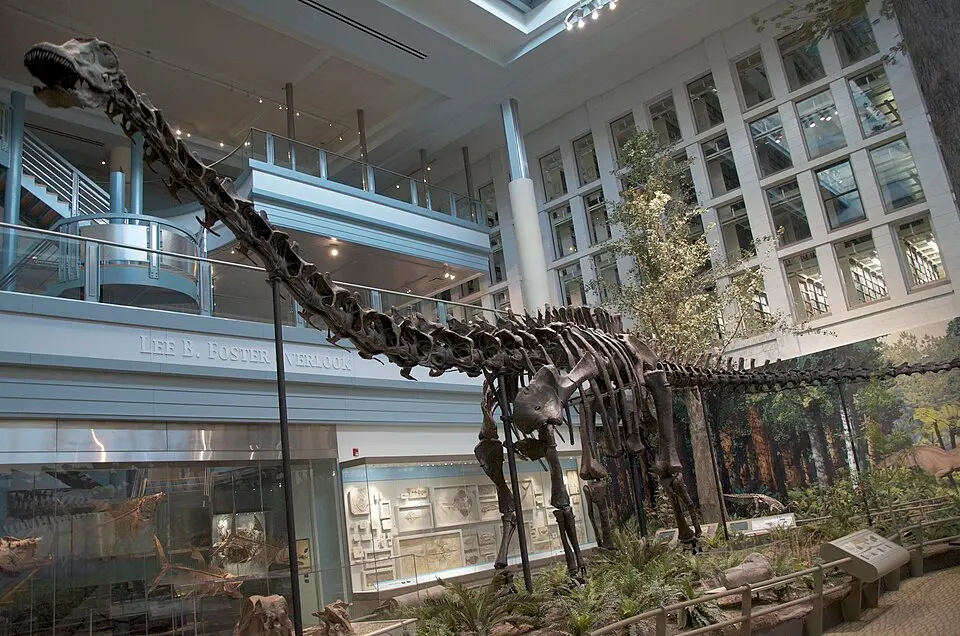
Skeleton / museum mount of Diplodocus: Diplodocus skeletal mount at the Carnegie Museum of Natural History,…
Myth or fact?
✗ Myth: Diplodocus spent its life in swamps so the water could hold up its heavy body.
✓ Fact: Its slim legs, compact feet and trackways on dry ground show it walked on land. Deep water would have pressed on its chest so hard it could barely breathe.
✗ Myth: Diplodocus dragged its long tail along the ground.
✓ Fact: Trackways almost never show tail-drag marks. Its tail was held up off the ground, balancing the long neck.
✏️ Quick quiz
Circle the right answer. Name: ______________________
What does 'Diplodocus' mean?
A Double beam
B Long neck
C Whip tail
D Heavy lizard
What shape were Diplodocus's teeth?
A Sharp and curved
B Flat like plates
C Thin like pegs
D It had no teeth
What is the name of the famous Diplodocus cast that toured museums?
A Sue
B Dippy
C Stan
D Lucy
Answers: 1–A 2–C 3–B
Sources and picture credits
Natural History Museum London — Diplodocus — www.nhm.ac.uk/discover/dino-directory/diplodocus.html
Wikipedia — Diplodocus — en.wikipedia.org/wiki/Diplodocus
 DinoVerse · Dinosaur fact sheet