DinoVerse · Dinosaur fact sheet
Kentrosaurus
Say it: KEN-troh-SORE-us · Name means: “Prickle lizard”
| ⏳ Lived | 155–150 million years ago Late Jurassic |
|---|---|
| 🌿 Diet | Herbivore (plant-eater) |
| 📏 Length | 4–4.5 m (13–15 ft) |
| ↕️ Height | 1.2–1.6 m (4–5 ft) |
| ⚖️ Weight | 700–1,600 kg (1,540–3,530 lb) |
| 📍 Found in | Africa |
| 🔎 Discovered | 1915 by Edwin Hennig (fossils dug up by the German Tendaguru expedition, 1909–1912) |
About Kentrosaurus
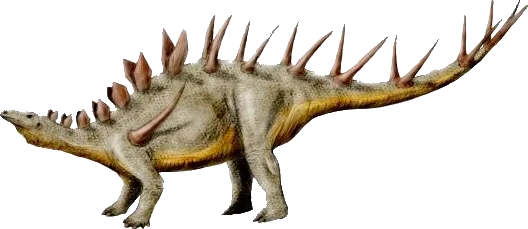
Kentrosaurus was a small cousin of Stegosaurus from Africa. It had plates on its front half and long, sharp spikes on its back half and tail.
Kentrosaurus was a stegosaurid from the Late Jurassic Tendaguru beds of Tanzania, known from more than a thousand bones from many individuals. Narrow plates on its neck and back gave way to paired spikes along the hips and tail, plus a long spike on each shoulder.
How big was it?
Drawn to scale next to a 1.7 m adult and a 12 m school bus.
Did you know?
- Kentrosaurus had more spikes than Stegosaurus — including one on each shoulder!
- It was about as long as a car.
- Its tail could swing in a wide arc, like a spiky whip.
- It lived in Africa, in what is now Tanzania.
- Computer models of its tail by Heinrich Mallison suggest Kentrosaurus could swing its spiked tail through a wide arc at speeds fast enough to break bones or cause deep wounds.
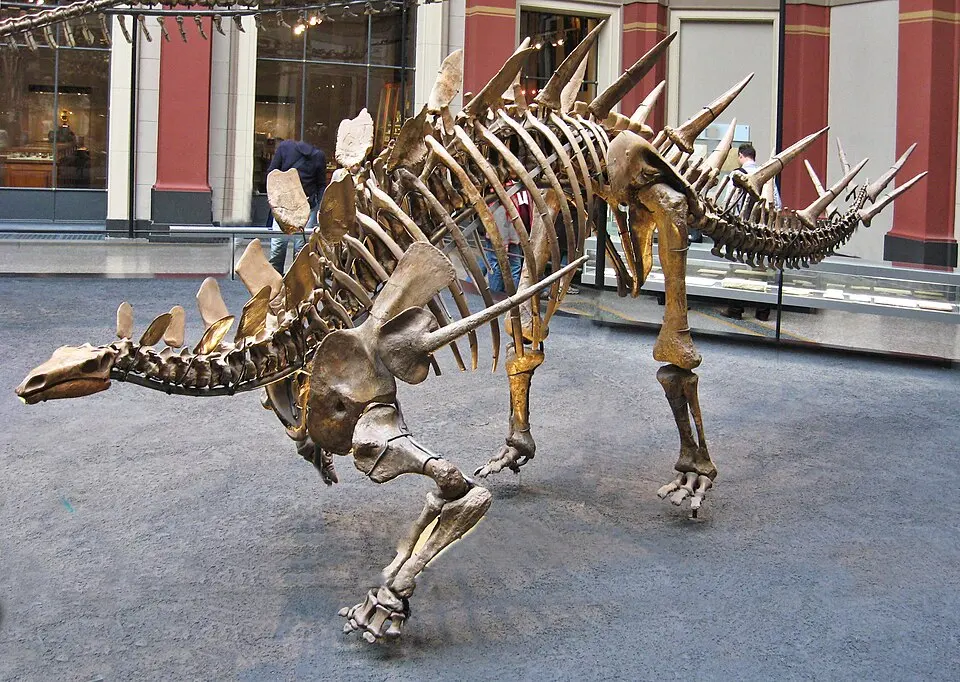
- Hennig originally placed the long spike over the hip, but later studies favour the shoulder; a few researchers still argue the evidence is not conclusive.
- Much of the original Kentrosaurus material was destroyed during the Second World War, but a mounted skeleton survives at the Museum für Naturkunde in Berlin.
- Differences in thigh bones from the Tendaguru quarry may reflect two body types, which some researchers interpret as males and females.