Say it: SALT-ah-SORE-us · Name means: “Lizard from Salta”
Key facts about Saltasaurus
⏳ Lived
71–67 million years ago Late Cretaceous
🌿 Diet
Herbivore (plant-eater)
📏 Length
8–12 m (26–39 ft)
↕️ Height
2.5–3.5 m (8–11 ft)
⚖️ Weight
2,500–7,000 kg (5,510–15,430 lb)
📍 Found in
South America
🔎 Discovered
1975 by José Bonaparte and Jaime Powell (named 1980)
About Saltasaurus
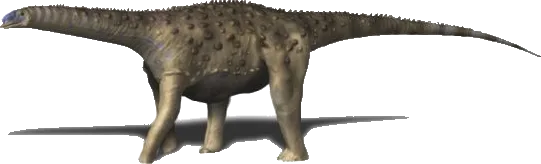
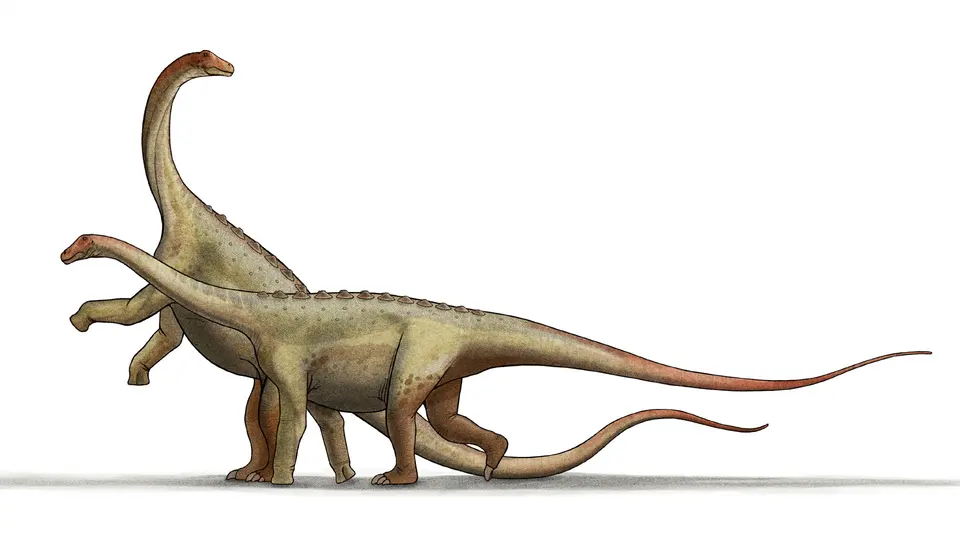
Saltasaurus was a fairly small long-necked dinosaur with bony armour in its skin. It lived in Argentina near the end of the age of dinosaurs.
Saltasaurus loricatus was a small saltasaurid titanosaur from the latest Cretaceous Lecho Formation of northwestern Argentina. It was the first sauropod found with clear body armour (osteoderms), which changed how scientists pictured these giants.
Drawn to scale next to a 1.7 m adult and a 12 m school bus.
Did you know?
Saltasaurus had little bony plates in its skin, like a suit of armour!
It was small for a long-necked dinosaur, only about as long as a bus.
It was named after Salta, the part of Argentina where it was found.
Its relatives laid eggs in huge nesting grounds with thousands of nests.
Its armour had two kinds of osteoderms: larger oval plates about 10 to 12 cm across and a dense mosaic of tiny bony studs a few millimetres wide.
When described in 1980, Saltasaurus overturned the idea that sauropods relied only on size for defence; osteoderms are now known in many other titanosaurs.
Titanosaur nesting grounds such as Auca Mahuevo in Argentina show that relatives of Saltasaurus laid clutches of round eggs in shallow pits, possibly returning to the same sites year after year.
Some scientists have suggested osteoderms may also have stored minerals for egg-laying, not only protected the animal; this idea is still debated.
DinoVerse· Saltasaurus fact sheet
Sauropods
🌿 What did it eat?
Food: Conifers, Ferns, Cycads, Flowering plants.
Cropped low and medium-height plants with simple, peg-like teeth at the front of its jaws, swallowing them whole to be broken down slowly in its large gut.
Clues scientists use: peg-like teeth seen in related titanosaurs; body shape suited to mid-height browsing; fossilised dung from Indian titanosaurs containing grasses and other plants.
Who might have hunted it: Abelisaurid theropods.
🗺️ Where fossils were found
Lecho Formation, El Brete, Salta Province, Argentina (South America)
Photo of Saltasaurus: Saltasaurus (which means "lizard from Salta") was a sauropod dinosaur of the Late…
Myth or fact?
✗ Myth: Sauropods were so big that they never needed armour.
✓ Fact: Saltasaurus had bony plates and studs in its skin, and similar osteoderms have now been found in many other titanosaurs.
✗ Myth: All sauropods were gigantic.
✓ Fact: Saltasaurus was only about 8 to 12 m long, showing that titanosaurs came in many sizes.
✏️ Quick quiz
Circle the right answer. Name: ______________________
What made Saltasaurus special among long-necked dinosaurs?
A It could fly
B It had horns
C It had bony armour
D It ate meat
Where was Saltasaurus found?
A Africa
B Argentina
C Australia
D Antarctica
What kind of dinosaur group did Saltasaurus belong to?
A Titanosaurs
B Raptors
C Duck-bills
D Horned dinosaurs
Answers: 1–C 2–B 3–A
Sources and picture credits
Natural History Museum London — Saltasaurus — www.nhm.ac.uk/discover/dino-directory/saltasaurus.html
Wikipedia — Saltasaurus — en.wikipedia.org/wiki/Saltasaurus
 DinoVerse · Dinosaur fact sheet