Quetzalcoatlus
Name means “Named after Quetzalcoatl, the feathered serpent god of the Aztecs”
🚫 Not a dinosaur!
Quetzalcoatlus was a pterosaur, a flying reptile. Pterosaurs were close cousins of dinosaurs, but their legs did not sit straight under the body in the dinosaur way and they evolved on a separate branch.
Quetzalcoatlus was one of the biggest flying animals ever, with wings as wide as a small plane. Standing up, it was as tall as a giraffe!
Quetzalcoatlus was an azhdarchid pterosaur from the end of the Cretaceous in Texas and one of the largest flying animals known, with a wingspan of roughly 10–11 m. Its long neck, stiff beak and long limbs suggest it hunted small animals on the ground.
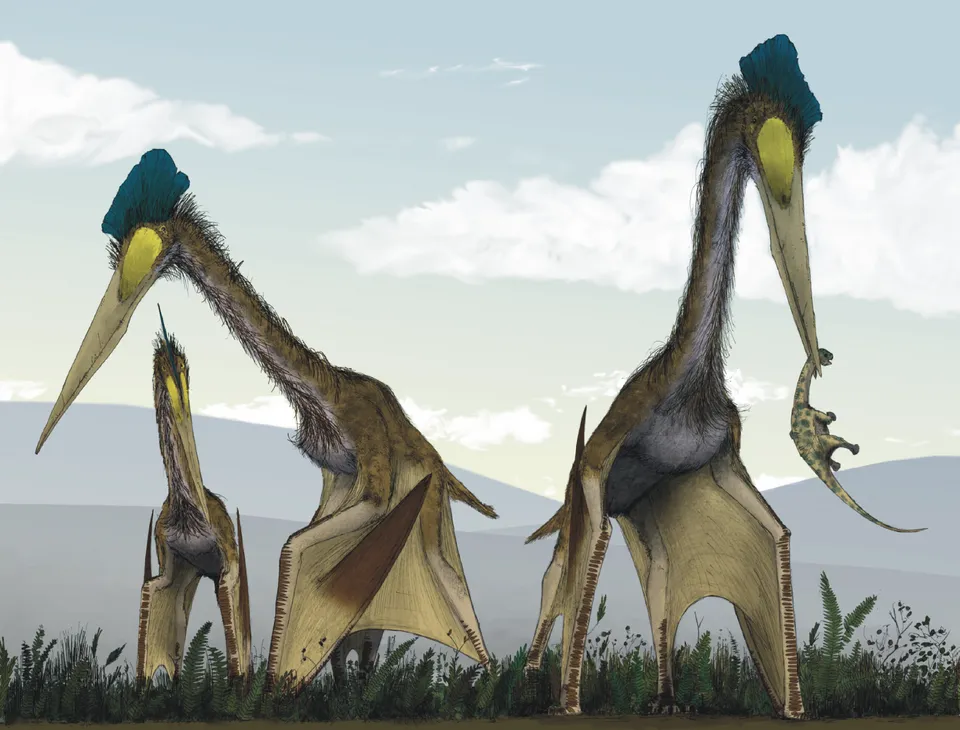
Life restoration of a group of giant azhdarchids, — Mark Witton and Darren Naish · CC BY 3.0
Pictures
Spin it in 3D
3D model description: a 3D model of Quetzalcoatlus shaped from a scientific life reconstruction painting, with the painting's colours and skin texture wrapped around it. It is not a scan of a real fossil.
About this model
This model is shaped from a scientific life reconstruction by ДиБгд at Russian Wikipedia: the painting's outline gives the 3D body and the painting itself is its skin. It is sized to the real animal's length (about 10.5 m), so in AR it appears life-size!
It looks best from the side, like the painting it comes from. It is not a fossil scan — museums such as the Smithsonian 3D collection share real fossil scans you can explore.
What might it sound like?
Transcript: Deep, breathy hiss with a rattling edge
🤔 Nobody knows exactly how dinosaurs sounded
This is a scientific guess. No pterosaur voice organ has fossilised. Crocodiles and birds, their closest living relatives, hiss and make throaty calls, and a giant like Quetzalcoatlus would have had a deeper sound than smaller pterosaurs.
Voice boxes and soft tissue almost never fossilise, so sound reconstructions use clues: body size (bigger animals make lower sounds), the calls of living relatives (crocodiles boom with closed mouths; birds coo and hiss), and hollow structures such as hadrosaur crests that could have worked like a trumpet.
Sound: synthesised by DinoVerse from these scientific ideas (CC0). It is a creative guess, not a recording.
Food and habits
Carnivore
Meat-eater
How it ate
Probably stalked on all fours across open ground like a giant stork, grabbing small animals with its long, toothless beak and swallowing them whole.
🔍 How do we know?
- long, stiff neck and toothless beak
- limb proportions suited to walking on land
- fossils found far inland, not in sea rocks
It ate…
- baby dinosaurs
- small mammals
- lizards
- other small animals
Quetzalcoatlus
…and was eaten by
👑 Probably nothing, once fully grown — a top predator or too big to tackle!
Arrows show energy moving up the food chain: from food to eater.
Watch it fly
Quick facts
| 📏 Wingspan | 10–11 m (33–36 ft) |
|---|---|
| ↕️ Height | 4.5–5 m (15–16 ft) |
| ⚖️ Weight | 200–250 kg (440–550 lb) |
| ⏳ When it lived | 68–66 million years ago (Late Cretaceous) |
| 📍 Fossils found | Javelina Formation, Big Bend National Park, Texas, USA |
| 🔎 Discovered | 1971 by Douglas Lawson (named in 1975) |
| 🧬 Group | Pterosaurs — Archosauria › Avemetatarsalia › Pterosauria |
Where scientists disagree, we show a range. Sizes are for adults.
How big was it?
Where and when
- 📍 Javelina Formation, Big Bend National Park, Texas, USA (North America)
Lived 68–66 million years ago
That's about 67 million years before you were born! Humans have only existed for about 0.3 million years.
See it on the big timeline →Did you know?
- 1When it stood on the ground, Quetzalcoatlus was as tall as a giraffe!
- 2Its wings were about as wide as a small airplane's.
- 3Even though it was huge, its bones were hollow, so it weighed about as much as two or three grown-ups.
- 4It probably walked around catching small animals, a bit like a giant stork.
- The 10–11 m figures are wingspan estimates; the type species, Q. northropi, is known from only a partial wing, so its size is scaled from the better-known smaller species, Q. lawsoni.
- Early ideas that it skimmed fish or scavenged like a vulture have mostly given way to 'terrestrial stalking', proposed by Witton and Naish in 2008, though a 2021 study suggested it may also have probed for prey in water or soft ground.
- A detailed 2021 description of Q. lawsoni argued it took off by leaping powerfully from the ground, and debate continues over whether the arms or the legs did most of the launch work.
- Its neck vertebrae are long, tube-like and internally braced, making the neck strong but not very flexible.
Myth vs fact
❌ MythQuetzalcoatlus was a giant flying dinosaur.
✅ FactIt was a pterosaur, a flying reptile on a different branch from dinosaurs.
❌ MythQuetzalcoatlus was too heavy to fly.
✅ FactIts hollow bones and huge, powerful wings mean most scientists think it could fly, possibly over long distances.
Mini quiz
1. Is Quetzalcoatlus a dinosaur?
2. About how tall was Quetzalcoatlus when it stood up?
3. Which ancient god is Quetzalcoatlus named after?
Related animals
 Not a dinosaur
Pteranodon
PterosaurLate CretaceousPiscivore Not a dinosaur
Rhamphorhynchus
PterosaurLate JurassicPiscivore
Tyrannosaurus rex
TheropodLate CretaceousCarnivore
Media on this page
- Life restoration of a group of giant azhdarchids, Quetzalcoatlus northropi, foraging on a Cretaceous fern prairie.png — Mark Witton and Darren Naish · CC BY 3.0
- Cumulus Clouds over Yellow Prairie2.jpg — Wing-Chi Poon, colors adjusted by Kjetil r · CC BY-SA 2.5
- Quetzalcoatlus 3D model, shaped from the life reconstruction "Quetzalcoatlus07.jpg" — ДиБгд at Russian Wikipedia (artwork); 3D shaping by DinoVerse · Public domain
- Quetzalcoatlus reconstructed call (synthesised) — DinoVerse (synthesised) · CC0 1.0
- Quetzalcoatlus northropi.jpg — Ghedoghedo · CC BY-SA 3.0
- Aff Quetzalcoatlus - Longrich et al 2018.PNG — Nicholas R. Longrich, David M. Martill and Brian Andres · CC BY 4.0
- Cast of Quetzalcoatlus northropi humerus 01 - Pterosaurs Flight in the Age of Dinosaurs.jpg — Tim Evanson · CC BY-SA 2.0
- Life restoration of a group of giant azhdarchids, Quetzalcoatlus northropi, foraging on a Cretaceous fern prairie.png — Mark Witton and Darren Naish · CC BY 3.0