Say it: AR-kee-OP-ter-iks · Name means: “Ancient wing”
Key facts about Archaeopteryx
⏳ Lived
151–148 million years ago Late Jurassic
🥩 Diet
Carnivore (meat-eater)
📏 Length
0.4–0.5 m (1–2 ft)
↕️ Height
0.2–0.3 m (1 ft)
⚖️ Weight
0.5–1 kg (1.1–2.2 lb)
📍 Found in
Europe
🔎 Discovered
1861 by Hermann von Meyer (named from a single feather and the London specimen)
About Archaeopteryx
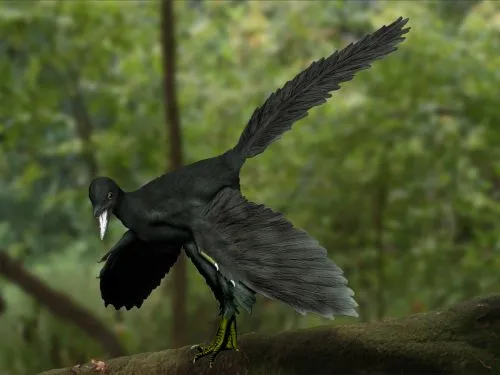
Archaeopteryx was a feathered dinosaur the size of a crow, with wings, teeth and a long bony tail. It is one of the earliest birds ever found.
Archaeopteryx is a Late Jurassic avialan dinosaur from southern Germany, combining bird-like feathered wings with teeth, clawed fingers and a long bony tail. Described just two years after Darwin's 'On the Origin of Species', it became a classic example of a transitional fossil linking non-avian dinosaurs and birds.
Drawn to scale next to a 1.7 m adult and a 12 m school bus.
Did you know?
Archaeopteryx is a dinosaur AND an early bird, both at once!
It had feathers and wings like a bird, but also teeth and a long bony tail like other dinosaurs.
It was about the size of a crow or a magpie.
The very first clue to Archaeopteryx was a single fossil feather found in 1861.
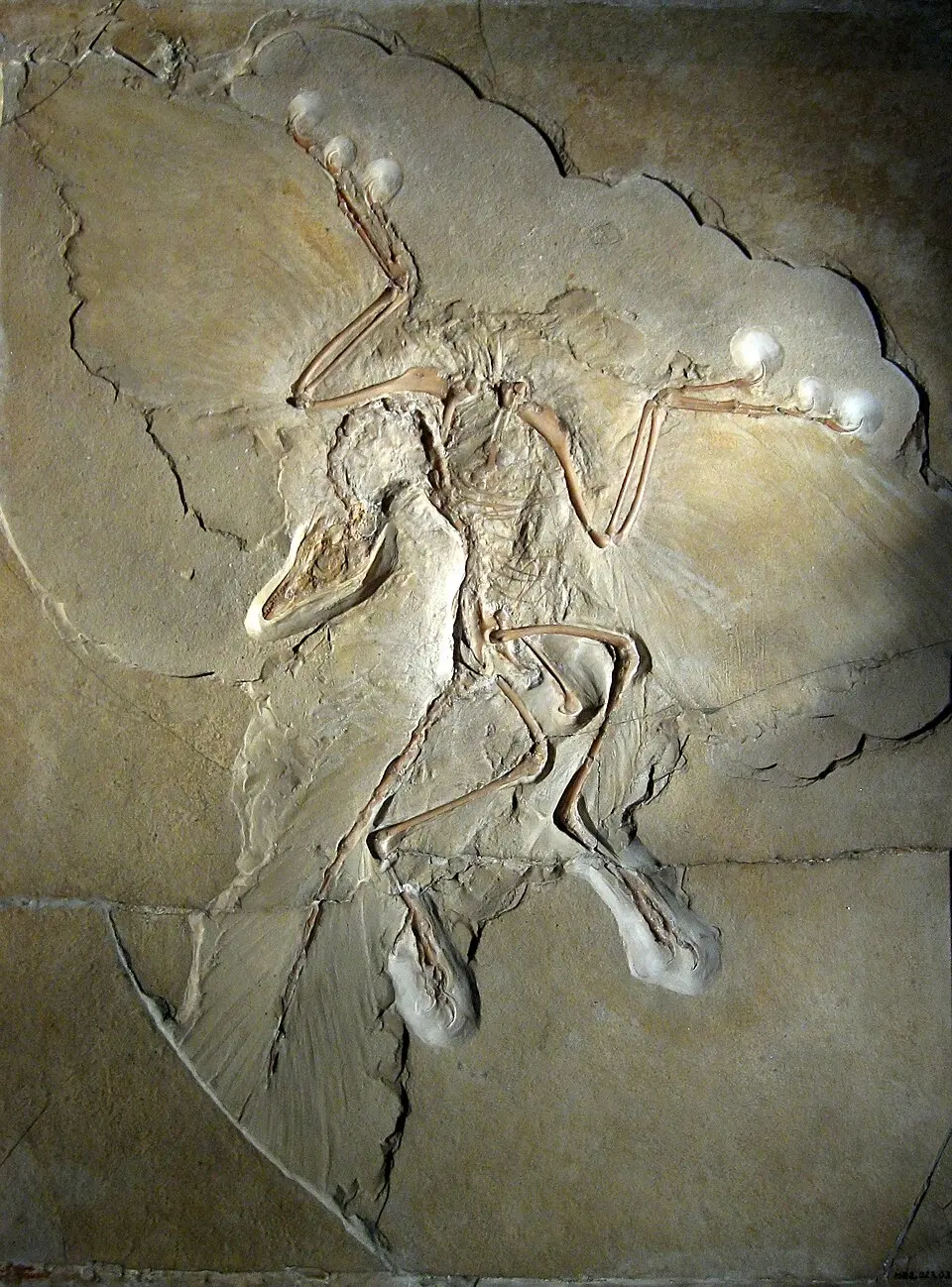
Around a dozen skeletons are known, all from the fine-grained Solnhofen limestones of Bavaria, which preserved even the outlines of its feathers.
Its feathers were asymmetric like those of modern flying birds, and most researchers think it could fly at least in short bursts, though how well it flapped is still debated.
A study of melanosomes in the isolated 1861 feather suggested it was black or dark, although the exact colour pattern of the whole animal remains uncertain.
Phylogenetic studies have sometimes placed Archaeopteryx closer to deinonychosaurs like Velociraptor than to modern birds; most still treat it as an early avialan, but the debate shows how blurry the line between birds and other dinosaurs is.
DinoVerse· Archaeopteryx fact sheet
Theropods
🥩 What did it eat?
Food: insects, small lizards, small fish, other small animals.
Snapped up insects and small animals with a beak-like snout full of small, sharp teeth, possibly using its clawed fingers to help hold food.
Clues scientists use: small, pointed, unserrated teeth; clawed fingers able to grasp; small body size and lagoon-island habitat.
🗺️ Where fossils were found
Solnhofen limestone, near Eichstätt, Bavaria, Germany (Europe)
Langenaltheim, Bavaria, Germany (Europe)
Skeleton / museum mount of Archaeopteryx: Archaeopteryx lithographica, specimen displayed at the Museum für…
Myth or fact?
✗ Myth: Archaeopteryx was a 'missing link' halfway between reptiles and birds, and not really a dinosaur.
✓ Fact: Birds are dinosaurs, and Archaeopteryx is a feathered dinosaur near the base of the bird family tree.
✗ Myth: Archaeopteryx was the direct ancestor of all modern birds.
✓ Fact: It is an early relative of birds, but probably a side branch rather than the great-great-grandparent of every bird alive today.
✏️ Quick quiz
Circle the right answer. Name: ______________________
Which of these did Archaeopteryx have?
A A beak with no teeth
B Fur
C A shell
D Feathers and teeth
What was the first Archaeopteryx fossil ever found?
A A single feather
B An egg
C A footprint
D A skull
Is Archaeopteryx a dinosaur?
A No, it is a pterosaur
B Yes, it is a feathered dinosaur and early bird
C No, it is a bat
D No, it is a lizard
Answers: 1–D 2–A 3–B
Sources and picture credits
Natural History Museum London — Archaeopteryx — www.nhm.ac.uk/discover/dino-directory/archaeopteryx.html
Wikipedia — Archaeopteryx — en.wikipedia.org/wiki/Archaeopteryx
 DinoVerse · Dinosaur fact sheet