Say it: veh-LOSS-ih-RAP-tor · Name means: “Swift thief”
Key facts about Velociraptor
⏳ Lived
75–71 million years ago Late Cretaceous
🥩 Diet
Carnivore (meat-eater)
📏 Length
1.5–2 m (5–7 ft)
↕️ Height
0.5–0.6 m (2 ft)
⚖️ Weight
15–20 kg (30–40 lb)
📍 Found in
Asia
🔎 Discovered
1923 by Peter Kaisen (American Museum of Natural History expedition)
About Velociraptor
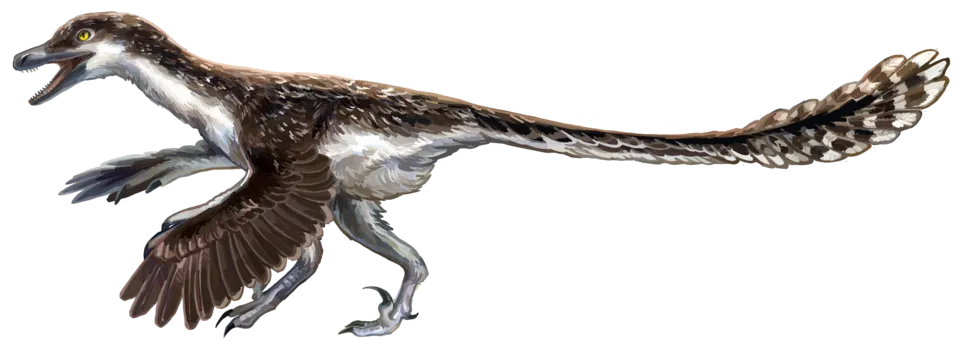
Velociraptor was a fast, feathered hunter about the size of a big turkey. It had a sharp, curved claw on each foot.
Velociraptor was a small dromaeosaurid theropod from the Late Cretaceous deserts of Mongolia and northern China. Quill knobs on its forearm bones show it had large wing feathers, and its retractable sickle claw was probably used to pin and hold struggling prey.
Drawn to scale next to a 1.7 m adult and a 12 m school bus.
Did you know?
Velociraptor was about as tall as your knee, not as tall as a person!
It had feathers, and even had little bumps on its arms where big wing feathers grew.
Each foot had one giant curved claw that it held up off the ground so it stayed sharp.
One famous fossil shows a Velociraptor and a Protoceratops frozen in the middle of a fight!
In 2007 researchers found quill knobs on a Velociraptor ulna, the attachment points for large feathers, showing it had well-developed wing feathers even though it could not fly.
The 'Fighting Dinosaurs' specimen, found in 1971, preserves a Velociraptor with its sickle claw in a Protoceratops's neck while the Protoceratops bites its arm; both were probably buried by a collapsing sand dune or sandstorm.
Studies of the sickle claw suggest it was not a slashing blade but a gripping hook, used like the talons of a hawk to pin prey while the predator fed (the 'raptor prey restraint' model).
Whether Velociraptor hunted in groups is debated: there is no direct fossil evidence of pack hunting, and many scientists now think dromaeosaurs behaved more like squabbling modern birds or Komodo dragons than coordinated wolves.
DinoVerse· Velociraptor fact sheet
Theropods
🥩 What did it eat?
Food: Protoceratops, small mammals, lizards, baby dinosaurs, pterosaurs (scavenged).
Pinned smaller prey down with its feet and big curved toe claw, then tore off bites with its narrow jaws full of small, hooked, serrated teeth.
Clues scientists use: the 'Fighting Dinosaurs' fossil locked in combat with a Protoceratops; a pterosaur bone found inside a Velociraptor's ribcage; Velociraptor tooth marks on Protoceratops bones; hooked, serrated tooth shape.
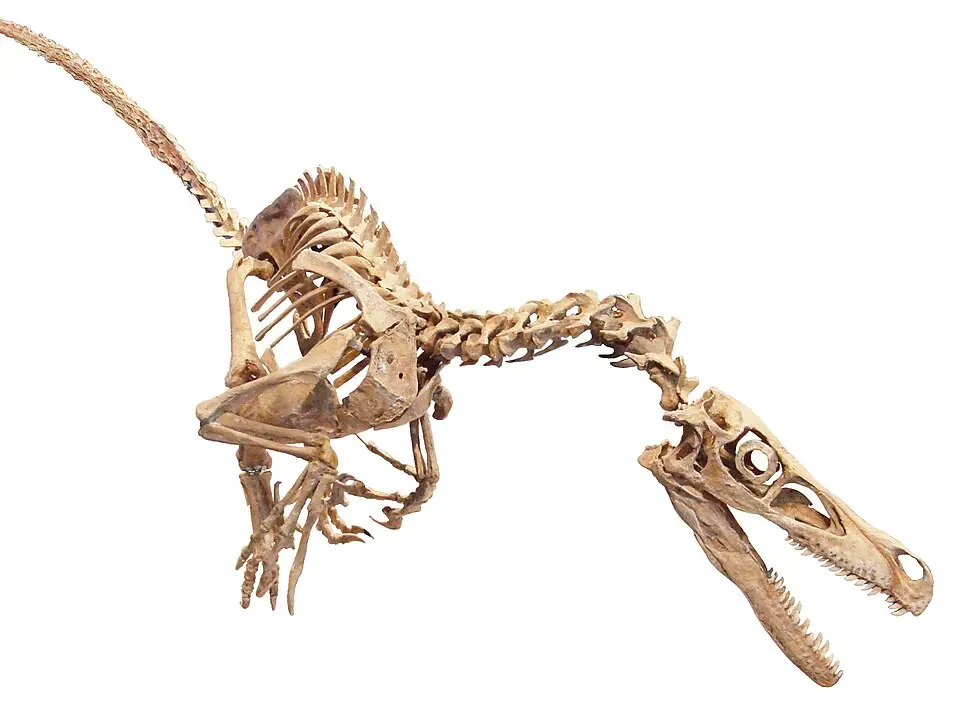
Skeleton / museum mount of Velociraptor: Velociraptor skeleton
Myth or fact?
✗ Myth: Velociraptor was taller than a person and had scaly skin.
✓ Fact: Real Velociraptor was turkey-sized, about half a metre tall at the hip, and covered in feathers. The giant film 'raptors' were based more on its bigger relative Deinonychus.
✗ Myth: Velociraptor was a genius that could open doors.
✓ Fact: Its brain was fairly large for a dinosaur, similar to some birds, but there is no evidence it was unusually intelligent.
✏️ Quick quiz
Circle the right answer. Name: ______________________
About how big was a real Velociraptor?
A As big as a bus
B As big as a horse
C As big as a turkey
D As big as a mouse
What covered Velociraptor's body?
A Feathers
B Fur
C Bony armour plates
D Smooth frog-like skin
In which country have most Velociraptor fossils been found?
A Canada
B Australia
C Egypt
D Mongolia
Answers: 1–C 2–A 3–D
Sources and picture credits
Natural History Museum London — Velociraptor — www.nhm.ac.uk/discover/dino-directory/velociraptor.html
Wikipedia — Velociraptor — en.wikipedia.org/wiki/Velociraptor
 DinoVerse · Dinosaur fact sheet