Say it: try-SERR-uh-tops · Name means: “Three-horned face”
Key facts about Triceratops
⏳ Lived
68–66 million years ago Late Cretaceous
🌿 Diet
Herbivore (plant-eater)
📏 Length
8–9 m (26–30 ft)
↕️ Height
2.9–3 m (10 ft)
⚖️ Weight
6,000–12,000 kg (13,230–26,460 lb)
📍 Found in
North America
🔎 Discovered
1889 by Othniel Charles Marsh (fossil found by John Bell Hatcher)
About Triceratops
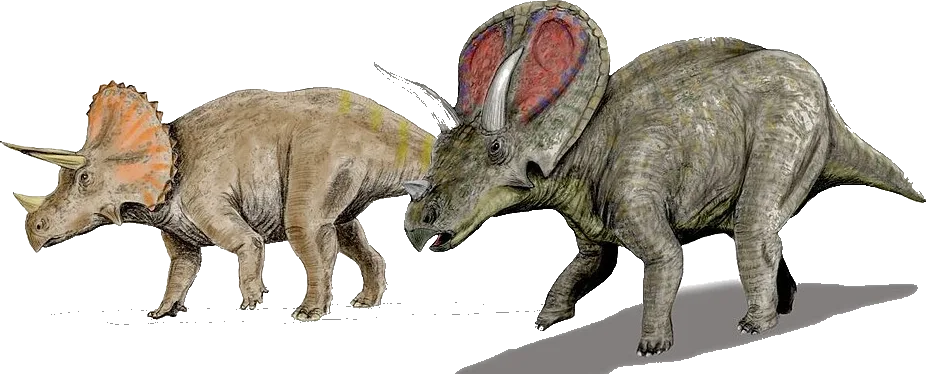
Triceratops was a giant plant-eater with three horns and a big bony frill around its neck. It lived at the same time and place as T. rex!
Triceratops was one of the last and largest ceratopsids, living in western North America in the final few million years before the end-Cretaceous extinction. Its fossils are among the most common in the Hell Creek and Lance formations, and its horns and solid frill were likely used for display, recognition and sparring with rivals.
Drawn to scale next to a 1.7 m adult and a 12 m school bus.
Did you know?
Each brow horn on a big Triceratops could be longer than your arm!
Triceratops had one of the biggest heads of any land animal ever.
It had hundreds of teeth packed in rows, and new teeth grew in when old ones wore out.
Some Triceratops skulls have healed holes from fighting with other Triceratops.
Its cheek teeth formed 'dental batteries' of up to around 800 teeth, with only a few in use at once, giving it a slicing, guillotine-like bite for tough, fibrous plants.
Healed lesions on Triceratops frills and skull bones match the pattern expected if rivals locked horns, supporting the idea that horns were used in combat with their own kind.
In 2010 researchers proposed that Torosaurus, with its larger, holed frill, was simply the fully grown form of Triceratops; later studies of skull shape and growth stages mostly disagree, and most palaeontologists still treat them as separate genera.
A skin impression from a Triceratops specimen shows large scales, some with cone-like bumps, so it was probably scaly rather than feathered.
Two species are recognised, T. horridus and T. prorsus, and some researchers think one may have evolved into the other over time.
Snipped tough plants with a sharp, parrot-like beak, then sliced them up with hundreds of tightly packed cheek teeth that worked like scissors.
Clues scientists use: tooth batteries built for slicing; beak shape; plant fossils from the same rock layers.
Who might have hunted it: Tyrannosaurus rex.
🗺️ Where fossils were found
Hell Creek Formation, Montana, USA (North America)
Lance Formation, Wyoming, USA (North America)
South Dakota, USA (North America)
Scollard Formation, Alberta, Canada (North America)
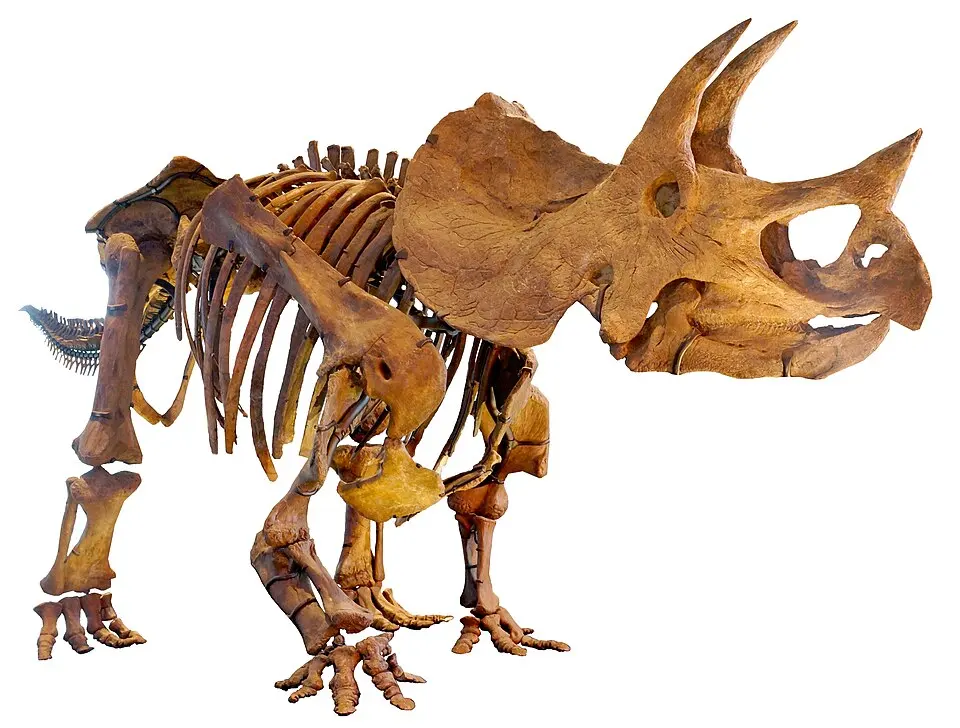
Skeleton / museum mount of Triceratops: Triceratops mounted skeleton at Los Angeles Museum of Natural…
Myth or fact?
✗ Myth: The first Triceratops horns belonged to a giant prehistoric bison.
✓ Fact: In 1887 a pair of horns was briefly named Bison alticornis, but better fossils soon showed they came from a horned dinosaur, which Marsh named Triceratops in 1889.
✗ Myth: Triceratops' frill was a shield to block T. rex bites.
✓ Fact: The frill was mostly for display and recognising its own kind; T. rex bite marks have even been found on frills, so it was not a perfect shield.
✏️ Quick quiz
Circle the right answer. Name: ______________________
What does the name 'Triceratops' mean?
A Spiked lizard
B Three-horned face
C Fused lizard
D Parrot lizard
Which big predator lived alongside Triceratops?
A Allosaurus
B Spinosaurus
C Tyrannosaurus rex
D Velociraptor
What did Triceratops eat?
A Plants
B Fish
C Other dinosaurs
D Insects only
Answers: 1–B 2–C 3–A
Sources and picture credits
Natural History Museum London — Triceratops — www.nhm.ac.uk/discover/dino-directory/triceratops.html
Wikipedia — Triceratops — en.wikipedia.org/wiki/Triceratops
Wikipedia — Torosaurus — en.wikipedia.org/wiki/Torosaurus
 DinoVerse · Dinosaur fact sheet