Elasmosaurus
Name means “Thin-plate lizard”
🚫 Not a dinosaur!
Elasmosaurus was a plesiosaur, a sea reptile that swam with four flippers. Dinosaurs lived on land with legs held straight under the body, and plesiosaurs belong to a completely separate branch of reptiles.
Elasmosaurus was a sea reptile with a super-long neck, a tiny head and four big flippers. It was not a dinosaur!
Elasmosaurus was a Late Cretaceous plesiosaur from the Western Interior Seaway, with about 72 neck vertebrae — more than any other known animal. Its neck made up more than half of its roughly 10 m length.
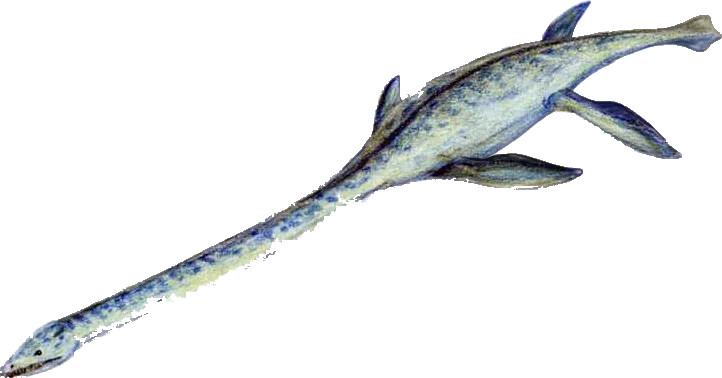
Elasmosaurus2.jpg — No machine-readable author provided. ArthurWeasley · CC BY 2.5
Pictures
Spin it in 3D
3D model description: a 3D model of Elasmosaurus shaped from a scientific life reconstruction painting, with the painting's colours and skin texture wrapped around it. It is not a scan of a real fossil.
About this model
This model is shaped from a scientific life reconstruction by No machine-readable author provided. ArthurWeasley~commonswiki assumed (based on copyright claims).: the painting's outline gives the 3D body and the painting itself is its skin. It is sized to the real animal's length (about 10.5 m), so in AR it appears life-size!
It looks best from the side, like the painting it comes from. It is not a fossil scan — museums such as the Smithsonian 3D collection share real fossil scans you can explore.
What might it sound like?
Transcript: Low, drawn-out groan echoing underwater
🤔 Nobody knows exactly how dinosaurs sounded
This is a scientific guess. No one knows if plesiosaurs called at all. Modern sea animals that breathe air, like whales and sea turtles, use low sounds that travel well underwater, so the sound here borrows from them.
Voice boxes and soft tissue almost never fossilise, so sound reconstructions use clues: body size (bigger animals make lower sounds), the calls of living relatives (crocodiles boom with closed mouths; birds coo and hiss), and hollow structures such as hadrosaur crests that could have worked like a trumpet.
Sound: synthesised by DinoVerse from these scientific ideas (CC0). It is a creative guess, not a recording.
Food and habits
Piscivore
Fish-eater
How it ate
Probably swam slowly towards schools of fish from below, then used its small head and long, needle-like interlocking teeth to snap up fish and soft-bodied prey.
🔍 How do we know?
- needle-like interlocking teeth
- stomach contents of related elasmosaurs
- gastroliths in related elasmosaurs
It ate…
- small fish
- squid-like cephalopods
- ammonites
Elasmosaurus
…and was eaten by
- Cretoxyrhina (ginsu shark)
- Tylosaurus
Arrows show energy moving up the food chain: from food to eater.
Watch it swim
Quick facts
| 📏 Length | 10–11 m (33–36 ft) |
|---|---|
| ↕️ Height | 0.8–1.2 m (3–4 ft) |
| ⚖️ Weight | 1,800–3,000 kg (3,970–6,610 lb) |
| ⏳ When it lived | 81–80 million years ago (Late Cretaceous) |
| 📍 Fossils found | Pierre Shale, Logan County, Kansas, USA |
| 🔎 Discovered | 1867 by Theophilus Turner (named by Edward Drinker Cope in 1868) |
| 🧬 Group | Plesiosaurs — Diapsida › Sauropterygia › Plesiosauria |
Where scientists disagree, we show a range. Sizes are for adults.
How big was it?
Where and when
- 📍 Pierre Shale, Logan County, Kansas, USA (North America)
Lived 81–80 million years ago
That's about 81 million years before you were born! Humans have only existed for about 0.3 million years.
See it on the big timeline →Did you know?
- 1Elasmosaurus's neck was longer than its body and tail put together!
- 2It had about 72 bones in its neck — you have only 7.
- 3It swam with four big flippers, like a sea turtle.
- 4Plesiosaurs gave birth to live babies in the water instead of laying eggs.
- When Edward Drinker Cope first reconstructed Elasmosaurus in 1868 he put the head on the end of the tail; his rival Othniel Marsh pointed out the error, helping start the 'Bone Wars'.
- Studies of neck vertebrae suggest the neck was fairly stiff and could not be raised high out of the water like a swan's; it was probably held mostly straight and moved gently from side to side.
- Related elasmosaurs have been found with stomach stones; scientists debate whether these helped grind food, controlled buoyancy, or were swallowed by accident.
- A 2011 fossil of the plesiosaur Polycotylus with an embryo inside showed that plesiosaurs gave birth to a single large baby, hinting at parental care.
Myth vs fact
❌ MythElasmosaurus held its neck high out of the water like a swan or the 'Loch Ness monster'.
✅ FactIts heavy, fairly stiff neck could not lift far out of the water; it was mostly held straight out in front.
❌ MythElasmosaurus was a swimming dinosaur.
✅ FactIt was a plesiosaur, a marine reptile on a separate branch from dinosaurs.
Mini quiz
1. Is Elasmosaurus a dinosaur?
2. About how many bones did Elasmosaurus have in its neck?
3. What mistake did Cope make with the first Elasmosaurus skeleton?
Related animals
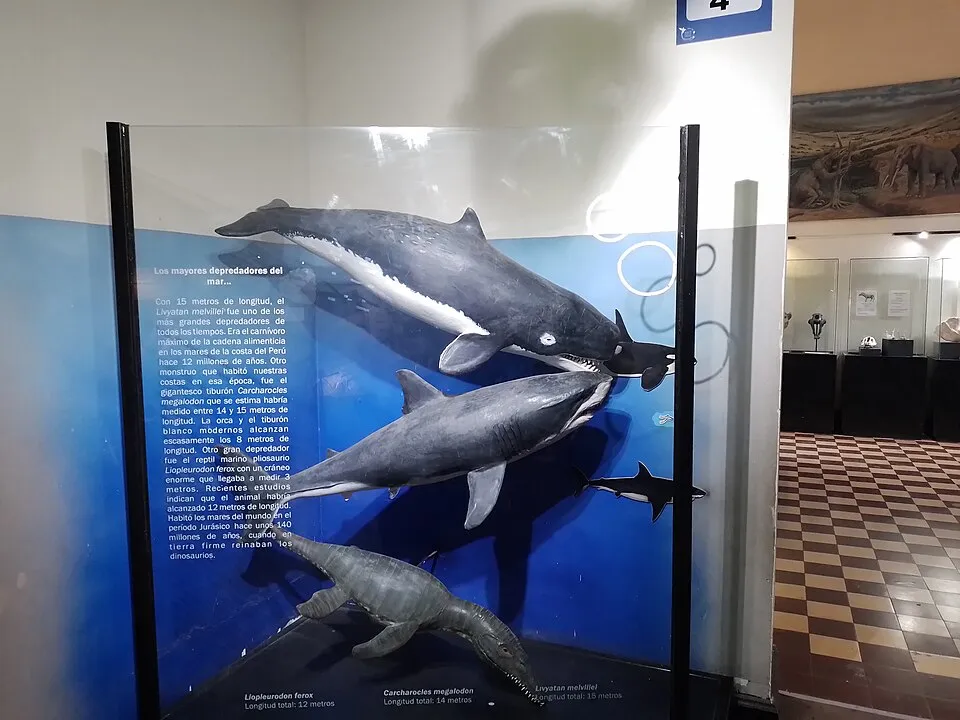 Not a dinosaur
Liopleurodon
PlesiosaurMiddle JurassicCarnivore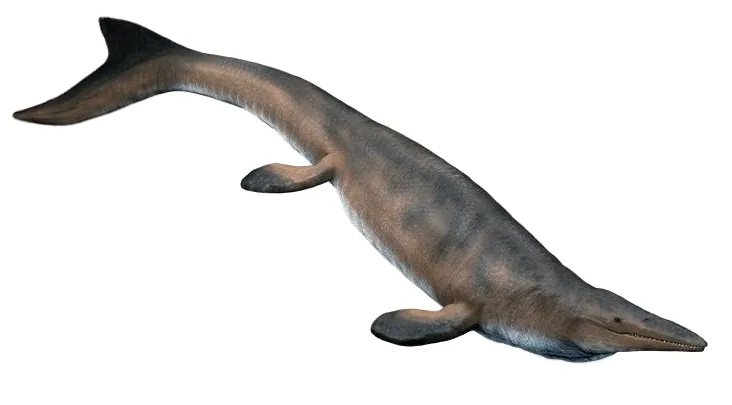 Not a dinosaur
Mosasaurus
MosasaurLate CretaceousCarnivore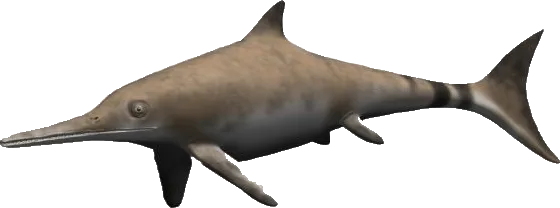 Not a dinosaur
Ichthyosaurus
IchthyosaurEarly JurassicPiscivore
Sources
Media on this page
- Elasmosaurus2.jpg — No machine-readable author provided. ArthurWeasley~commonswiki assumed (based on copyright · CC BY 2.5
- Underwater light (generated background) — DinoVerse (original artwork) · CC0 1.0
- Elasmosaurus 3D model, shaped from the life reconstruction "Elasmosaurus2.jpg" — No machine-readable author provided. ArthurWeasley~commonswiki assumed (based on copyright · CC BY 2.5
- Elasmosaurus reconstructed call (synthesised) — DinoVerse (synthesised) · CC0 1.0
- Elasomosaurus Face Clean.png — MCDinosaurhunter · CC BY-SA 3.0
- Dorsal vertebrae of Elasmosaurus.jpg — T. Sinclair · Public domain
- Elasmosaurus.jpg — Corbin Rainbolt · CC BY 4.0