Mamenchisaurus
Name means “Mamenxi lizard (named after a place in China)”
Mamenchisaurus had one of the longest necks of any animal ever. Its neck was almost half the length of its whole body!
Mamenchisaurus was a mamenchisaurid sauropod from the Middle to Late Jurassic of China, with several species of different sizes. Its neck, built from up to 19 long, air-filled vertebrae, made up nearly half its total length, making it an extreme example of sauropod neck evolution.
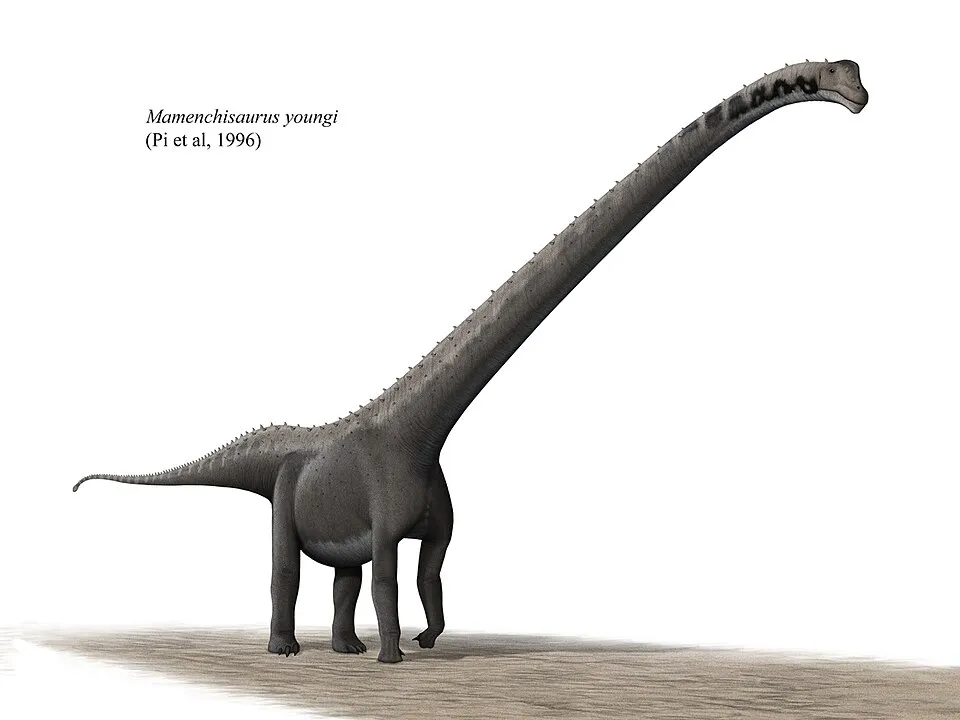
Mamenchisaurus youngi steveoc 86.jpg — Steveoc 86 · CC BY-SA 2.5
Pictures
Spin it in 3D
3D model description: a smooth, rounded model of Mamenchisaurus built from the DinoVerse illustration, showing its overall body shape and proportions. It is not a scan of a real fossil.
About this model
This is a simplified body-shape model, sized to the real animal's length (about 21.5 m). In AR it appears life-size!
It looks best from the side, like the painting it comes from. It is not a fossil scan — museums such as the Smithsonian 3D collection share real fossil scans you can explore.
What might it sound like?
Transcript: Deep, resonant boom, about 4 seconds long
🤔 Nobody knows exactly how dinosaurs sounded
This is a scientific guess. No one knows how Mamenchisaurus sounded, but big animals usually have deep voices, and birds and crocodiles, its living relatives, make low closed-mouth booms.
Voice boxes and soft tissue almost never fossilise, so sound reconstructions use clues: body size (bigger animals make lower sounds), the calls of living relatives (crocodiles boom with closed mouths; birds coo and hiss), and hollow structures such as hadrosaur crests that could have worked like a trumpet.
Sound: synthesised by DinoVerse from these scientific ideas (CC0). It is a creative guess, not a recording.
Food and habits
Herbivore
Plant-eater
How it ate
Stood in one spot and swept its extremely long neck over a huge area of plants, nipping off leaves with spoon-shaped teeth and swallowing them without chewing.
🔍 How do we know?
- spoon-shaped tooth shape
- tooth wear
- very long neck suited to feeding over a wide area
- plant fossils from the Shaximiao and Shishugou formations
It ate…
- Conifer leaves
- Ginkgo leaves
- Cycads
- Ferns
- Horsetails
Mamenchisaurus
…and was eaten by
- Yangchuanosaurus
- Sinraptor
Arrows show energy moving up the food chain: from food to eater.
Watch it feed
Quick facts
| 📏 Length | 13–30 m (43–98 ft) |
|---|---|
| ↕️ Height | 3–5 m (10–16 ft) |
| ⚖️ Weight | 5,000–60,000 kg (11,020–132,280 lb) |
| ⏳ When it lived | 161–150 million years ago (Late Jurassic) |
| 📍 Fossils found | Yibin, Sichuan, China; Zigong, Sichuan, China; Hechuan, Chongqing, China; Junggar Basin, Xinjiang, China |
| 🔎 Discovered | 1952 by Highway construction workers (named by C. C. Young, 1954) |
| 🧬 Group | Sauropods — Saurischia › Sauropodomorpha › Sauropoda |
Where scientists disagree, we show a range. Sizes are for adults.
How big was it?
Where and when
- 📍 Yibin, Sichuan, China (Asia)
- 📍 Zigong, Sichuan, China (Asia)
- 📍 Hechuan, Chongqing, China (Asia)
- 📍 Junggar Basin, Xinjiang, China (Asia)
Lived 161–150 million years ago
That's about 156 million years before you were born! Humans have only existed for about 0.3 million years.
See it on the big timeline →Did you know?
- 1The neck of the biggest Mamenchisaurus may have been about 15 metres long, longer than a school bus!
- 2The first one was found by workers building a highway in China.
- 3Its neck bones were full of air pockets, which kept that super-long neck light.
- 4It could stand still and eat a whole patch of plants just by swinging its neck around.
- A 2023 CT-scan study of Mamenchisaurus sinocanadorum estimated its neck at roughly 14 to 15 m, possibly the longest neck of any known animal, with vertebrae that were more air than bone.
- Long, overlapping cervical ribs ran beneath the neck vertebrae and probably stiffened the neck, so it may have been less flexible than its length suggests.
- Mamenchisaurus contains several species of very different size, from M. constructus at about 13 to 15 m and 5 tonnes to giants that may have weighed several tens of tonnes, which is why the size ranges here are so wide.
- The name comes from a mix-up: C. C. Young's accent turned the place name Mamingxi ('horse-neighing brook') into Mamenxi.
Myth vs fact
❌ MythSauropods like Mamenchisaurus lived in swamps so the water could hold up their weight.
✅ FactIts strong legs, air-filled bones and fossil trackways show it walked on dry land like other sauropods.
❌ MythA neck that long must have been floppy like a garden hose.
✅ FactLong overlapping neck ribs and bony struts made the neck fairly stiff, more like a crane arm than a hose.
Mini quiz
1. What was Mamenchisaurus famous for?
2. In which country was Mamenchisaurus found?
3. Who found the first Mamenchisaurus fossil?
Related animals
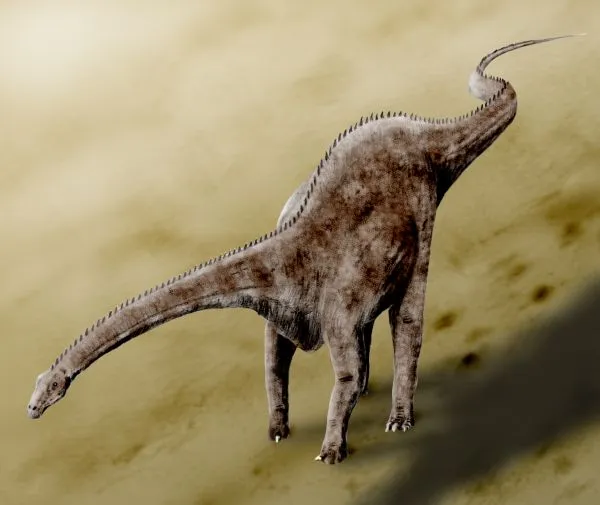
Diplodocus
SauropodLate JurassicHerbivore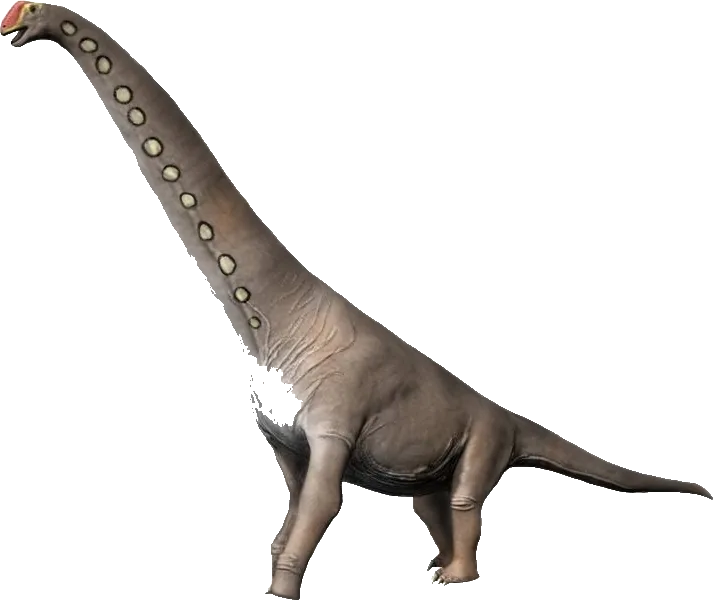
Brachiosaurus
SauropodLate JurassicHerbivore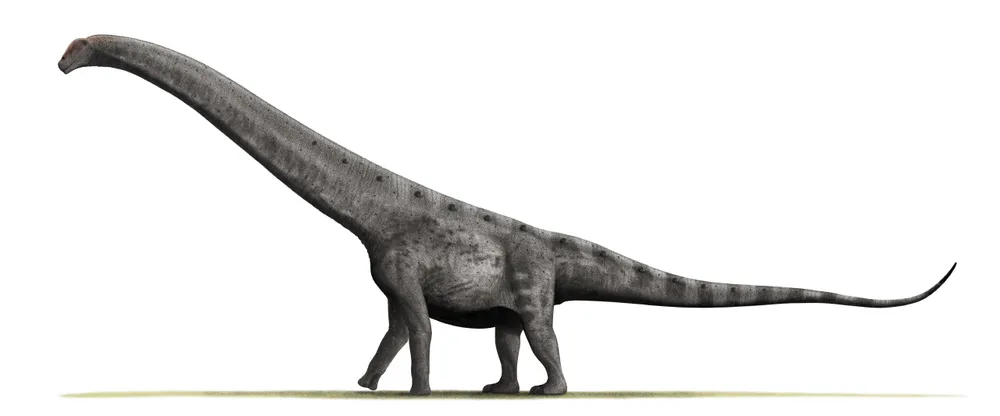
Argentinosaurus
SauropodLate CretaceousHerbivore
Sources
Media on this page
- Mamenchisaurus youngi steveoc 86.jpg — Steveoc 86 · CC BY-SA 2.5
- Fern in forest by I. Levitan (1895, N. Novgorod).jpg — Isaac Levitan · Public domain
- Mamenchisaurus simplified 3D model — DinoVerse (generated from original artwork) · CC0 1.0
- Mamenchisaurus reconstructed call (synthesised) — DinoVerse (synthesised) · CC0 1.0
- Zigong Dinosaur Museum Mamenchisaurus hochuanensis.jpg — Zhangzhugang · CC BY-SA 4.0
- Mamenchisaurus hochuanensis Field Museum.jpg — James St. John · CC BY 2.0
- Mamenchisaurus in Japan.jpg — Kabacchi · CC BY 2.0
- Mamenchisaurus jingyanensis BMNHC.jpg — Jonathan Chen · CC BY 4.0