Say it: mah-MUN-chee-SORE-us · Name means: “Mamenxi lizard (named after a place in China)”
Key facts about Mamenchisaurus
⏳ Lived
161–150 million years ago Late Jurassic
🌿 Diet
Herbivore (plant-eater)
📏 Length
13–30 m (43–98 ft)
↕️ Height
3–5 m (10–16 ft)
⚖️ Weight
5,000–60,000 kg (11,020–132,280 lb)
📍 Found in
Asia
🔎 Discovered
1952 by Highway construction workers (named by C. C. Young, 1954)
About Mamenchisaurus
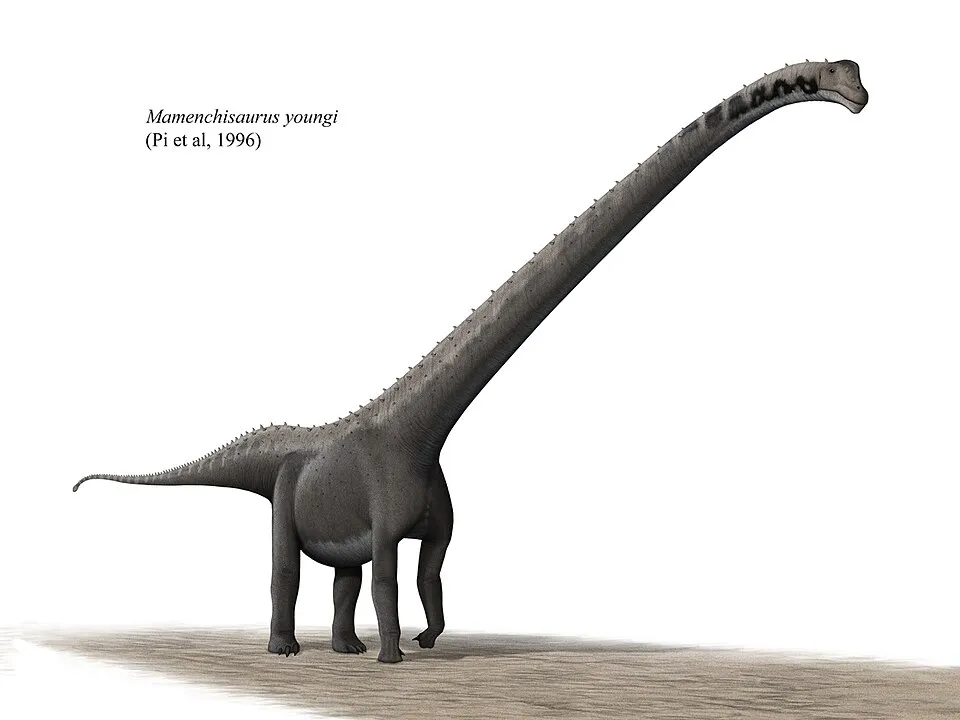
Mamenchisaurus had one of the longest necks of any animal ever. Its neck was almost half the length of its whole body!
Mamenchisaurus was a mamenchisaurid sauropod from the Middle to Late Jurassic of China, with several species of different sizes. Its neck, built from up to 19 long, air-filled vertebrae, made up nearly half its total length, making it an extreme example of sauropod neck evolution.
Drawn to scale next to a 1.7 m adult and a 12 m school bus.
Did you know?
The neck of the biggest Mamenchisaurus may have been about 15 metres long, longer than a school bus!
The first one was found by workers building a highway in China.
Its neck bones were full of air pockets, which kept that super-long neck light.
It could stand still and eat a whole patch of plants just by swinging its neck around.
A 2023 CT-scan study of Mamenchisaurus sinocanadorum estimated its neck at roughly 14 to 15 m, possibly the longest neck of any known animal, with vertebrae that were more air than bone.
Long, overlapping cervical ribs ran beneath the neck vertebrae and probably stiffened the neck, so it may have been less flexible than its length suggests.
Mamenchisaurus contains several species of very different size, from M. constructus at about 13 to 15 m and 5 tonnes to giants that may have weighed several tens of tonnes, which is why the size ranges here are so wide.
The name comes from a mix-up: C. C. Young's accent turned the place name Mamingxi ('horse-neighing brook') into Mamenxi.
Stood in one spot and swept its extremely long neck over a huge area of plants, nipping off leaves with spoon-shaped teeth and swallowing them without chewing.
Clues scientists use: spoon-shaped tooth shape; tooth wear; very long neck suited to feeding over a wide area; plant fossils from the Shaximiao and Shishugou formations.
Who might have hunted it: Yangchuanosaurus, Sinraptor.
🗺️ Where fossils were found
Yibin, Sichuan, China (Asia)
Zigong, Sichuan, China (Asia)
Hechuan, Chongqing, China (Asia)
Junggar Basin, Xinjiang, China (Asia)
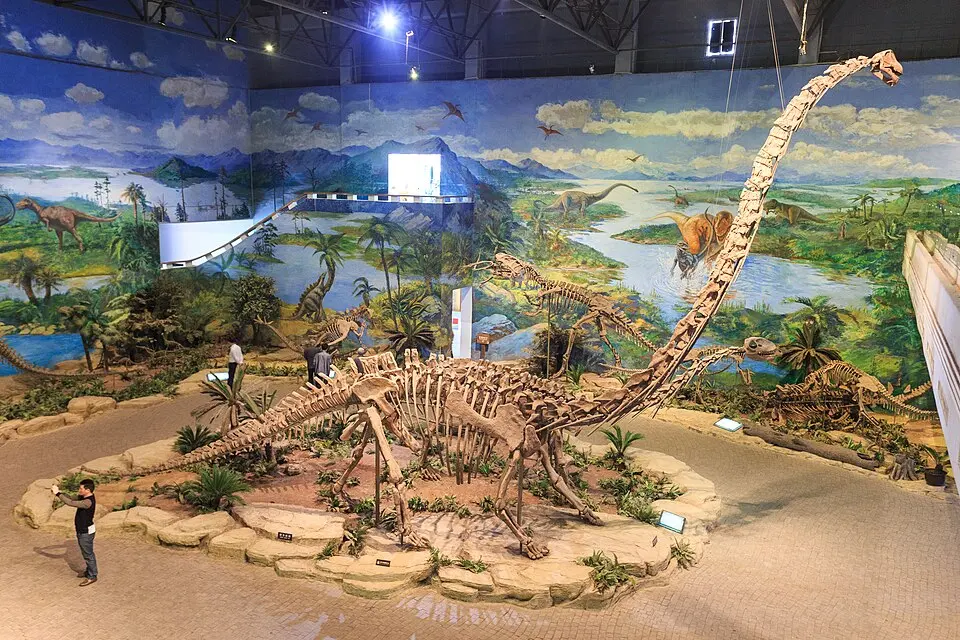
Skeleton / museum mount of Mamenchisaurus: Mamenchisaurus hochuanensis. (The front dinosaur) Symtemtic…
Myth or fact?
✗ Myth: Sauropods like Mamenchisaurus lived in swamps so the water could hold up their weight.
✓ Fact: Its strong legs, air-filled bones and fossil trackways show it walked on dry land like other sauropods.
✗ Myth: A neck that long must have been floppy like a garden hose.
✓ Fact: Long overlapping neck ribs and bony struts made the neck fairly stiff, more like a crane arm than a hose.
✏️ Quick quiz
Circle the right answer. Name: ______________________
What was Mamenchisaurus famous for?
A Its sharp claws
B Its armour plates
C Its extremely long neck
D Its horns
In which country was Mamenchisaurus found?
A China
B Mongolia
C India
D Japan
Who found the first Mamenchisaurus fossil?
A Farmers digging a well
B Children on a beach
C Miners in a coal mine
D Workers building a highway
Answers: 1–C 2–A 3–D
Sources and picture credits
Natural History Museum London — Mamenchisaurus — www.nhm.ac.uk/discover/dino-directory/mamenchisaurus.html
Wikipedia — Mamenchisaurus — en.wikipedia.org/wiki/Mamenchisaurus
 DinoVerse · Dinosaur fact sheet