DinoVerse · Dinosaur fact sheet
Yutyrannus
Say it: YOO-tie-RAN-us · Name means: “Feathered tyrant”
| ⏳ Lived | 126–122 million years ago Early Cretaceous |
|---|---|
| 🥩 Diet | Carnivore (meat-eater) |
| 📏 Length | 7.5–9 m (25–30 ft) |
| ↕️ Height | 2.5–3 m (8–10 ft) |
| ⚖️ Weight | 1,100–1,400 kg (2,430–3,090 lb) |
| 📍 Found in | Asia |
| 🔎 Discovered | 2012 by Xu Xing and colleagues (described from three specimens) |
About Yutyrannus
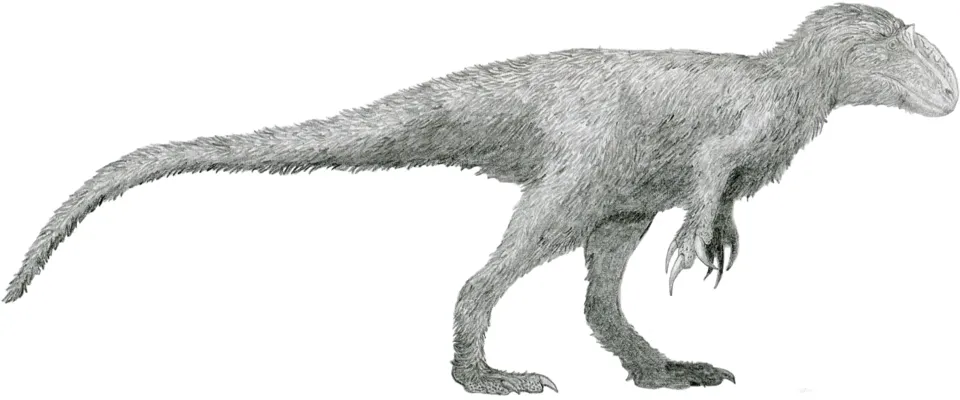
Yutyrannus was a big, fluffy meat-eater covered in long feathers. It is the largest animal ever found with fossil feathers on its body.
Yutyrannus huali was a large tyrannosauroid theropod from the Early Cretaceous of northeastern China, known from three skeletons preserved with long, filament-like feathers. Its discovery showed that feather coats were not limited to small dinosaurs, perhaps helping it keep warm in a cool climate.
How big was it?
Drawn to scale next to a 1.7 m adult and a 12 m school bus.
Did you know?
- Yutyrannus was covered in long, fluffy feathers, like a giant bird.
- It was as long as a bus and weighed about as much as a car.
- Its feathers were longer than a pencil.
- It was a cousin of T. rex, but lived about 60 million years earlier.
- Its feathers were simple filaments up to about 15 to 20 centimetres long, preserved on the neck, hips, arms and tail of different specimens.
- At around 1.1 to 1.4 tonnes, it is the largest animal known with direct fossil evidence of feathers.
- Climate studies suggest the Yixian Formation had relatively cool average temperatures, which may explain why a large animal kept an insulating coat.
- It was described as an early tyrannosauroid, but some recent analyses find its exact position uncertain, so its relationship to T. rex is still being tested.
- Three specimens of different ages were found together, which has led to suggestions that it lived or died in groups, though this is not certain.